Cheapest Countries to Live: The Real Numbers Nobody Talks About
Key Takeaway: The average American spends $4,500/month just on housing, food, and transportation. In at least 15 countries, you can live better —...
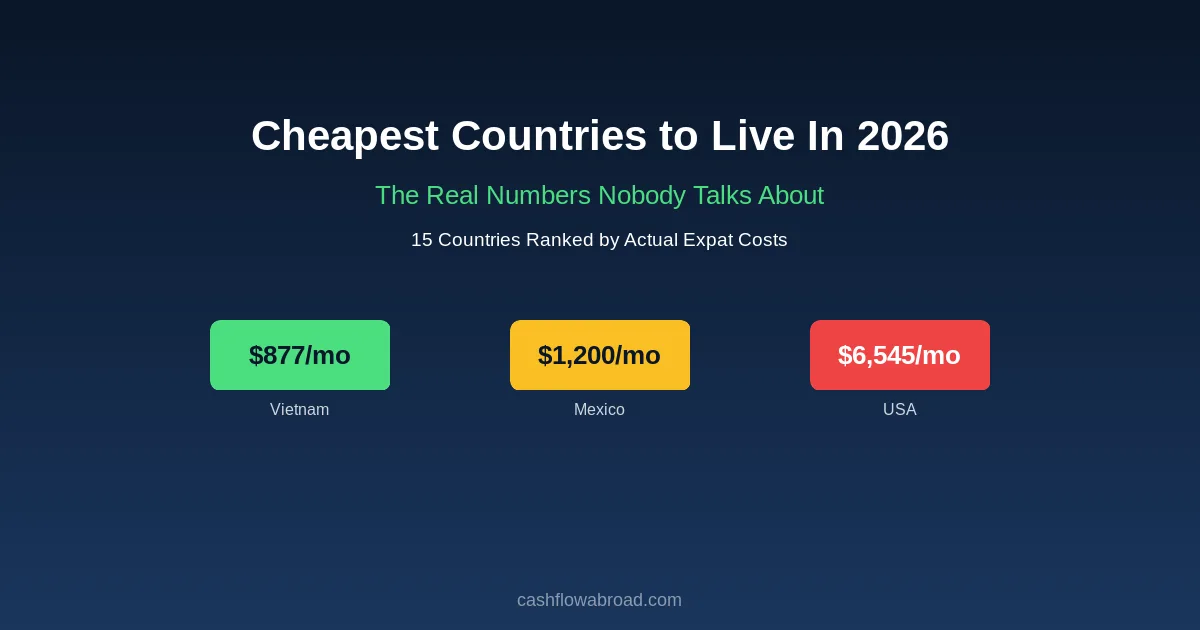
Key Takeaway: The average American spends $4,500/month just on housing, food, and transportation. In at least 15 countries, you can live better —...
Key Takeaway:
The average American spends $4,500/month just on housing, food, and transportation. In at least 15 countries, you can live better — full-time housekeeper, private healthcare, dining out daily — for under $2,000. This guide has the real numbers.
Why the "Official" Cost of Living Data Is Wrong
Here's a number that should make you uncomfortable: the average American household spends $72,967 per year — roughly $6,080 per month — according to the Bureau of Labor Statistics. Housing alone eats $2,025 of that. Add healthcare ($600+), transportation ($900+), and groceries ($500+), and you're hemorrhaging cash before you've done anything fun.
Related: best retirement countries guide
Now here's the punchline: in Ho Chi Minh City, you can rent a modern one-bedroom apartment with a pool and gym for $450, eat three restaurant meals a day for $15, and see a private doctor for $20. Your total monthly burn? Around $1,100.
But most "cheapest countries" lists online are garbage. They cite Numbeo averages that mix expat budgets with local wages, ignore visa costs entirely, and pretend that a $300/month apartment in rural Cambodia is the same experience as a $300/month apartment in Lisbon. It's not.
This guide is different. Every number below reflects what it actually costs for a foreigner to live comfortably — not backpacker-mode, not luxury-mode — in each country's most popular expat city. We're talking a decent apartment, eating well, reliable internet, health coverage, and the occasional night out.
How We Calculated These Numbers
For each country, we priced out a consistent lifestyle: a furnished one-bedroom apartment in a safe, expat-friendly neighborhood; eating a mix of home cooking and restaurants; private health insurance or out-of-pocket care; reliable internet (50+ Mbps); local SIM with data; transportation (motorbike, public transit, or ride-hailing); and basic entertainment. Visa costs are noted separately since they vary by nationality and length of stay.
The 15 Cheapest Countries to Live Well
1. Vietnam — $1,000–$1,400/month
Best city: Ho Chi Minh City (Saigon) or Da Nang
Vietnam is the undisputed king of bang-for-your-buck living. A modern studio in District 2 of Saigon runs $400–$550/month. A bowl of pho costs $1.50. A Vietnamese coffee is $0.80. Private health insurance through a local provider runs $40–$60/month. The internet is screaming fast — Vietnam ranks in the global top 10 for mobile speeds.
| Expense | Monthly Cost |
|---|---|
| Rent (1BR, furnished) | $400–$550 |
| Food (mix of cooking/eating out) | $200–$300 |
| Health insurance | $40–$60 |
| Internet + phone | $20–$30 |
| Transportation | $50–$80 |
| Entertainment/misc | $150–$250 |
| TOTAL | $860–$1,270 |
Visa situation: E-visa (90 days, $25) or business visa sponsorship through an agency (~$300/6 months). Vietnam is rolling out a digital nomad visa framework, but for now most long-termers use business visa extensions.
The catch: Air quality in Hanoi is rough. Saigon traffic is organized chaos. And the bureaucracy for anything official (bank accounts, long-term leases) can be maddening. But for pure cost-of-living-to-quality ratio, nothing beats Vietnam.
2. Indonesia (Bali) — $1,200–$1,800/month
Best area: Canggu or Ubud
Bali has become the world's digital nomad capital for good reason. A private villa with a pool in Canggu runs $500–$800/month. Coworking spaces are everywhere ($100–$150/month). A meal at a local warung is $2; a fancy smoothie bowl at a hipster cafe is $6. The community of remote workers is massive — you'll never lack for networking or social events.
| Expense | Monthly Cost |
|---|---|
| Rent (villa/1BR) | $500–$800 |
| Food | $250–$400 |
| Health insurance | $50–$80 |
| Motorbike rental + gas | $60–$80 |
| Coworking | $100–$150 |
| Entertainment/misc | $200–$300 |
| TOTAL | $1,160–$1,810 |
Visa situation: B211A visa (60 days, extendable to 180 days, ~$300 through an agent). Indonesia also offers a Digital Nomad Visa (5-year stay, tax-free on foreign income) for those earning $60K+/year.
The catch: Bali specifically is getting more expensive every year as influencer culture drives up prices in Canggu. Ubud remains cheaper and quieter. Outside Bali — Lombok, Yogyakarta, Bandung — Indonesia is dramatically cheaper but with less expat infrastructure.
3. Thailand — $1,100–$1,700/month
Best cities: Chiang Mai or Bangkok
Thailand wrote the book on affordable expat living. Chiang Mai is the OG digital nomad hub — a spacious condo near Nimman runs $350–$500/month. Bangkok is pricier but still absurdly cheap by Western standards: a BTS-accessible condo is $500–$700. Street food is legendary and costs $1–$3 per meal. Private hospitals like Bumrungrad are world-class at a fraction of US prices — an MRI runs about $200 vs. $2,600 in the States.
| Expense | Chiang Mai | Bangkok |
|---|---|---|
| Rent (1BR, furnished) | $350–$500 | $500–$700 |
| Food | $200–$300 | $250–$400 |
| Health insurance | $50–$80 | $50–$80 |
| Transport | $30–$60 | $60–$100 |
| Entertainment | $150–$250 | $200–$350 |
| TOTAL | $780–$1,190 | $1,060–$1,630 |
Visa situation: Thailand now offers a Long-Term Resident (LTR) visa for remote workers earning $80K+/year (5 years, 17% flat tax on Thai income). The older options include ED visas (Thai language school, ~$500/year), retirement visas (50+, $25K in a Thai bank), and the classic border-run-every-60-days approach.
The catch: Thailand's immigration system is in transition. The rules change frequently and enforcement varies by office. Also, you technically can't work on a tourist visa — most digital nomads fly under the radar, but the LTR visa is the proper route if you qualify.
4. Colombia — $1,200–$1,800/month
Best cities: Medellín or Bogotá
Colombia has exploded onto the expat scene, and Medellín is ground zero. The "City of Eternal Spring" offers year-round 75°F weather, a modern metro system, world-class healthcare, and apartments in El Poblado or Laureles for $500–$800/month. A lunch set menu (almuerzo) at a local restaurant is $3. Private health coverage through an EPS runs $80–$120/month and covers essentially everything.
For a deep dive on living costs, neighborhoods, and the full expat experience in Colombia, check out the comprehensive guides at ColombiaMove.com's cost of living breakdown and their neighborhood guide for Medellín. And if you need local services — lawyers, accountants, translators — Trabajo Colombia is a free job board for the expat community.
| Expense | Medellín | Bogotá |
|---|---|---|
| Rent (1BR, furnished) | $500–$800 | $400–$650 |
| Food | $200–$350 | $200–$300 |
| Health (EPS) | $80–$120 | $80–$120 |
| Transport | $40–$70 | $40–$70 |
| Entertainment | $200–$300 | $150–$250 |
| TOTAL | $1,020–$1,640 | $870–$1,390 |
Visa situation: Colombia's digital nomad visa is straightforward — prove $3,000+/month income, get 2 years. The visitor visa (V-type) gives you 180 days. After 5 years of residency, you can apply for citizenship.
The catch: El Poblado in Medellín has gotten touristy and prices have crept up. Savvy expats are moving to Laureles, Envigado, or Sabaneta for better value. Security has improved dramatically but you still need street smarts. And the Colombian peso can swing wildly — great when it weakens, painful when it strengthens against the dollar.
5. Mexico — $1,300–$2,000/month
Best cities: Mexico City (CDMX), Mérida, Oaxaca, or Lake Chapala
Related: digital nomad visa rankings
Mexico is the default choice for American expats — same time zones, 3-hour flights from most US cities, and no visa needed for stays under 180 days. Mexico City is a world-class capital where a nice apartment in Roma or Condesa runs $600–$900/month. Mérida in the Yucatán offers colonial charm and even lower costs. Oaxaca is the foodie paradise. Lake Chapala has the largest concentration of American/Canadian retirees outside the US.
| Expense | CDMX | Mérida |
|---|---|---|
| Rent (1BR) | $600–$900 | $400–$600 |
| Food | $300–$450 | $200–$300 |
| Health insurance | $60–$100 | $50–$80 |
| Transport | $50–$80 | $30–$50 |
| Entertainment | $200–$350 | $150–$250 |
| TOTAL | $1,210–$1,880 | $830–$1,280 |
Visa situation: Tourist permit (FMM) on arrival gives 180 days. Temporary resident visa requires proof of income ($2,600+/month or $43,000 in savings). After 4 years of temporary residency, you can apply for permanent residency.
The catch: Mexico is taxing — literally. If you stay more than 183 days, you may become a Mexican tax resident. The Roma/Condesa neighborhoods in CDMX have been gentrified by remote workers, causing resentment and rising rents. And safety varies enormously by region.
6. Portugal — $1,800–$2,500/month
Best cities: Lisbon, Porto, or the Algarve
Portugal is the priciest entry on this list, but it's here because it's the cheapest country in Western Europe that still delivers a first-world lifestyle. Lisbon has gotten expensive (blame the golden visa boom and short-term rental craze), but Porto and smaller cities like Braga, Aveiro, and Coimbra remain affordable. The Non-Habitual Resident (NHR) tax regime — which used to offer 10 years of flat 20% tax — ended for new applicants, but Portugal still doesn't tax US Social Security under the tax treaty.
| Expense | Lisbon | Porto |
|---|---|---|
| Rent (1BR) | $900–$1,300 | $650–$900 |
| Food | $300–$450 | $250–$350 |
| Health (SNS + private) | $50–$100 | $50–$100 |
| Transport | $40–$60 | $35–$50 |
| Entertainment | $250–$400 | $200–$300 |
| TOTAL | $1,540–$2,310 | $1,185–$1,700 |
Visa situation: D7 passive income visa (requires ~$850/month income proof). Digital nomad visa for remote workers. After 5 years, you can apply for citizenship — and a Portuguese passport is one of the most powerful in the world.
7. Malaysia — $1,000–$1,500/month
Best city: Kuala Lumpur or Penang
Malaysia is Southeast Asia's best-kept secret for quality-of-life per dollar. Kuala Lumpur is a modern, cosmopolitan city where English is widely spoken, the food scene rivals any city on Earth, and a luxury condo with pool and gym runs $400–$600/month. Healthcare is excellent — private hospitals cost 60–80% less than the US. Penang offers a more laid-back island vibe with even lower costs.
| Expense | Monthly Cost |
|---|---|
| Rent (1BR condo w/ pool) | $400–$600 |
| Food | $200–$300 |
| Health insurance | $40–$70 |
| Transport (Grab/public) | $30–$60 |
| Entertainment | $150–$250 |
| TOTAL | $820–$1,280 |
Visa situation: The DE Rantau digital nomad visa (12 months, renewable) requires $24K+/year income. The older MM2H (Malaysia My Second Home) program has been revamped with higher requirements. Tourist visa gives 90 days visa-free for Americans.
8. Ecuador — $1,000–$1,500/month
Best cities: Cuenca or Quito
Ecuador uses the US dollar — no exchange rate risk. Cuenca is the retirement capital of South America: colonial architecture, 8,000-foot elevation with perfect weather, and a massive expat community. A nice apartment in El Centro or Gringolandia runs $400–$600/month. Healthcare is the star: Ecuador's public IESS system costs just $80/month and covers everything, including prescriptions. Private care is equally affordable — a specialist visit runs $30–$50.
| Expense | Monthly Cost |
|---|---|
| Rent (1BR) | $400–$600 |
| Food | $200–$300 |
| Health (IESS) | $80 |
| Transport | $30–$50 |
| Entertainment | $100–$200 |
| TOTAL | $810–$1,230 |
Visa situation: Pensioner visa (requires $1,450+/month income) or professional visa. Ecuador offers generous senior discounts (50% off utilities, flights, and more for those 65+).
9. Georgia (the Country) — $800–$1,300/month
Best city: Tbilisi or Batumi
Georgia is the dark horse on this list. It's visa-free for Americans for a full year, charges a flat 1% tax for small businesses earning under $155K, and Tbilisi is one of Europe's most underrated cities — incredible food, wine culture that dates back 8,000 years, and rents that make Southeast Asia look expensive. A modern apartment in Vake or Vera runs $300–$500/month.
| Expense | Monthly Cost |
|---|---|
| Rent (1BR) | $300–$500 |
| Food | $150–$250 |
| Health insurance | $30–$50 |
| Transport | $20–$40 |
| Entertainment | $100–$200 |
| TOTAL | $600–$1,040 |
Visa situation: Americans can stay visa-free for 365 days. Just leave and re-enter to reset. Georgia also offers a "Remotely from Georgia" program for digital workers. The flat 1% small business tax is a massive draw for freelancers.
10. Cambodia — $800–$1,200/month
Best city: Phnom Penh or Siem Reap
Cambodia is Southeast Asia's most laissez-faire country. Everything runs on US dollars (alongside the local riel). Business visas are easy to get and extend indefinitely. There's no real enforcement of work permits for online workers. A serviced apartment in Phnom Penh's BKK1 district runs $350–$500/month. Beer is $0.50. A solid local meal is $2–$3.
| Expense | Monthly Cost |
|---|---|
| Rent (1BR) | $350–$500 |
| Food | $150–$250 |
| Health insurance | $40–$60 |
| Transport | $30–$50 |
| Entertainment | $100–$200 |
| TOTAL | $670–$1,060 |
Visa situation: Business visa (E-type, $35) extendable to 1 year ($300). Extremely lax enforcement. Cambodia is one of the easiest countries in the world for long-term stays.
11. Turkey — $900–$1,400/month
Best cities: Istanbul, Antalya, or Izmir
The Turkish lira has collapsed — which is terrible for Turks but incredible for anyone earning in dollars. Istanbul is a world-class megacity where you can rent a modern apartment in Kadıköy for $350–$500/month. A full Turkish breakfast spread at a cafe costs $4. Private health insurance runs $50–$80/month. The food, history, and culture rival anywhere in Europe — at a quarter of the price.
| Expense | Monthly Cost |
|---|---|
| Rent (1BR) | $350–$500 |
| Food | $200–$300 |
| Health insurance | $50–$80 |
| Transport | $30–$50 |
| Entertainment | $150–$250 |
| TOTAL | $780–$1,180 |
Visa situation: Tourist e-visa (90 days in 180-day period, $50). Residence permit available with proof of income or property rental. Turkey also offers citizenship by investment ($400K real estate).
12. Argentina — $800–$1,300/month
Best city: Buenos Aires
Related: expat health insurance guide
Argentina's economic crisis is your geographic arbitrage opportunity. Buenos Aires is a European-style capital with world-class steakhouses, vibrant nightlife, and stunning architecture — and the peso devaluation means your dollar goes absurdly far. A beautiful apartment in Palermo runs $400–$600/month. A massive steak dinner with wine at a top restaurant: $15–$25. The caveat is inflation — prices in pesos change constantly, but as long as you're earning in dollars, you're winning.
| Expense | Monthly Cost |
|---|---|
| Rent (1BR, Palermo) | $400–$600 |
| Food | $150–$250 |
| Health (prepaid plan) | $50–$80 |
| Transport | $20–$40 |
| Entertainment | $100–$200 |
| TOTAL | $720–$1,170 |
Visa situation: 90-day tourist visa on arrival. The Digital Nomad Visa (Rentista) gives 6 months, renewable. Argentina offers one of the fastest paths to citizenship in the world — 2 years of residency.
13. Nepal — $500–$900/month
Best city: Kathmandu or Pokhara
Nepal is the cheapest country on this list where you can still live comfortably as a foreigner. Kathmandu is chaotic but charming — a furnished apartment in Thamel or Lazimpat runs $200–$350/month. A dal bhat meal is $1.50. Pokhara, with its lakeside setting and Himalayan views, is even cheaper and far more relaxed. Internet can be spotty outside the main cities, but fiber is available in Kathmandu (30+ Mbps for $15/month).
| Expense | Monthly Cost |
|---|---|
| Rent (1BR) | $200–$350 |
| Food | $100–$200 |
| Health insurance | $30–$50 |
| Transport | $15–$30 |
| Entertainment | $50–$100 |
| TOTAL | $395–$730 |
Visa situation: Tourist visa on arrival (90 days, $125). Extensions available at immigration. Nepal doesn't have a specific digital nomad visa, so most long-termers do visa runs to India or cycle through tourist visas.
14. Philippines — $900–$1,400/month
Best cities: Cebu, Dumaguete, or Manila (Makati/BGC)
The Philippines is the easiest country on this list for English speakers — it's one of the official languages. Cebu offers a mix of city life and island proximity. Dumaguete is the laid-back university town that retirees love. Manila's business districts (Makati, BGC) are modern and well-connected but pricier. A condo in Cebu IT Park runs $300–$500/month. Filipino food is cheap — a full meal at a carinderia is $1.50–$2.
| Expense | Monthly Cost |
|---|---|
| Rent (1BR condo) | $300–$500 |
| Food | $200–$300 |
| Health insurance | $40–$70 |
| Transport | $40–$70 |
| Entertainment | $100–$200 |
| TOTAL | $680–$1,140 |
Visa situation: 30 days visa-free, extendable to up to 36 months through successive extensions at immigration offices (~$30–$50 per extension). The SRRV (Special Resident Retiree's Visa) is available for those 35+ with a $20K–$50K deposit.
15. Bolivia — $600–$1,000/month
Best cities: Sucre or Cochabamba
Bolivia is South America's most affordable country, period. Sucre, the constitutional capital, is a gorgeous colonial city at 9,000 feet with year-round pleasant weather. An apartment runs $200–$350/month. A full almuerzo lunch is $1.50. The tradeoff is infrastructure — internet speeds are lower, amenities are more basic, and the expat community is tiny. But if you want maximum dollar stretch and don't mind roughing it slightly, Bolivia can't be beaten.
| Expense | Monthly Cost |
|---|---|
| Rent (1BR) | $200–$350 |
| Food | $100–$200 |
| Health | $20–$40 |
| Transport | $15–$30 |
| Entertainment | $50–$100 |
| TOTAL | $385–$720 |
Visa situation: 90-day tourist visa on arrival for Americans. Specific residence visa required for stays beyond that — the process is bureaucratic but doable.
Side-by-Side Budget Comparison
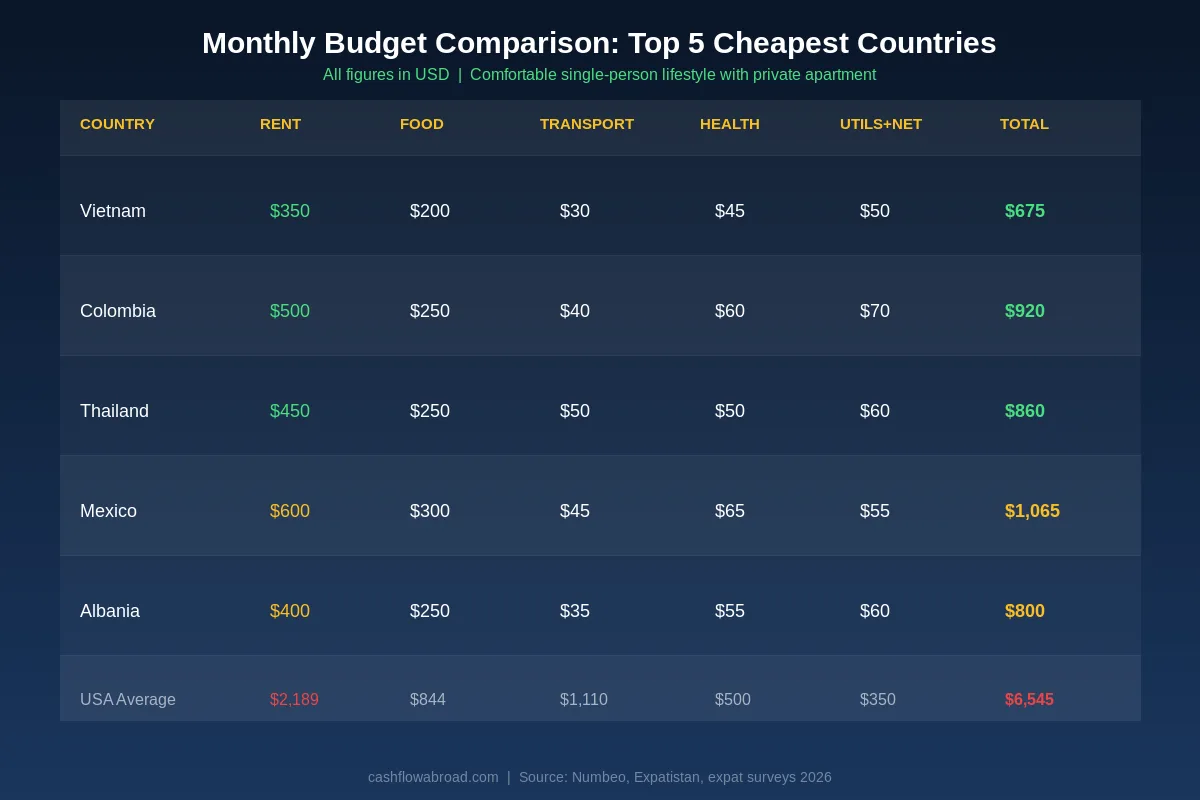
| Country | Rent | Food | Health | Total (Low) | Total (High) |
|---|---|---|---|---|---|
| Vietnam | $400 | $200 | $40 | $860 | $1,270 |
| Georgia | $300 | $150 | $30 | $600 | $1,040 |
| Cambodia | $350 | $150 | $40 | $670 | $1,060 |
| Nepal | $200 | $100 | $30 | $395 | $730 |
| Bolivia | $200 | $100 | $20 | $385 | $720 |
| Argentina | $400 | $150 | $50 | $720 | $1,170 |
| Turkey | $350 | $200 | $50 | $780 | $1,180 |
| Thailand | $350 | $200 | $50 | $780 | $1,190 |
| Malaysia | $400 | $200 | $40 | $820 | $1,280 |
| Ecuador | $400 | $200 | $80 | $810 | $1,230 |
| Philippines | $300 | $200 | $40 | $680 | $1,140 |
| Colombia | $500 | $200 | $80 | $1,020 | $1,640 |
| Indonesia | $500 | $250 | $50 | $1,160 | $1,810 |
| Mexico | $600 | $300 | $60 | $1,210 | $1,880 |
| Portugal | $650 | $250 | $50 | $1,185 | $2,310 |
The Hidden Costs Nobody Mentions
Every "cheapest countries" list conveniently forgets these expenses:
Flights home. Living in Thailand is cheap until you need to fly home for Thanksgiving. Budget $1,500–$3,000/year for return flights depending on where you live. Latin America (Mexico, Colombia, Ecuador) wins here for Americans — flights are $200–$500 round trip.
Visa runs and renewals. If you're not on a long-term visa, you're burning money and time on border runs, visa extensions, and immigration office visits. Budget $50–$300 per run, plus lost workdays.
The "foreigner tax." In many countries, landlords charge expats 20–50% more than locals. This is baked into our estimates above, but be aware that the apartment your local friend rents for $250, you'll pay $400 for.
Health insurance. Local insurance is cheap, but it often doesn't cover evacuation or treatment in your home country. A solid international policy through SafetyWing runs $45–$83/month and covers you globally — including trips home. Worth every penny.
Currency transfer fees. Moving money from your US bank account to a local account can eat 2–5% if you use your bank's exchange rate. Use Remitly (formerly TransferWise) instead — their fees are 0.4–0.8% and you get the real mid-market rate. Over a year of transferring $2,000/month, that saves you $300–$900.
Loneliness and social costs. Not a financial cost, but it affects everything. Some countries (Colombia, Mexico, Thailand, Portugal) have massive, welcoming expat communities. Others (Nepal, Bolivia, Cambodia) are more isolating. Your social life affects your happiness, which affects your productivity, which affects your income. Don't optimize purely for cost.
The Geographic Arbitrage Angle
The real power move isn't just living cheaply — it's earning in a strong currency while spending in a weak one. If you make $5,000/month from a US-based remote job or online business, here's what that looks like:
| Scenario | Monthly Spend | Monthly Savings | Annual Savings |
|---|---|---|---|
| Living in the US | $4,500 | $500 | $6,000 |
| Living in Thailand | $1,200 | $3,800 | $45,600 |
| Living in Georgia | $900 | $4,100 | $49,200 |
| Living in Colombia | $1,400 | $3,600 | $43,200 |
That's not a typo. By moving abroad, you can go from saving $6,000/year to saving $43,000–$49,000/year — on the same income. Invest that difference in index funds at a 7% return, and you're looking at $500K+ in 8–9 years.
For a complete deep dive into this strategy, read our Geographic Arbitrage Playbook — it breaks down exactly how to structure this for maximum wealth building.
And if you're a US expat, don't forget: the Foreign Earned Income Exclusion (FEIE) lets you exclude over $126,500 of earned income from US federal tax. Combine that with living in a territorial tax country like Georgia or Panama, and your effective tax rate can drop to near zero. We break down the full strategy in our guide to paying zero federal tax as an expat.
Bottom Line
The cheapest country to live in isn't necessarily the best country to live in. The sweet spot is where low cost meets good infrastructure, reliable internet, quality healthcare, and a community you want to be part of. For most people, that's Thailand, Colombia, Mexico, Malaysia, Portugal, or Georgia. Pick the one that matches your lifestyle — then watch your savings rate transform.
This guide is general information, not personalized tax, legal, or investment advice. Rules change; verify current thresholds with official sources or a qualified professional before acting.