Canada for US Expats: Taxes, Visas & the Double Tax Problem
And unlike most countries where Americans can escape US taxes by moving abroad, Canada doesn't offer that escape hatch. You pay the CRA and the IRS.
And unlike most countries where Americans can escape US taxes by moving abroad, Canada doesn't offer that escape hatch. You pay the CRA and the IRS.
Disclosure: this article contains affiliate links. If you open an account through one of them, Cashflow Abroad may earn a referral commission at no extra cost to you.
Here's a number that should give any American considering a Canada move some serious pause: the combined federal and provincial marginal tax rate in Ontario hits 53.5%. And unlike most countries where Americans can escape US taxes by moving abroad, Canada doesn't offer that escape hatch. You pay the CRA and the IRS. The only question is how much of your income gets eaten twice.
That's the part nobody tweets about when they're rage-quitting the US and googling "how to move to Canada." It's not impossible—millions of Americans have done it successfully—but the financial picture is nothing like moving to the UAE or Paraguay. This guide gives you the real numbers.
Why Americans Are Looking North
Canada consistently ranks among the top destinations for Americans relocating abroad. It makes intuitive sense—shared language, proximity to family, and universal healthcare that actually covers you as a resident. What trips people up is assuming the tax situation mirrors their US experience. It doesn't.
Canada and the US are two of the only developed nations that each tax worldwide income—Canada by residency, the US by citizenship. Move to Canada and you're suddenly in the jurisdiction of both tax authorities simultaneously. That double exposure is the defining financial reality of American life in Canada, and it shapes every decision from what accounts to open to when to retire.
How to Get There: Visa Pathways for Americans
Americans don't get any special visa treatment. You go through the same immigration system as everyone else, which is well-organized but demanding.
Express Entry (Fastest Path to PR)
Express Entry is the points-based system Canada uses to manage skilled worker applications for permanent residency. You enter a pool, receive a Comprehensive Ranking System (CRS) score, and wait for an Invitation to Apply (ITA). In 2026, general draw CRS scores have ranged from 475 to 510. Occupation-specific draws—targeting healthcare workers, STEM professionals, and trades—run lower at 420 to 480. Processing time after receiving an ITA is typically six months or less.
Scoring well requires: post-secondary education verified by an Education Credential Assessment, a language test in English or French (even for Americans—yes, you take the IELTS or CELPIP), and either Canadian work experience or qualifying foreign work history. Arranged employment in Canada adds 50–200 points instantly, which is often the difference between waiting two years and getting invited in six months.
For 2026, IRCC introduced new priority occupational categories including senior managers, researchers with Canadian work experience, transport occupations, and medical doctors. These category-based rounds are expected to account for well over half of all invitations issued.
Provincial Nominee Programs
Most provinces run their own immigration streams targeting occupations their economy needs. Nova Scotia's Labour Market Priorities stream, Saskatchewan's SINP, and Manitoba's MPNP all have lower CRS cutoffs than federal draws. A job offer in a province hungry for labor—many rural and northern communities qualify—can accelerate your timeline dramatically.
Work Permits and CUSMA
Most Americans who eventually get PR start on a temporary work permit under a job offer or via CUSMA (the successor to NAFTA). CUSMA provides expedited entry for certain professional categories—engineers, accountants, lawyers, scientists, and others—allowing a work permit issued at the border without the standard application queue. Intracompany transfers also work if your employer has Canadian operations.
Important timing note: your Canadian tax obligations begin the day you establish residency, not the day you get PR. A one-year work permit with 183+ days in Canada makes you a Canadian tax resident immediately.
The Tax Math Nobody Warns You About
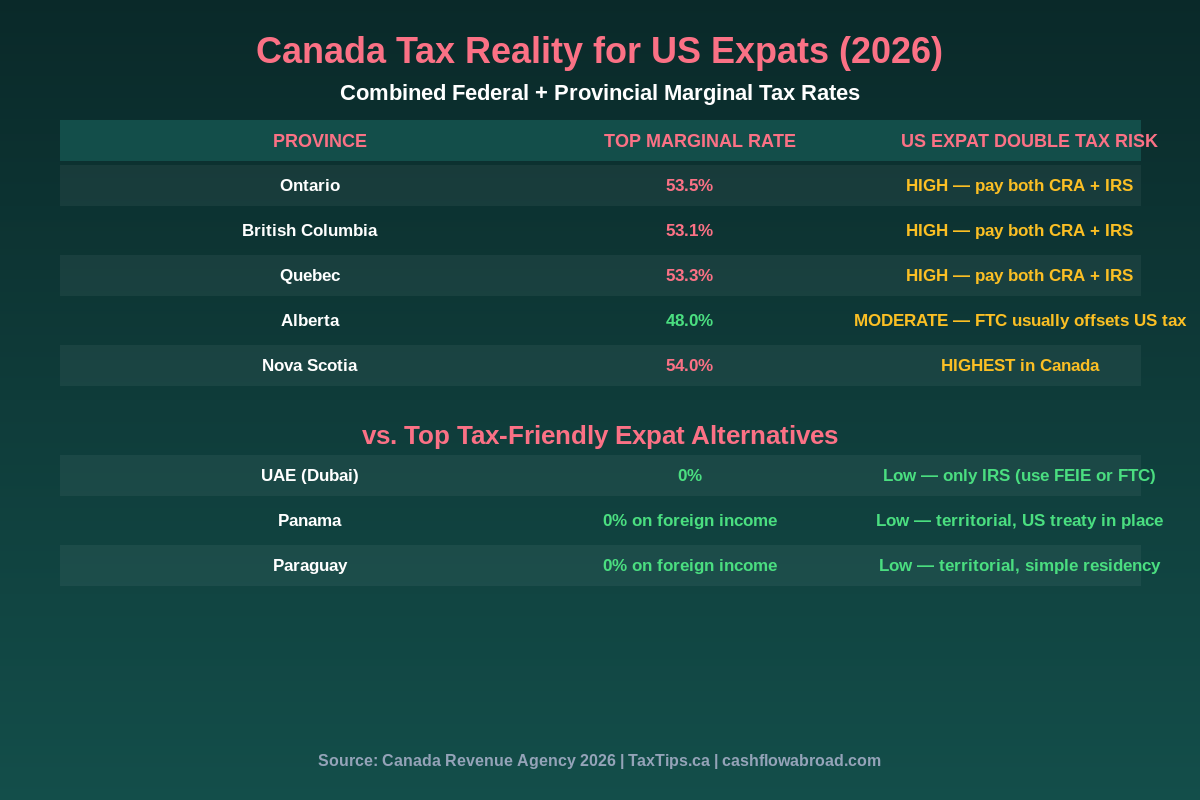
Canada's federal tax brackets for 2026 start at 14% on the first $57,375 CAD, then 20.5% on $57,375–$114,750, 26% on $114,750–$158,519, 29% on $158,519–$220,000, and 33% above $220,000. Add your province's rate on top of that.
| Province | Combined Top Marginal Rate | Applies Above (CAD) |
|---|---|---|
| Nova Scotia | 54.0% | ~$150,000 |
| Ontario | 53.5% | ~$220,000+ |
| Quebec | 53.3% | ~$119,000+ |
| British Columbia | 53.1% | ~$240,000+ |
| Manitoba | 50.4% | ~$100,000+ |
| Alberta | 48.0% | ~$355,000+ |
These are Canadian rates only. Then there's the IRS.
Why the Foreign Tax Credit Usually Wins in Canada
Most US expats in high-tax countries use the Foreign Tax Credit (FTC) rather than the Foreign Earned Income Exclusion (FEIE). The logic is simple: Canada's combined rates often exceed US rates, so the taxes you pay to Canada generate enough credit to eliminate your US liability on the same income entirely.
The FEIE—which excludes up to $130,000 of earned income from US tax in 2025—is generally less useful in Canada because it only reduces what you owe the IRS. Canada taxes that income anyway. If you're paying 48–53% to the CRA, those taxes generate FTC that fully offset your IRS bill without any exclusion needed. The FEIE makes most sense in low-tax or zero-tax countries where you'd otherwise owe the IRS on income that went untaxed locally.
For a deeper breakdown of when each approach wins, see the FEIE guide and the complete US expat tax reference.
What the US-Canada Tax Treaty Actually Does
The treaty (originally 1980, updated multiple times) does several things worth knowing:
- Reduces withholding on Canadian dividends paid to US residents to 15% (5% for corporate shareholders holding 10%+ of voting stock)
- Caps withholding on interest and royalties at 10%
- Makes RRSP contributions deductible and growth deferrable for US tax purposes (more on this below)
- Routes CPP/OAS benefits and US Social Security to be taxed only in the country of residence
What the treaty doesn't do: exempt you from filing US returns. The saving clause lets the US tax its citizens as if the treaty didn't exist, with specific carve-outs. You file Form 1040 every year, full stop. If you've never filed as an expat, the IRS's Streamlined Foreign Offshore Procedure lets you catch up without the standard penalties.
The TFSA Trap: Canada's "Roth IRA" That Wrecks US Expats
The Tax-Free Savings Account is one of Canada's most popular investment vehicles. Any resident can contribute $7,000 CAD per year in 2026, invest in equities, ETFs, or GICs inside it, and withdraw everything tax-free anytime. For Canadians, it's elegant. For Americans in Canada, it's a landmine.
The IRS does not recognize the TFSA. The treaty is completely silent on it—TFSAs didn't exist until 2009 and were never included in any treaty update. The IRS treats your TFSA like any other foreign brokerage account, with several painful consequences:
- Annual taxation of all gains. Interest, dividends, and capital appreciation inside the TFSA are taxable to the IRS each year—not at withdrawal, but as they accrue. The Canadian tax-free status means nothing to the IRS.
- PFIC exposure. Most TFSAs hold Canadian mutual funds or ETFs, which are Passive Foreign Investment Companies under US law. PFIC rules are arguably the harshest regime in the tax code—excess distribution treatment can push effective rates above 50% and require complex annual mark-to-market elections. The PFIC guide covers exactly why this matters.
- FBAR required. If your TFSA balance plus other foreign accounts exceeds $10,000 at any point in the year, you file FBAR (FinCEN 114). Missed filings can trigger $10,000 penalties per violation.
- Possible Form 3520/3520-A. Some professionals classify the TFSA as a foreign grantor trust, triggering these additional reporting forms. Others successfully argue it's just a custodial account. The IRS has never issued definitive guidance, which means you're paying someone to take a position.
The rule for US citizens in Canada: don't touch the TFSA. The Canadian tax benefit is completely neutralized by the US compliance cost and potential penalties.
The RRSP: The One Account That Actually Works For You
The Registered Retirement Savings Plan is Canada's equivalent of a traditional 401(k). Contributions are deductible in Canada, growth is tax-deferred, and withdrawals in retirement are taxed as income. Unlike the TFSA, the US-Canada treaty explicitly protects it.
Under Article XVIII of the treaty, US citizens can elect to defer US taxation on RRSP growth until they take distributions. You make this election on your annual Form 1040, attaching a treaty-based position statement. Done correctly, the RRSP functions exactly like a US traditional IRA for federal tax purposes—compound growth without annual IRS taxation.
The 2026 RRSP contribution limit is 18% of prior-year earned income, up to $32,490 CAD (~$23,500 USD at current exchange rates). That's substantial tax-deferred space on both sides of the border, and it's the most powerful retirement tool available to Americans building wealth in Canada.
Cost of Living: City by City
Canada's purchasing power varies more than most people realize. Vancouver and Toronto are genuinely expensive—comparable to major US metros. Secondary cities and smaller markets offer real relief, though the overall value proposition depends heavily on the exchange rate.
| City | 1BR Apartment (City Center) | Monthly Budget (Single, Mid-Range) | Notes |
|---|---|---|---|
| Vancouver | $2,500–$3,200 CAD | $4,500–$6,000 CAD | Most expensive; strong tech/film industry |
| Toronto | $2,400–$3,000 CAD | $4,000–$5,500 CAD | Finance hub; high salaries partially offset costs |
| Montreal | $1,500–$2,200 CAD | $3,000–$4,000 CAD | Cheapest major city; French language environment |
| Calgary | $1,800–$2,400 CAD | $3,500–$4,500 CAD | Alberta's lower provincial taxes are a real advantage |
| Ottawa | $1,600–$2,200 CAD | $3,200–$4,200 CAD | Government-driven stability; bilingual required |
| Halifax | $1,400–$1,900 CAD | $2,800–$3,800 CAD | Affordable but Nova Scotia has Canada's highest provincial tax |
At the current exchange rate of roughly 1.38 CAD to 1 USD, a $3,000 CAD Toronto apartment costs about $2,170 USD—which looks manageable until you add groceries running 15–20% more than equivalent US prices. Dalhousie University's Agri-Food Analytics Lab projects Canadian food prices rising 4–6% through 2026, adding nearly $1,000 per year to a typical household grocery bill.

Healthcare: The Part That Actually Works
Once you establish provincial residency—after a waiting period that ranges from zero to three months depending on the province—you're enrolled in the provincial public health insurance plan. Physician visits, hospital stays, and most specialist care are covered at no out-of-pocket cost.
Gaps exist: prescription drugs (provincial drug plans cover some but not all), dental, vision, and most paramedical services require supplemental insurance or cash pay. Employer-sponsored plans or private supplemental coverage typically costs $100–$200 CAD per month.
For Americans used to $500–$700/month individual health insurance premiums, this is transformative. A family of four with $1,200/month in US health insurance costs immediately recaptures $14,400/year by moving to Canada—a real offset against the higher provincial tax rates. That said, wait times for specialist care and elective procedures are a genuine issue in most provinces.
During your 3-month eligibility waiting period, SafetyWing bridges the gap with comprehensive international health coverage starting around $45/month.
Banking and Investment Setup
Opening a Canadian bank account as an American is refreshingly easy compared to most of the world. Major banks—RBC, TD, Scotiabank, BMO, CIBC—accept US citizens without the FATCA paranoia common in Europe and Asia. Canada's FATCA implementation is mature and the banks handle cross-border clients routinely.
For your US-side accounts, Charles Schwab International is the expat default: no foreign transaction fees, free ATM withdrawals worldwide (reimbursed monthly), and they won't close your account for having a Canadian address—unlike Fidelity and Vanguard, which have been known to lock out expats.
Keep a US mailing address active. You need it for IRS correspondence, maintaining state domicile, and keeping US banking relationships intact. A Traveling Mailbox virtual address gives you a real US street address in 50+ cities with mail scanning and check deposit from $15/month—full breakdown in the virtual mailbox guide.
Moving Money Between Countries
If you're earning USD and paying CAD expenses—or sending money to US accounts from Canadian income—exchange rate efficiency matters. Remitly offers competitive USD/CAD rates with transparent fees and fast transfer times, typically same-day for standard transfers. Avoid airport exchanges and most bank wire transfers where the spread alone can cost you 2–3%.
Canada vs. Tax-Friendly Alternatives
Compared to most expat-popular destinations, Canada is expensive from a tax standpoint. If your primary goal is reducing your global tax burden, Canada isn't your move. Panama, Paraguay, and Georgia offer territorial tax systems where foreign-source income goes untaxed locally. Dubai, Bahrain, and the UAE run 0% personal income tax. Even the geographic arbitrage playbook makes clear that lifestyle-maximizing countries and tax-minimizing countries are usually different lists.
Canada's competitive advantages are different: institutional stability, English-language dominance, proximity to the US, and universal healthcare. You're paying a premium for those—much as you'd pay more to live in Boston than in Medellín. The question isn't whether Canada is tax-efficient (it isn't) but whether the premium is worth it to you specifically.
The Filing Obligations: What You Owe Each Year
| Form / Obligation | Who It Applies To | Deadline |
|---|---|---|
| Canadian T1 Tax Return | All Canadian tax residents | April 30 (June 15 for self-employed) |
| US Form 1040 | All US citizens worldwide | June 15 automatic expat extension |
| FBAR (FinCEN 114) | Foreign accounts exceeding $10,000 | April 15 (auto-extended to Oct 15) |
| Form 8938 (FATCA) | Foreign assets over $200K (filing abroad) | Filed with Form 1040 |
| Form 3520/3520-A | TFSA holders (if classified as foreign trust) | Filed with Form 1040 |
| RRSP Deferral Election | US citizens with RRSP accounts | With Form 1040, first year of account |
This filing stack requires a professional who understands both systems. A Canadian accountant who doesn't know US law will miss the RRSP deferral election. A US-only CPA will miss provincial credits and CRA filing requirements. Find a cross-border firm that handles both—there are several that specialize in exactly this client profile.
Who Canada Actually Works For Financially
Canada is defensible for US expats in specific situations: high earners employed by Canadian companies (your taxes go to Canada regardless, and you get healthcare in exchange); retirees with Social Security as primary income (taxed only in Canada under the treaty, and at lower effective rates if income is modest); people with significant healthcare needs (the savings on premiums can materially offset higher tax rates); and Canadians who hold US citizenship through parentage and simply need to manage their existing cross-border reality properly.
Canada is not the right move if you're optimizing for tax efficiency, running remote income with geographic flexibility, or hoping to build wealth through Canadian investment accounts. The TFSA trap, PFIC exposure on Canadian funds, and the dual filing burden erode the lifestyle appeal over time for financially motivated expats.
Bottom Line
Moving to Canada as an American is a lifestyle decision, not a tax strategy. You're trading one complex system for two simultaneous ones, with universal healthcare as partial compensation. The headline rates—54% in Nova Scotia—are real, but the more insidious traps are the TFSA compliance nightmare, the PFIC rules on Canadian mutual funds, and the annual dual-filing burden that most Americans moving north simply don't anticipate.
Go in with a plan: avoid the TFSA entirely, maximize the RRSP and make the deferral election, use the Foreign Tax Credit rather than FEIE, hire a cross-border CPA from day one, and keep your US mailing address active. With that infrastructure in place, Canada is genuinely livable—and for the right person, the premium is worth paying.
Financial disclaimer: This post is for informational purposes only and does not constitute tax, legal, or financial advice. US expat tax law is complex and changes frequently. Tax rates, thresholds, and treaty provisions cited reflect available 2026 data and may have changed. Consult a qualified cross-border CPA or tax attorney before making any decisions about international relocation or filing strategy.
This guide is general information, not personalized tax, legal, or investment advice. Rules change; verify current thresholds with official sources or a qualified professional before acting.
Related guides
 Expat Tax & FinanceOctober 19, 2026
Foreign Tax Credit Carryover: How Many Years?
Carry unused foreign tax back 1 year and forward 10 years. Learn which income basket keeps the credit and what makes the balance expire.
 Expat Tax & FinanceOctober 15, 2026
Can You Claim FEIE and the Standard Deduction?
Yes, claim the foreign earned income exclusion and the standard deduction. A $16,100 single deduction still cuts tax on wages the exclusion left
 Expat Tax & FinanceOctober 11, 2026
Do You Pay US Taxes If You Live Abroad?
Check the $15,750 single filing line, why excluded foreign wages still count, and the $400 self-employment rule before you skip a US return.