Australia for US Expats: Taxes, Visas & the $3,500/Month Life
On paper, it's the lowest-friction English-speaking move you can make. Here's the real picture before you book the flight.
On paper, it's the lowest-friction English-speaking move you can make. Here's the real picture before you book the flight.
Disclosure: this article contains affiliate links. If you open an account through one of them, Cashflow Abroad may earn a referral commission at no extra cost to you.
Every American I know who moved to Australia said the same thing before they left: "It's basically America but with better beaches." Same language, familiar legal system, Costco in the suburbs. On paper, it's the lowest-friction English-speaking move you can make.
But Australia holds one of the nastiest tax traps for US citizens abroad — the superannuation problem — that has blindsided expats with $20,000+ in unexpected IRS bills. That, combined with costs that rival San Francisco, makes Australia a very different financial proposition than most Americans assume going in.
Here's the real picture before you book the flight.
Why Americans Choose Australia
Roughly 100,000 Americans live in Australia at any given time. The pull is obvious: no language barrier, a median wage around AUD $92,000 (~$58,000 USD), world-class metro infrastructure, and a lifestyle that consistently ranks among the best on Earth. Sydney and Melbourne have become genuine tech hubs — "Silicon Harbour" draws serious fintech and cloud infrastructure talent, and Melbourne's startup scene attracts remote workers from across the Pacific.
The time zone — overlapping with US West Coast mornings and Asian business hours simultaneously — makes Australia uniquely useful for companies running US-APAC operations. For Americans who want an English-speaking expat life without sacrificing career earnings, Australia is often the first serious conversation.
What It Actually Costs to Live There
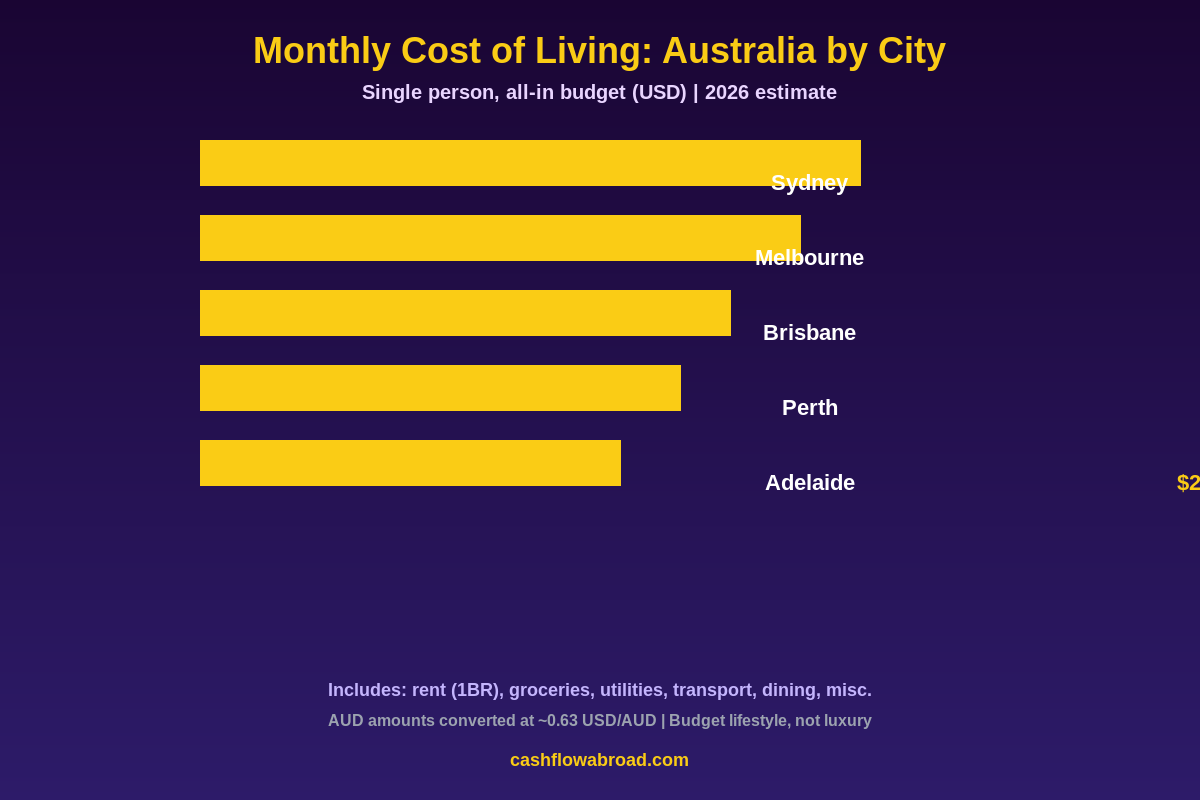
No geographic arbitrage here. Australia's major cities are among the most expensive in the Asia-Pacific. Sydney ranks in the top 15 most expensive cities globally, and Melbourne isn't far behind. Here's what a single American expat actually spends per month:
| City | Rent (1BR) | Food & Dining | Transport | Utilities | Total (est.) |
|---|---|---|---|---|---|
| Sydney | $1,450–$1,750 | $700–$900 | $80–$130 | $160–$220 | ~$3,900/mo |
| Melbourne | $1,200–$1,550 | $650–$850 | $100–$130 | $150–$200 | ~$3,500/mo |
| Brisbane | $1,100–$1,400 | $600–$800 | $20–$30 | $140–$180 | ~$3,100/mo |
| Perth | $1,050–$1,300 | $580–$750 | $80–$110 | $140–$180 | ~$2,900/mo |
| Adelaide | $850–$1,100 | $550–$700 | $70–$100 | $120–$160 | ~$2,600/mo |
USD figures at ~0.63 USD/AUD. Moderate lifestyle — not luxury, not backpacker.
A few cost drivers catch Americans off guard:
- Groceries run 20–30% higher than the US. Woolworths and Coles share a near-duopoly — competition is limited and prices reflect it.
- Cars carry luxury import taxes that push a base Honda Civic to AUD $28,000+.
- Dining out averages AUD $22–30 per casual meal, plus a mandatory 10% GST on everything.
- Brisbane is the exception: capped public transit at roughly AUD $50/month — dramatically cheaper than Sydney's AUD $200 monthly pass.
The offset: Australian wages are genuinely high. Minimum wage sits at AUD $24.10/hour ($15.20 USD). Tech professionals in Sydney or Melbourne routinely earn AUD $120,000–$200,000. If you're earning locally, the math changes substantially.
Australian Tax Rates for US Expats
Australia uses progressive income tax brackets. For 2025–26 (the Australian tax year runs July 1 – June 30):
| Taxable Income (AUD) | Tax Rate |
|---|---|
| $0 – $18,200 | 0% (tax-free threshold) |
| $18,201 – $45,000 | 16% |
| $45,001 – $120,000 | 30% |
| $120,001 – $180,000 | 37% |
| Above $180,000 | 45% |
Add the 2% Medicare Levy on top for tax residents. Starting July 1, 2026, the 16% bracket drops to 15% — a modest but real improvement. Non-residents face 32.5% from dollar one up to AUD $135,000 with no tax-free threshold — significantly worse.
Tax residency in Australia isn't purely day-count based. If you arrive with an intention to stay — a long-term visa, rented apartment, enrolled in local services — the ATO may treat you as a tax resident from day one, regardless of whether you've hit 183 days.
The US-Australia Tax Treaty (1982, supplemented 2001) coordinates taxing rights and provides foreign tax credits to prevent double taxation on most income categories. Most US expats in Australia use the Foreign Tax Credit rather than the FEIE, because Australian rates generate enough credits to wipe out most residual US liability. But the treaty's Savings Clause preserves the IRS's right to tax US citizens regardless — you file in both countries no matter what. For a clear breakdown of the FTC vs. FEIE choice, this guide walks through the decision.
The Superannuation Trap (Read This Twice)
This is the section your US accountant almost certainly doesn't know, and the one that catches American expats most badly off guard.
What is superannuation? It's Australia's mandatory retirement system — the functional equivalent of a 401(k). Every employer must contribute 11.5% of your salary into a super fund on your behalf, every paycheck. Starting July 1, 2025, these contributions are made on payday rather than quarterly — the new "Payday Super" rules.
Why the IRS doesn't recognize it: The US does not treat Australian superannuation as a "qualified" retirement plan. Employer contributions are not deductible on your US return — they're taxable income to you the year they're made. On an AUD $120,000 salary with 11.5% super, that's AUD $13,800 (~$8,700 USD) of additional taxable income the IRS recognizes that you never actually received in cash.
It gets worse:
- If you've personally contributed more than 50% to your super fund, the IRS classifies it as a Foreign Grantor Trust.
- As a grantor trust, all investment growth inside the fund — dividends, capital gains, interest — is taxed in the US annually, not deferred until withdrawal the way a 401(k) is.
- You must file Form 3520 each year — the Annual Return to Report Transactions with Foreign Trusts. Miss it and the penalty starts at $10,000 per year per form, regardless of whether any tax was actually owed.
- Super fund balances likely trigger FBAR reporting obligations once they exceed $10,000, and Form 8938 at higher thresholds.
In practice, expats who accumulate $100,000–$300,000 in super over a career without proper US filing can face years of unfiled obligations that compound into a nightmare — catch-up filing costs alone routinely run $5,000–$15,000 in professional fees on top of any actual tax owed.
The fix: engage a cross-border CPA who specializes in US-Australia tax before your first Australian paycheck arrives. Some expats successfully argue a treaty-based position to defer US tax on super growth, though this remains legally contested. Structurally, ensuring your employer contributes more than 50% of your super balance (standard employer contributions alone usually satisfy this) keeps you out of grantor trust territory. See also the complete US expat banking and tax guide for the broader FBAR and FATCA picture.
Visa Options for Americans in 2026
Australia completed a major skilled migration overhaul in late 2025. The new Skills in Demand (SID) framework replaced the old Temporary Skill Shortage visa:
| Visa | Best For | Key Threshold | Duration | PR Path |
|---|---|---|---|---|
| Skills in Demand — Core Skills (482) | Employer-sponsored workers in listed occupations | AUD $76,515 salary + 1yr experience | 4 years | After 2 years (Subclass 186) |
| Skills in Demand — Specialist Skills (482) | High earners in any profession | AUD $141,210+ salary | 4 years | After 2 years (Subclass 186) |
| Global Talent (Subclass 858) | Exceptional achievers in target sectors | Endorsement + AUD $162,050+ earning capacity | Permanent | Grants PR directly |
| Working Holiday (Subclass 417) | Americans aged 18–35 | No employer needed | 1–3 years | No direct path |
The Specialist Skills stream is the standout change. Earn above AUD $141,210 and you can get a 4-year visa processed in as little as 7 calendar days — no occupation list required. For US tech executives, senior finance professionals, or experienced consultants with a job offer in hand, this is a genuine fast lane.
The Working Holiday (Subclass 417) is the easiest entry for Americans under 35 who want to test the country before committing. Work in regional Australia and you can extend to 3 years. Tax treatment is simpler: a flat 15% on the first AUD $45,000.
The Global Talent Visa is harder to qualify for but grants permanent residency directly. Target sectors include fintech, medtech, cybersecurity, AI, agtech, and green energy. You need endorsement from a recognized Australian organization plus documented evidence of international recognition in your field.
Path to citizenship: After 2 years on a 482 visa, you can apply for Subclass 186 permanent residency. After 4 years as a permanent resident, you're eligible for Australian citizenship — which means an Australian passport, one of the most powerful travel documents on Earth.
Banking, Healthcare, and Practical Setup

Opening an Australian bank account is straightforward. Commonwealth Bank, ANZ, Westpac, and NAB all permit remote account opening before arrival if you have a confirmed visa. Most US expats keep their American accounts running alongside local ones — Charles Schwab International reimburses every ATM fee worldwide and charges zero foreign transaction fees, making it the ideal companion account for everyday spending in Australia.
Before you leave the US, lock in a US mailing address. Traveling Mailbox gives you a real US street address in 50+ cities, scans every piece of mail digitally, and handles check deposits for $15/month. It's essential for IRS correspondence, maintaining state domicile, and keeping US bank and brokerage accounts alive — most US financial institutions require a US address on file.
Healthcare: Australia's Medicare system is excellent — but as a temporary visa holder on a 482, you generally cannot access it. You need private health insurance. Local Australian plans run AUD $150–250/month (~$95–$160 USD) for a healthy single adult. SafetyWing Nomad Health covers you globally including Australia from around $145/month — often cheaper than domestic private insurance for expats under 40.
For US investment accounts: many major brokerages quietly close expat accounts when they discover you're abroad. The workaround is detailed in the expat investor's playbook — short version: Schwab and Interactive Brokers are the two that reliably don't close accounts for overseas residents.
Is Australia Worth It Financially?
Honest assessment: Australia is not a geographic arbitrage play in the traditional sense. You're not earning $80,000 USD and living on $1,200/month in Chiang Mai. You're earning AUD $150,000 and spending $3,500/month in Melbourne.
But that framing misses where the real financial opportunity is:
- High wages offset high costs. An Australian tech salary of AUD $150,000 after super and tax leaves roughly $70,000–$80,000 USD equivalent per year — comparable to clearing $130,000 in New York after federal, state, and city tax plus a Manhattan rent premium.
- Superannuation is forced employer savings. On AUD $150,000, your employer contributes AUD $17,250/year into your retirement — money that doesn't come out of your take-home. Managed correctly for US tax purposes, this compounds into serious long-term wealth.
- Currency dynamics work in your favor. Earning AUD while holding USD assets creates a natural hedge. When the AUD softens against the dollar, your US investment portfolio gains purchasing power relative to your Australian living costs.
- The quality-of-life premium is real. World-class cities, excellent public infrastructure, 3-hour flights to Southeast Asia, and more outdoor space per capita than virtually anywhere else on earth.
The honest comparison isn't Australia vs. Bali. It's Australia vs. staying in a high-cost US city. On that comparison, the financial case for Australia is often stronger than the sticker shock of AUD rents suggests — particularly for high earners who get the tax structure right from day one. For a broader look at how Australia stacks up against lower-cost alternatives, this geographic arbitrage breakdown across 10 countries puts the numbers in perspective.
The Bottom Line
Australia is a premium expat destination: premium lifestyle, premium costs, and a premium set of tax complications. The superannuation trap is real and compounds every year you leave it unaddressed. The cost of living requires either high local earnings or a strong USD remote income to make the numbers work.
But if you arrive with the right cross-border CPA, keep your US financial infrastructure intact, and start counting your 2-year clock toward permanent residency from day one — Australia is one of the most livable and financially defensible expat moves an American can make.
The beaches are better. The financial complexity just requires more preparation than the brochure suggests.
Financial disclaimer: This article is for informational purposes only and does not constitute tax, legal, or financial advice. Australian and US tax laws change frequently and individual circumstances vary widely. Consult a licensed cross-border tax professional before making residency, investment, or tax strategy decisions.
This guide is general information, not personalized tax, legal, or investment advice. Rules change; verify current thresholds with official sources or a qualified professional before acting.
Related guides
 Geographic ArbitrageOctober 25, 2026
Italy Nomad Visa Income Requirements
Italy's nomad visa income test is €25,500 on 2026 sheets. See the $133.60 Washington fee and the US return you still file.
 Geographic ArbitrageOctober 4, 2026
Greece Nomad Visa: The €3,500 Monthly Test
See whether your pay clears Greece's digital nomad visa: €3,500 net a month, or €4,200 with a spouse, before you apply now.
 Geographic ArbitrageSeptember 21, 2026
Korea F-1-D Workation Income Rules for Expats
As of June 2026, Korea’s F-1-D visa starts at ₩52.4M outside Seoul for ages 18–34. Map income tiers, US FEIE, and where you park the paycheck.