
Argentina has defaulted on its sovereign debt nine times, suffered 211% annual inflation in 2023, and watched the peso shed more than 95% of its value against the dollar over the past decade. It is also, right now, one of the most compelling places on earth to live if you earn in dollars. That is not a contradiction — it is the arithmetic of geographic arbitrage in action.
At roughly 1,400 Argentine pesos per US dollar (the current official rate as of May 2026), a $1,500 monthly income converts to about 2.1 million pesos. A furnished one-bedroom apartment in Palermo — Buenos Aires' most desirable neighborhood for expats — costs 1.05 to 1.33 million pesos, or $750–950 USD. Monthly groceries run another 308,000 to 350,000 pesos ($220–250). That leaves you 700,000 pesos — roughly $500 — for dining out at the best parrillas on earth, co-working memberships, gym fees, and whatever else you want from a city that genuinely rivals Paris for architecture, food, and culture.
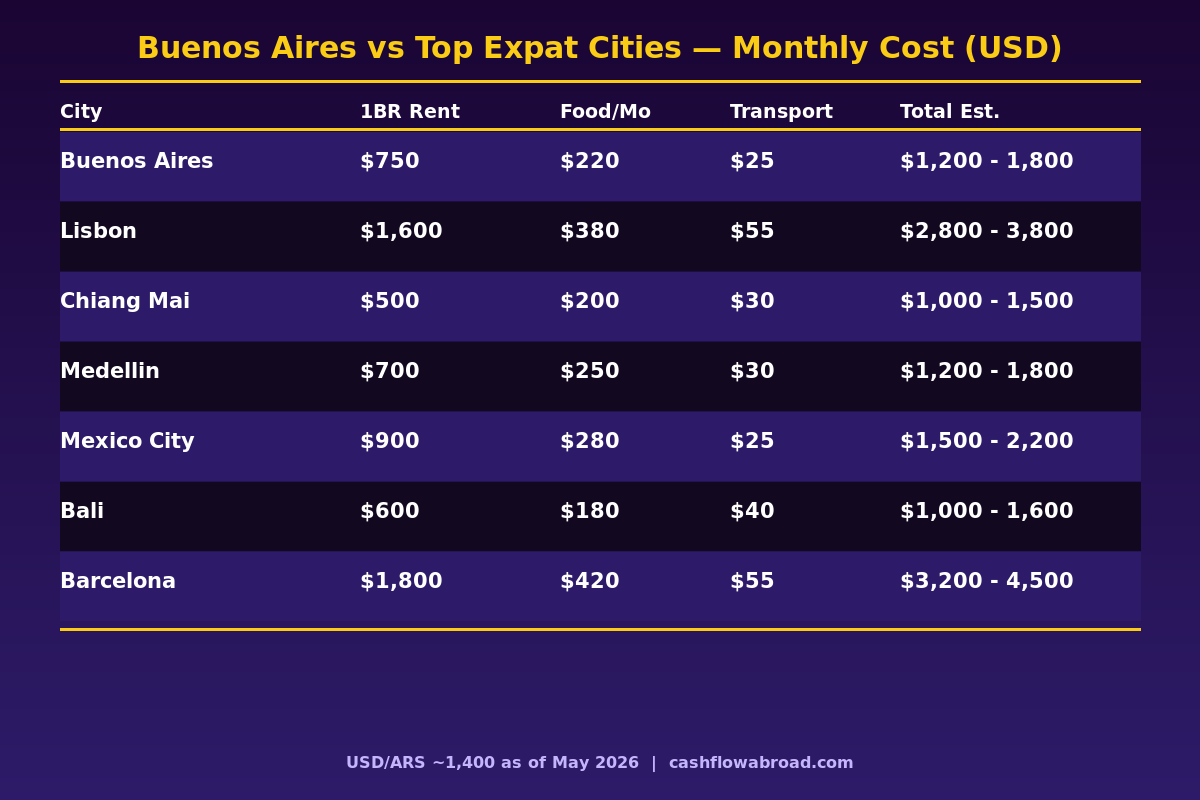
Compare that to Lisbon, where the same comfortable lifestyle costs $3,200 a month minimum. Or Medellin, which is no longer the budget darling it was — comfortable life there now runs $1,500–2,000. Buenos Aires delivers European quality at a price point that makes most other "expat-friendly" cities look expensive.
What $1,500/Month Actually Gets You
Here is a realistic monthly budget for a single person living well in Buenos Aires in 2026:
| Expense | Budget Option | Comfortable |
|---|---|---|
| 1BR apartment (Palermo/Recoleta) | $700 | $950 |
| Groceries | $150 | $250 |
| Dining out (10–15x/month) | $100 | $200 |
| Co-working space | $80 | $150 |
| Utilities + internet | $60 | $90 |
| Transport (Subte + Uber) | $20 | $40 |
| Health insurance | $65 | $150 |
| Entertainment + misc | $80 | $150 |
| Total | $1,255 | $1,980 |
A parrilla dinner with wine runs $15–25. Specialty coffee at a Palermo café costs under $1. A gym membership: $25–40/month. Theater tickets at Teatro Colón — one of the world's great opera houses — start at $8. The value compression is remarkable. You are not "roughing it" in a developing country; you are living in a metropolis of 15 million people with a deeply sophisticated food scene, excellent public transport, fast fiber internet, and a cultural calendar that never stops.
Neighborhoods: Where to Base Yourself
Buenos Aires is a city of distinct barrios, each with its own personality. For expats and digital nomads, these four dominate:
Palermo Soho / Hollywood — The expat epicenter. Walkable, leafy, packed with co-working spaces, restaurants, and English-friendly services. Furnished 1BR apartments run $750–1,100/month. The highest concentration of co-working options in the city.
Recoleta — European-feel grand boulevards, proximity to cultural institutions, and slightly quieter than Palermo. Rent runs $900–1,300/month for a well-located 1BR. Preferred by longer-term residents who prioritize security and tranquility.
San Telmo — Historic, bohemian, significantly cheaper at $600–800/month. The trade-off is an older housing stock and fewer co-working options. Good for those who want character over convenience.
Villa Crespo / Chacarita — The emerging picks for people who have been in Buenos Aires long enough to want what locals want: better value, more authentic neighborhoods, and a short bike or subway ride from Palermo's amenities. Rents run $600–900/month.
For furnished short-term rentals while you scout longer-term options, Airbnb and local platforms like ZonaProp list hundreds of furnished apartments monthly. Expect to pay a 20–30% premium for fully furnished, short-term-friendly units versus bare apartments on annual leases.
The Visa Playbook: From Tourist to Resident
Americans can enter Argentina visa-free and stay up to 90 days as tourists. That window is enough to explore Buenos Aires, test the lifestyle, and decide whether to formalize your stay. If you want to stay longer — and most people who arrive do — you have several legal paths:
Digital Nomad Visa (12 Months)
Argentina launched its digital nomad visa (Residencia Temporal para Trabajadores Remotos) to attract remote workers who earn income abroad. The core requirements:
- Proof of remote income from outside Argentina: minimum $1,500/month (though $2,000+ improves approval odds)
- Valid international health insurance — SafetyWing's Nomad Insurance ($65–80/month) meets this requirement and is the most popular option among applicants
- Clean police background check from your home country
- Valid passport with at least 6 months remaining
Processing time: 10–30 days. Application fee: $200–400 USD at the consulate. The visa is valid for 12 months and renewable for another 12. After two years on this track, you can apply for permanent residency. See the full landscape of digital nomad visas ranked by value if you want to compare Argentina's offering against other countries.
Rentista and Permanent Residency
For those planning to stay indefinitely, the rentista pathway requires demonstrating a minimum monthly income from abroad — roughly $1,500–2,000/month from passive sources like rental income, dividends, or pensions. Once permanent residency is established, you gain the right to work locally, open unrestricted bank accounts, and access the national healthcare system (PAMI).

Tax Reality for Americans in Argentina
Here is where it gets nuanced — and where a lot of expats get confused.
As a tourist or on the digital nomad visa: You are not an Argentine tax resident. Argentina only taxes Argentine-source income, which you almost certainly have none of. Your foreign-source income — remote salary, freelance clients, US investments — is not taxed by Argentina during this phase. You are, however, still required to file US taxes as an American citizen regardless of where you live in the world.
After becoming an Argentine tax resident — typically triggered by 12 continuous months in the country or obtaining permanent residency — Argentina taxes your worldwide income at progressive rates of 5–35%. The US-Argentina tax treaty and the Foreign Tax Credit mechanism mean you generally avoid true double taxation: Argentine taxes paid are credited against your US bill. That said, Argentina's income tax brackets, wealth tax (bienes personales), and reporting requirements are complex. Budget for a local accountant ($500–1,500/year) if you reach this stage.
For those using the Foreign Earned Income Exclusion, the physical presence test requires 330 days outside the US in any 12-month period — straightforward to hit if Argentina is your primary base. See our complete FEIE guide and our FEIE vs. Foreign Tax Credit comparison to determine which approach fits your situation.
One mandatory US-side obligation: if you hold foreign bank accounts with an aggregate balance exceeding $10,000 at any point during the year, you must file an FBAR with FinCEN. Argentine bank accounts — including USD-denominated accounts — trigger this requirement. See our expat banking and taxes guide for the full details.
Banking and Moving Money
Banking in Argentina is manageable but requires some setup. The practical stack for most expats:
Charles Schwab International account: The single most useful financial tool for any expat in Argentina. Schwab refunds all ATM fees worldwide, which means you can withdraw pesos at any Buenos Aires ATM with zero network charges — only the Argentine bank's per-transaction peso limit applies (typically 10,000–20,000 ARS per pull, so plan on a few transactions). This avoids the need for wire transfers and is the standard approach for expats in their first months.
Mercado Pago: Argentina's dominant digital wallet, used by roughly 60% of the population. Sign up with a passport and local phone number. Accepted for utilities, some landlords, most online purchases, and peer-to-peer transfers. Free and fast to set up — often functional within 24 hours of arrival.
Argentine USD bank account: Once you have a local tax ID (CUIL/CUIT), you can open a USD-denominated savings account at Banco Galicia, Santander Argentina, or BBVA. This is the smartest setup for stays longer than 3 months — receive transfers in USD and convert to pesos when you need local spending money rather than converting everything at once.
International transfers into Argentina: For sending money from a US bank to Argentina, Remitly offers competitive rates with transparent fees. The blue dollar black market rate, while popular among tourists in 2022–2023, has shrunk significantly since Milei's exchange rate reforms — the official rate now sits within 5–10% of any informal market, and the legal route avoids substantial legal risk.
Dollar savings: If you're earning in or converting to stablecoins, ARQ Finance lets you hold USDC/USDT balances, earn up to 4% on dollar savings, and swap to pesos as needed — useful as a local dollar buffer without the friction of a formal bank account in the early months. Available in Argentina, Mexico, Colombia, and Brazil.
For maintaining a real US mailing address while abroad — essential for US banking, IRS correspondence, and state domicile purposes — Traveling Mailbox provides a real US street address in 50+ cities for $15/month, with mail scanning and check deposits. Losing your US address is one of the most common mistakes people make when relocating abroad, and recovering from it is painful. See our virtual mailbox guide for the full setup.
Buenos Aires vs. Other Top Expat Cities
| City | 1BR Rent | Monthly Food | Comfort Budget | Visa Ease (Americans) |
|---|---|---|---|---|
| Buenos Aires | $750–950 | $220–280 | $1,200–1,800 | 90-day visa-free + DNV |
| Lisbon | $1,500–2,000 | $350–450 | $2,800–4,000 | D7 visa required |
| Chiang Mai | $400–600 | $150–250 | $900–1,400 | Tourist visa + LTR |
| Medellin | $600–900 | $220–300 | $1,200–1,800 | 90-day + DNV available |
| Mexico City | $800–1,200 | $250–350 | $1,500–2,200 | 180-day visa-free |
| Barcelona | $1,600–2,200 | $380–500 | $3,000–4,500 | Non-lucrative visa |
Buenos Aires is not the cheapest expat destination — Chiang Mai and Bali still win on raw cost. But it offers something neither of those cities does: a genuinely world-class urban experience. World-class steak and wine culture, tango, one of the continent's best healthcare systems, a sophisticated arts scene, and nightlife that operates on European hours. For expats who want affordability and serious urban quality, Buenos Aires sits in a unique position.
The Real Downsides
No honest Argentina guide skips this section.
Inflation still moves prices: Even with Milei's reforms driving inflation from 211% (2023) down to a projected 20–25% for 2026, costs still shift. What costs $900/month in rent today may cost $1,050 in 12 months. Dollar earners are naturally hedged — your purchasing power stays roughly stable — but you'll notice the shifting landscape, especially during lease renewals.
Exchange rate bands add uncertainty: Starting in 2026, Argentina's exchange rate operates within monthly-adjusted bands rather than a fixed peg. The rate is more predictable than 2022–2023 but not static. Budget conservatively and treat favorable movements as a bonus.
Bureaucracy is real: Getting a CUIL tax ID, opening a bank account, and navigating Argentine paperwork requires patience. Budget 2–4 weeks for basic administrative setup after arrival. Having a local fixer or immigration attorney ($200–400 one-time) accelerates this considerably.
US banking from an Argentine IP: Some US banks flag Argentine IP addresses or block transactions. A NordVPN subscription routed through a US server resolves most of these issues — standard practice for expats maintaining US accounts remotely.
International schools are expensive: Families with children should factor in $800–1,500/month per child for international schools. This changes the budget calculus significantly and narrows (though doesn't eliminate) the arbitrage advantage.
Who This Works For — and Who It Doesn't
Buenos Aires is an excellent base for remote workers earning $2,000–5,000/month who want to save aggressively, freelancers who want European-quality urban living at Latin American prices, retirees with US Social Security or pension income who want a sophisticated city over a beach town, and entrepreneurs building online businesses who want low overhead and a large English-speaking expat network.
It's a harder fit for families with multiple school-age children, anyone who needs total financial stability, and those who find macroeconomic turbulence stressful. Argentina's economic history is chaotic — if currency crises keep you up at night, you'll sleep better in a more stable location. Our geographic arbitrage playbook covers ten alternatives across the risk-return spectrum.
The Bottom Line
Argentina's economic crisis has, paradoxically, created one of the best dollar-arbitrage environments on earth. The country is more stable now than it has been in years — inflation is down dramatically, the exchange rate is more transparent, and the Milei government has dismantled most of the currency controls that used to complicate life for foreign earners. The city itself is genuinely world-class. $1,500/month in Buenos Aires buys a lifestyle that would cost $3,500 in Lisbon or $4,000 in Barcelona.
The arbitrage window does not stay open forever. As Argentina stabilizes and the peso strengthens, price levels will gradually converge toward regional norms. Expats who establish a base now lock in the best exchange-rate environment since 2020 — and the opportunity to build savings and investments while their day-to-day overhead is minimal.
Financial disclaimer: This article is for informational purposes only and does not constitute financial, tax, or legal advice. Tax obligations depend on individual circumstances and change frequently — consult a qualified US expat tax professional and an Argentine accountant before making residency or banking decisions. Exchange rates and cost estimates referenced reflect publicly available data as of May 2026 and will fluctuate.