Albania's 15% Flat Tax: Europe's Hidden Expat Haven
Albania offers a digital nomad visa at €817/month income, sub-$1,500/month living, 12-month foreign income tax holiday, and visa-free entry for Americans — Europe's most overlooked expat deal.
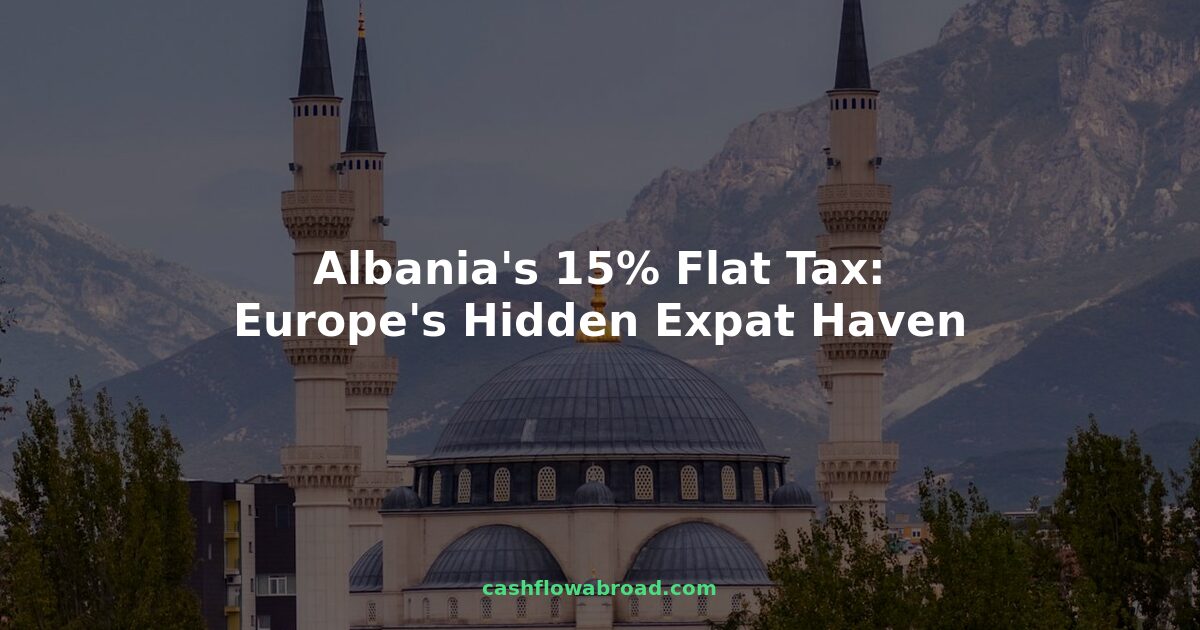
Albania's digital nomad visa requires just €817/month, living costs under $1,500/month, and a 12-month foreign income tax exemption. Full expat guide.
Disclosure: this article contains affiliate links. If you open an account through one of them, Cashflow Abroad may earn a referral commission at no extra cost to you.
Most expats spend months agonizing over Portugal's dead NHR program, Spain's Beckham Law income caps, or Greece's non-dom flat tax at €100,000/year. Meanwhile, a country three hours from Rome is quietly letting Americans walk in without a visa, stay for a full 365 days, and work remotely at rates that make Lisbon look like San Francisco.
That country is Albania — and it isn't on most expats' radar because, until recently, it wasn't on the news for good reasons. The Albania of 2026 bears almost no resemblance to the Albania of 1990. Tirana has a Blloku neighborhood full of rooftop bars and co-working cafes. The Albanian Riviera has beaches that rival parts of Greece at a fraction of the price. And the government actively courts foreign remote workers with a digital nomad visa that requires just €817/month in provable income to qualify — the lowest threshold of any active European program.
Here's everything you need to make an informed decision: the real costs, the actual tax rules, the banking situation, and what internet speeds look like on a Tuesday afternoon in Tirana.
Why Albania Is Worth Serious Attention in 2026
Albania has two facts working in its favor that almost no other European country can match simultaneously: it's genuinely cheap, and it has legitimate tax advantages that aren't gimmicks.
The visa-free access for US citizens is the first anomaly. Albania unilaterally extended visa-free stays to US citizens for up to one year. You can fly into Tirana, clear customs, and start working without a single form filled out for up to 12 months. The only other non-EU European country with a comparable arrangement for Americans is Georgia. You can't do this with Portugal, Spain, France, or anywhere in the Schengen zone beyond 90 days.
The second fact: Albania is an EU accession candidate country. It's not in the EU yet — which is exactly why costs are still low. Portugal's NHR created a feedback loop: tax incentive attracted foreigners, foreigners drove up real estate, Lisbon became unaffordable for both locals and the nomads who originally came for the deal. Albania hasn't hit that wall yet. EU membership, when it comes, will close this window.
The third: internet speeds. Albania ranks in the global top 50 for fixed-line internet, averaging around 250 Mbps in Tirana — faster than Germany's national average. Video calls, cloud file syncing, and remote collaboration run without friction in any neighborhood of the capital.
The Albanian Digital Nomad Visa (Unique Permit)
Albania's official name for this visa is the Unique Permit for Digital Mobile Workers. It's a Type D long-stay visa that converts into a one-year residence permit, renewable annually for up to five years. It launched in 2022 and has been running steadily since — far less publicized than Portugal's D8 or Barbados Welcome Stamp, which is partly what keeps it functional.
Who Qualifies
Core requirements:
- Employed by a foreign (non-Albanian) company, or self-employed with contracts from clients outside Albania
- Minimum provable income of approximately €817/month (~$890 USD)
- Bank statement showing at least €4,000 deposited over the past 12 months
- Valid health insurance covering Albania with at least €30,000 in coverage
- Criminal background check from your home country (apostilled)
- Proof of accommodation in Albania — a signed lease works
Compare this to the alternatives: Portugal's D8 visa requires €3,280/month. Spain's Digital Nomad Visa requires €2,646/month (200% of Spain's minimum wage). Albania's bar is roughly the same as a low-cost US state's minimum wage — intentionally accessible to people who aren't already earning a six-figure salary.
For health insurance, SafetyWing's Nomad Insurance runs $42–$56/month for most applicants under 40, covers Albania, and meets the €30,000 minimum coverage requirement. It also generates the kind of insurance certificate that Albanian immigration offices accept.
Application Process
The application goes through Albania's e-visa portal. Processing takes 15–30 working days. Once approved, you receive a visa sticker, then convert it to a residence permit at the local civil registration office after arrival.
Documents to prepare well in advance:
- Employment contract or 3+ months of paid client invoices
- 12 months of bank statements
- Passport valid at least 3 months beyond the requested visa duration
- Health insurance certificate
- Apostilled criminal background check — budget 3–6 weeks for this if sourcing from the US State Department
- Albanian lease agreement or confirmed hotel booking
The apostille requirement is where most applicants lose time. Everything else you can gather quickly; that document has an institutional processing timeline that doesn't flex.
Albania's Tax System: The Real Numbers
The "15% flat tax" headline circulating in expat forums is a simplification. Albania's tax structure has two distinct components and they apply differently depending on income type.
Personal Income Tax (Progressive, Updated January 2025)
| Annual Income (ALL) | Annual Income (USD approx.) | Tax Rate |
|---|---|---|
| Up to 600,000 ALL | Up to ~$5,500 | 0% |
| 600,001 – 3,000,000 ALL | ~$5,500 – ~$27,500 | 13% |
| Above 3,000,000 ALL | Above ~$27,500 | 23% |
These rates are low by European standards. Someone earning $80,000/year in Albania — a tax resident — would pay roughly 19–20% effective rate on that income. In Germany, the same income would face ~35–40% in combined federal and solidarity tax. In France, over 30%. Even the UK's basic band (20%) kicks in on far less income with fewer exemptions.
Investment Income: The Actual 15% Flat Tax
Albania taxes passive income at a flat 15% rate. This includes:
- Dividends: 15%
- Interest income: 15%
- Rental income: 15%
- Capital gains on most assets: 15%
- Capital gains on primary residence held 2+ years: 0%
Albania has no wealth tax, no inheritance tax, and no gift tax. For someone with meaningful passive income — a dividend portfolio, rental properties back home, or capital gains events — 15% on that income is extremely competitive with any EU or US alternative.
The Digital Nomad Visa Tax Holiday
Here's the clause that matters most and gets skipped in most coverage: Unique Permit holders receive a full 12-month tax exemption on foreign-sourced income from the date the permit is issued. That's not just a reduced rate — it's zero Albanian tax on your foreign employment or freelance income for the first year, regardless of whether you've technically become a tax resident.
This provides runway to structure your finances before committing to full Albanian tax residency — whether that means timing a capital event, restructuring a business entity, or simply seeing whether you like living there before filing a bunch of forms.
US Citizens: The IRS Still Has a Claim
Albania has no tax treaty with the US, Canada, Australia, or New Zealand. US citizens owe US taxes on worldwide income regardless of where they live — citizenship-based taxation doesn't care what country you reside in.
The two tools that make this manageable:
- Foreign Earned Income Exclusion (FEIE): Excludes up to ~$126,500 in foreign earned income from US federal tax (2024 figure, adjusted annually) if you pass the physical presence test — 330 days outside the US in a 12-month period. Full breakdown at Zero Federal Income Tax: The FEIE Guide.
- Foreign Tax Credit (FTC): Offsets US tax dollar-for-dollar with Albanian taxes paid. Since Albania's rates are lower than US rates, the FTC won't fully eliminate US liability — but FEIE + FTC combined reduces the bill substantially for most earners.
Albania's no-treaty status means you don't have the simplified documentation that treaty countries provide, but the underlying tax mechanics still work. A US expat in Albania earning $90,000/year, qualifying for FEIE, typically ends up owing minimal US federal tax. Consult a qualified expat tax professional before establishing residency — the specifics matter enormously for your situation.
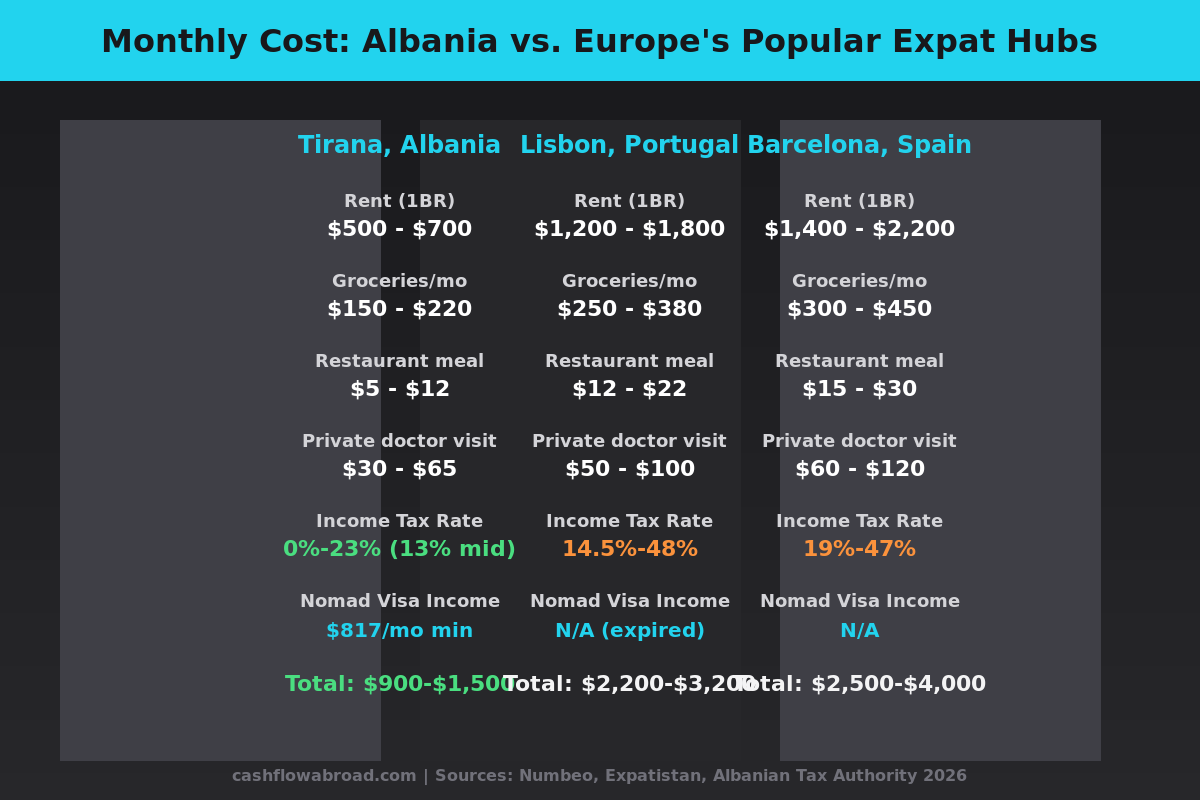
Cost of Living: What $1,200/Month Actually Gets You
Tirana has seen real estate appreciation — rents climbed roughly 7% year-over-year in 2026 — but remains dramatically cheaper than Western European capitals. Here's what real numbers look like:
| Expense | Tirana Budget | Tirana Comfortable | Lisbon Equivalent |
|---|---|---|---|
| 1BR apartment, central | $450–$550 | $600–$750 | $1,300–$1,800 |
| Groceries/month | $120–$170 | $180–$250 | $280–$400 |
| Restaurant dinner (mid-range) | $8–$14 | $14–$25 | $18–$35 |
| Coffee shop (cappuccino) | $1.50–$2.50 | $2–$3.50 | $3–$5 |
| Co-working day pass | $8–$15 | $15–$25 | $25–$40 |
| Private clinic visit | $30–$45 | $45–$65 | $60–$120 |
| Gym membership | $20–$35 | $35–$55 | $50–$90 |
| Local transport (monthly) | $15–$25 | $30–$50 | $40–$50 |
A realistic all-in budget for a single expat living well in Tirana — decent central apartment, eating out several times a week, coworking a few days, weekend travel — runs $1,100–$1,600/month. The equivalent lifestyle in Lisbon costs $2,500–$3,500. In Barcelona, you're looking at $3,000–$4,200.
Albania also has more coffee shops per capita than almost anywhere else on earth — which matters practically, because cafes with solid wifi serve as free co-working spaces all day. A flat white runs $2. The concept of being asked to leave or buy another drink doesn't really exist there.
Albanian Riviera: The Summer Option
The coastal towns of Saranda, Himara, and Ksamil offer Mediterranean water clarity that European travel publications consistently rank among the continent's best. Saranda looks directly across a narrow strait at Corfu. Out of peak season (May–June and September–October are optimal), rents fall to $350–$500/month for sea-view apartments. In summer, prices roughly double as domestic and international tourism peaks.
The trade-off: internet in coastal areas averages 20–50 Mbps vs. 250 Mbps in Tirana, and professional networking infrastructure is essentially absent outside the capital.
Banking and Money
The Albanian Lek (ALL) is the local currency — roughly 92–95 ALL to 1 USD as of 2026. Tirana has solid ATM coverage from Raiffeisen Bank, OTP Bank, and credins bank. Most accept Visa and Mastercard, with withdrawal limits of 30,000–50,000 ALL per transaction ($315–$525).
The cleanest setup for US expats: Charles Schwab's international checking account refunds all ATM fees worldwide with no foreign transaction fee. Open it before you leave the US — Schwab is one of the few accounts that's straightforward to open for people with a US address. It becomes your daily spending card once you're in Albania, since you'll be withdrawing Lek from ATMs rather than using Lek-denominated accounts.
Opening a local Albanian bank account requires your residence permit (after the visa converts), passport, and an Albanian tax identification number (NIPT). The process takes 1–2 weeks. Most short-term expats skip it and run on international cards.
For international transfers — paying contractors, moving money between countries, or sending funds home — Remitly supports ALL-to-USD and USD-to-ALL at competitive mid-market rates, with first-transfer promotions that often beat exchange booths in Tirana.
One infrastructure requirement most expats overlook: a US mailing address. Even after you move, you'll need one for IRS correspondence, US brokerage accounts, and any financial accounts that require a US street address. A virtual US mailbox like Traveling Mailbox gives you a real street address in 50+ US cities, mail scanning, and check deposit capability for ~$15/month. The virtual mailbox guide covers how to set this up as part of your pre-departure infrastructure.
Healthcare: Cheap Private Clinics, Know the Limits
Albania's public healthcare system is functional but underfunded compared to EU standards. Expats use private clinics — better equipped, English-speaking staff, and still inexpensive by Western standards.
A private clinic consultation in Tirana: $30–$65. Dentist visit (cleaning, checkup): $20–$40. Most common prescriptions are available over-the-counter at pharmacies for a few dollars, similar to how pharmacies work in Spain or Portugal.
For major procedures or emergencies, the realistic backup is medical evacuation to Athens (45 minutes by plane), Rome, or Vienna. Health insurance that includes evacuation coverage is the minimum rational hedge — not optional for extended stays.
SafetyWing Nomad Insurance covers primary care, hospital stays, and emergency evacuation. For expats who want fuller coverage — lower deductibles, better dental, higher limits — the complete expat health insurance guide walks through the options available at different price points.
How Albania Compares to the Usual Suspects
| Factor | Albania | Georgia | Serbia | Portugal |
|---|---|---|---|---|
| Monthly budget (comfortable) | $1,100–$1,600 | $900–$1,400 | $1,200–$1,800 | $2,500–$3,500 |
| Income tax (top rate) | 23% | 20% (1% as sole trader) | 10% flat | 48% |
| Nomad visa income req. | €817/mo | None (visa-free 1 yr) | ~€700/mo | €3,280/mo (D8) |
| US visa-free period | 1 year | 1 year | 30 days | 90 days (Schengen) |
| EU candidate status | Yes | Yes | Yes | Full member |
| US tax treaty | No | No | No | Yes |
| Average fixed internet | ~250 Mbps | ~50 Mbps | ~200 Mbps | ~150 Mbps |
Georgia is Albania's closest analog — also visa-free for a year for Americans, also inexpensive, also no US tax treaty. Georgia has the 1% sole trader tax option, which beats Albania's progressive rates for self-employed workers. But Georgia's infrastructure outside Tbilisi is thinner, and its geopolitical situation has added uncertainty. Albania's proximity to major European airports (direct flights to London, Rome, Vienna, Frankfurt, Istanbul from Tirana's Rinas airport) is a real practical advantage for people who value ease of movement through Europe.
Serbia (covered in the Serbia 10% flat tax guide) offers a lower headline rate, but Belgrade's costs have risen significantly and the nomad permit process has gotten more bureaucratic. Albania's Unique Permit remains cleaner to navigate.
For a full framework on evaluating destinations across all these variables, the geographic arbitrage playbook covers ten countries with side-by-side analysis.
Two Expat Profiles That Work Well in Albania
Remote Workers Earning $50K–$120K/Year
The Unique Permit's 12-month tax holiday is a genuine benefit. Combined with FEIE on the US side, a remote worker in this income range can legally pay minimal taxes in both jurisdictions during the first year in Albania. Sub-$1,500/month living costs with fast internet and good co-working options make Tirana a viable primary base — not just a cheap transit stop. The digital nomad scene in Tirana is active; expat WhatsApp groups, regular meetups, and a core of established nomads who've been there for years.
Retirees Drawing Social Security + Investment Income
A retiree drawing $2,500/month from Social Security and a modest dividend portfolio lives extremely well in Albania. Social Security is taxed by the US government but Albania doesn't tax it as Albanian-sourced income. Investment income (dividends, interest) faces Albania's 15% flat rate if you're a tax resident — competitive with most alternatives. No wealth tax means your accumulated portfolio sits untouched by Albanian law beyond what you actually realize.
Note: Albania has no totalization agreement with the US, so Social Security taxes paid in the US don't offset Albanian taxes. The totalization agreements guide explains which countries do have these agreements and what difference they make.
What Albania Is Not (Honest Caveats)
Language barrier is real. Albanian (Shqip) is a language isolate — it shares almost no vocabulary with Latin, Slavic, Germanic, or Slavic languages. The learning curve is steep. English is widely spoken in Tirana among younger Albanians and the business community, but meaningfully less outside the capital. Basic Albanian phrases matter more here than in Portugal or Colombia.
Bureaucracy is slower than Western Europe. Simple documentation tasks can require multiple visits and waiting periods that don't logically follow from the steps involved. Budget time and patience, especially for anything involving the residence permit process.
EU accession timeline is uncertain. When Albania joins the EU — if it does, and the current trajectory suggests it will eventually — costs will rise, mobility rights will improve, and the current cost-tax-visa combination will fundamentally change. You're betting on a window, not a permanent state.
No US tax treaty. This is a structural gap for US citizens. You won't have the treaty-based protections that countries like Germany or Portugal offer for specific income types. The lack of a treaty makes professional tax advice before establishing Albanian tax residency a requirement, not a suggestion.
Verdict: The Best European Expat Value Nobody Is Talking About Yet
Albania's combination of low living costs, accessible digital nomad visa, reasonable income tax rates, 15% flat investment income tax, and 12-month foreign income exemption for new permit holders is the best overall package in Europe for expats who don't need EU membership and don't want to spend $3,000/month to live in Lisbon.
The window is open now because Albania isn't famous yet. EU accession negotiations, rising real estate investor interest, and a growing expat community are already moving the baseline upward — though from such a low floor that it remains cheap by any comparison to Western Europe. The Albanian Riviera in particular is on a trajectory that looks a lot like Croatia's coastline did 15 years ago: underpriced, gradually discovered, eventually priced like everywhere else.
The expats who benefit most from the Albania arbitrage are the ones who show up before the NYT travel section writes about it. That point hasn't arrived yet — but the early digital nomads are already there, working from Blloku rooftops with 250 Mbps fiber, paying $600 in rent, and waiting patiently for the rest of the world to catch on.
For next steps on the expat banking and tax setup that makes a move like this actually function, the US expat banking and taxes guide is the right starting point.
This article is for informational purposes only and does not constitute tax, legal, or financial advice. US citizens remain liable for US federal taxes on worldwide income regardless of residency. Albanian tax rules, visa requirements, and income thresholds are subject to change — verify current requirements with the Albanian government's official e-visa portal and consult a qualified international tax professional before making residency or relocation decisions.
This guide is general information, not personalized tax, legal, or investment advice. Rules change; verify current thresholds with official sources or a qualified professional before acting.
Related guides
 Geographic ArbitrageMay 3, 2026
Andorra Tax Residency: Europe's Hidden 10% Tax Haven
Andorra offers 10% max income tax, zero inheritance tax, and 4.5% VAT. Full 2026 guide to residency options, costs, and the US expat catch.
 Geographic ArbitrageAugust 31, 2026
Hungary White Card: The €3,000 Subsistence Test
Prove €3,000 net for six months, pay €110, and model Hungary's 15% PIT. The White Card is a two-year Budapest permit, not a path to settle.
 Geographic ArbitrageJuly 19, 2026
Sofia Remote Work Budget Under $2,000
Price rent, transit, utilities, insurance, and visa caveats before using Sofia, Bulgaria as a lower-cost EU base for remote work.