

A solo founder in Medellín is pocketing $4,200/month managing ten AI phone bots for US dental offices, law firms, and HVAC companies — while his total tool spend is under $180/month. He has never met a single client in person. He doesn't cold-call anyone. And the work to maintain each bot takes about 30 minutes a month after it's live.
This is the AI voice agent arbitrage play, and almost nobody in the expat space is talking about it yet. Local service businesses in the US lose an estimated 28% of potential revenue to missed calls — a painter on a job site, a dentist between procedures, a plumber under a sink. They physically can't answer. That missed call goes to a competitor. An AI voice agent answers in under two seconds, 24/7, speaks naturally, books appointments, collects caller info, and sends a summary to the owner.
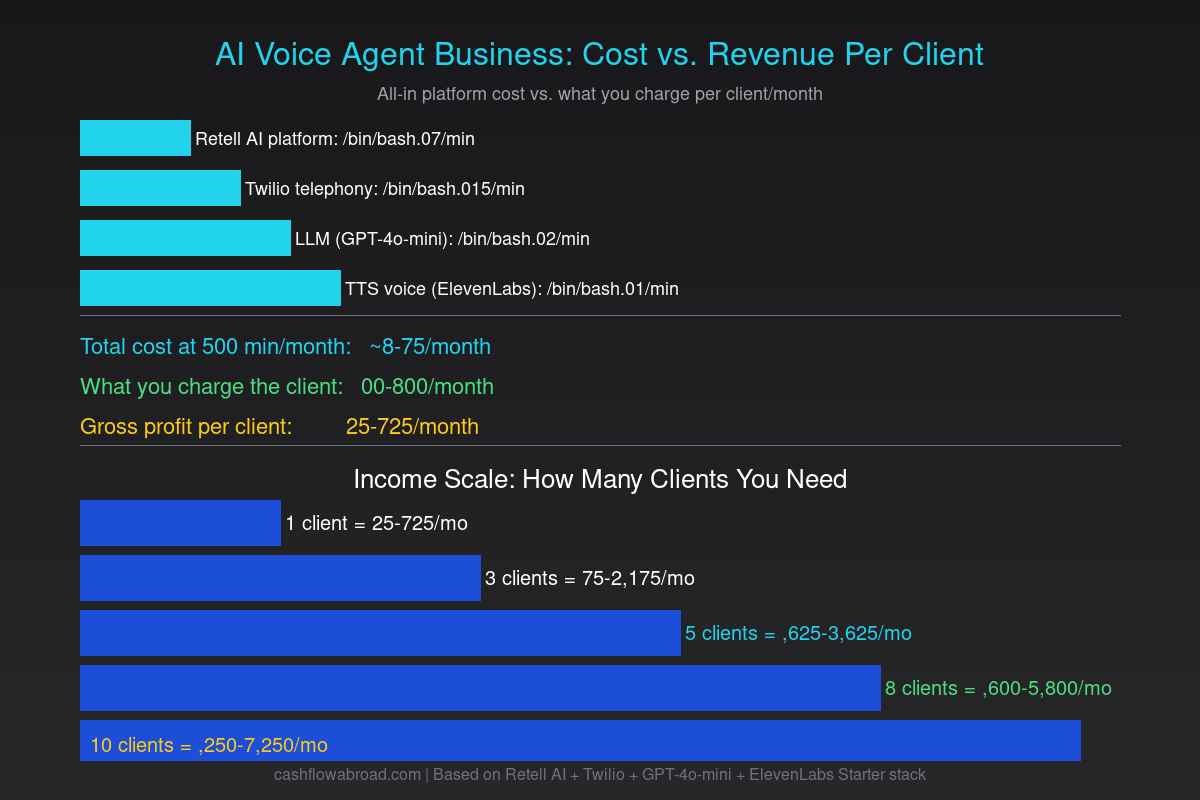
You build it once in a few hours. You charge $400–$800/month to manage and maintain it. The business owner saves $50K+/year in lost bookings. You earn $325–$725/month per client in profit. Eight clients and you're at $5,000+/month — from a cafe in Chiang Mai or a co-working space in Lisbon.
Why Small Businesses Keep Losing Calls (and Cash)
Most solo operators and small businesses can't afford a full-time receptionist ($35,000–$45,000/year fully loaded). Virtual assistant services run $1,200–$2,500/month. Human answering services charge $100–$400/month but still miss nuance, can't book into CRM systems automatically, and aren't available at 2am when someone's toilet is flooding.
The industries most exposed to this problem are exactly the ones with high call volume and a direct dollar value per inquiry:
- Dental practices: Each new patient booking is worth $200–$2,500 over a lifetime. Missing 5 new patient calls/week is easily $50,000/year in lifetime value.
- Law firms: One missed intake call for a personal injury firm can be a $5,000–$50,000 case lost to a competitor.
- HVAC, plumbing, roofing: Emergency calls are high-margin. A missed HVAC emergency in July is a $1,500 job gone.
- Real estate agents: A property inquiry not answered within 5 minutes has a 78% chance of going cold (Harvard Business Review data).
The pitch sells itself. You're not selling technology — you're selling recovered revenue. That framing is what separates a $150/month sale from a $700/month retainer.
What You're Actually Building (and Selling)
An AI voice agent is a phone number that, when called, is answered by a conversational AI. It speaks, listens, understands context, and takes action — booking into a calendar, sending a confirmation SMS, updating a CRM, or escalating to a human when needed.
The agent uses four pieces of technology stitched together:
- Speech-to-text (STT): Converts the caller's voice to text in real time (Deepgram is standard, ~12ms latency)
- Large language model (LLM): Understands intent and generates responses (GPT-4o-mini, Sonnet, or Llama for cost control)
- Text-to-speech (TTS): Converts the AI's response back to natural-sounding voice (ElevenLabs, Cartesia, or Deepgram)
- Telephony: The actual phone infrastructure (Twilio, Vonage, or built-in numbers from the platform)
You don't need to wire these together yourself. Platforms like Retell AI and Vapi handle the orchestration layer — you focus on the agent logic (what it says, what it does, how it handles edge cases) and the client relationship.
The Tech Stack: Exactly What You Need and What It Costs
Here's how the three main platforms compare in 2026:
| Platform | Advertised Rate | True All-In Cost | Free Tier | Best For |
|---|---|---|---|---|
| Retell AI | $0.07/min (platform only) | ~$0.12–0.18/min | Yes (testing minutes) | Developers wanting control |
| Vapi | $0.05/min (platform only) | ~$0.12–0.20/min | Yes ($10 free credit) | Fastest to deploy, good docs |
| Bland AI | $0.09/min | ~$0.15–0.25/min | Limited | Enterprise clients, higher volume |
The "all-in" cost includes telephony (Twilio adds ~$0.015/min), LLM inference (GPT-4o-mini runs ~$0.02/min at typical call lengths), and TTS voice synthesis (ElevenLabs Starter: $5/month covers most small accounts). For a typical client receiving 500 minutes of calls per month, your real cost is $60–$90/month.
Your monthly tool spend for 5 active clients:
| Tool | Cost | Notes |
|---|---|---|
| Retell AI (5 agents, ~500 min/client) | ~$175–$225 | Pay-as-you-go, no base fee |
| Twilio (telephony) | ~$40–$60 | Per-minute + number rental (~$1.15/number) |
| ElevenLabs Starter | $5/month | Professional voices, 30K chars/month |
| Cal.com Pro (booking integration) | $15/month | Connects agent to client calendar |
| DigitalOcean (webhook server) | $6/month | $4/mo droplet + IP |
| Total (5 clients) | ~$241–$311/month |
You're charging 5 clients $500/month each ($2,500/month revenue). After tool costs: $2,189–$2,259/month gross profit. Scale to 10 clients and the margin improves because your fixed costs (ElevenLabs, Cal.com, DigitalOcean) don't scale linearly.
Step-by-Step: Build Your First Agent in Under 2 Hours
Here's the exact workflow using Retell AI — the recommended starting point for developers and technical non-developers alike.
Step 1: Create Your Retell AI Account and a Twilio Phone Number
Sign up at retellai.com — no credit card required for testing. Then set up a Twilio account and purchase a US local number (~$1.15/month). In Twilio, configure the number to forward to Retell AI via a SIP connection or webhook. Retell has a one-click Twilio import that handles this in about 90 seconds.
Step 2: Define Your Agent's Persona and Workflow
In Retell's dashboard, create a new agent. You'll configure:
- System prompt: Tell the agent who it is ("You are Sarah, the virtual receptionist for Greenfield Dental in Austin, TX…"), what it can do (book appointments, answer hours/location questions, handle cancellations), and how to escalate ("If the caller is in pain or needs urgent care, immediately offer to page the on-call dentist").
- Voice: Pick from ElevenLabs or Cartesia voices. "Rachel" and "Josh" (ElevenLabs) are popular for professional US business contexts.
- Latency target: Set response delay to 500–800ms — sounds natural without feeling robotic.
A sample system prompt for a dental office:
You are Alex, the AI receptionist for Riverside Family Dental in Phoenix, AZ.
Your job is to answer calls warmly, answer common questions, and book appointments.

Office hours: Mon-Fri 8am-5pm, Sat 9am-1pm. Closed Sundays.
Address: 4820 E Camelback Rd, Phoenix, AZ 85018

When booking, collect: full name, date of birth, insurance provider,
reason for visit, preferred time slot. Then use the booking_tool to schedule.

If caller has dental emergency (severe pain, swelling, broken tooth),
say you will have a dentist call them back within 15 minutes and collect number.
Never discuss treatment specifics or pricing for procedures.
Step 3: Wire Up the Booking Integration
This is where most tutorials skip the hard part. The agent needs to actually put appointments somewhere real. Options:
- Cal.com: Best for businesses without scheduling software. Connect via Retell's function calling — pass name, date, time, and the Cal.com API handles the rest.
- Google Calendar API: Works for small operators. Pass credentials via environment variable on your DigitalOcean server; the agent calls your webhook, your server books via the Google API.
- Dentrix / Eaglesoft: Dental-specific practice management software. Requires custom integration — add a $150–$300 setup fee.
For your webhook server, a minimal Python Flask server on a DigitalOcean $4/month droplet is all you need. Here's the core Retell webhook handler:
from flask import Flask, request, jsonify
import requests

app = Flask(__name__)

CAL_API_KEY = "your_cal_api_key"

@app.route("/book-appointment", methods=["POST"])
def book_appointment():
    data = request.json
    name = data.get("name")
    email = data.get("email")
    date_time = data.get("preferred_time")  # ISO 8601

    response = requests.post(
        "https://api.cal.com/v1/bookings",
        headers={"Authorization": f"Bearer {CAL_API_KEY}"},
        json={
            "eventTypeId": 12345,  # client appointment type ID
            "start": date_time,
            "name": name,
            "email": email,
            "timeZone": "America/Phoenix"
        }
    )

    if response.status_code == 200:
        return jsonify({"status": "booked",
                        "message": f"Confirmed for {name}"})
    return jsonify({"status": "error",
                    "message": "Could not book — please call back"})
Step 4: Test With Real Calls, Then Go Live
Use Retell's built-in call simulator to run through 10–15 scenarios: normal booking, wrong number, after-hours inquiry, angry caller, emergency. Fix edge cases in the system prompt. Then make a live test call from your own phone. When it handles all scenarios cleanly, give the client a new forwarding number and flip the switch. Total build time for a standard booking agent: 90 minutes to 3 hours depending on integration complexity.
Who to Sell To and What to Charge
Industry selection matters enormously. You want businesses with high inbound call volume, high value per booked appointment, and no full-time receptionist. The sweet spots:
| Industry | Avg Value/Booking | Suggested Monthly Retainer | Agent Complexity |
|---|---|---|---|
| Dental (general/cosmetic) | $300–$2,500+ | $500–$750/month | Medium (insurance Q&A) |
| Personal injury law firm | $3,000–$50,000/case | $700–$1,200/month | High (intake screening) |
| HVAC / plumbing / electrical | $200–$2,000 | $400–$600/month | Low-Medium (dispatch logic) |
| Real estate agent/team | $5,000–$20,000/deal | $500–$800/month | Medium (lead qualification) |
| Med spa / aesthetics | $150–$800/treatment | $450–$700/month | Low (booking-focused) |
| Restaurant (multi-location) | $50–$200/reservation | $350–$500/month | Low (reservations + specials) |
Pricing structure that works: Charge a one-time setup fee ($300–$600) plus a monthly management retainer ($400–$800). The setup fee covers your build time — never skip it. Clients who pay no setup fee undervalue the product and churn at higher rates. The retainer covers monitoring, prompt updates, edge case fixes, and quarterly reviews. Frame it as "performance insurance" — if something breaks at midnight, you fix it.
How to Land Your First Three Clients
Cold outreach works, but the framing has to shift from "I sell AI" to "I found a problem at your business." Here's a sequence that consistently converts:
The 3-Step Cold Email Sequence
Email 1 (Day 1): Call the business at 6pm local time. If nobody answers, write down the number and send this email the next morning: "Hi Dr. Martinez, I called Riverside Dental today at 6:47pm to check your availability. Nobody answered and there was no voicemail option. That's probably happening to 10–20 callers a week. I build AI phone receptionists that answer 24/7, book appointments, and handle FAQs — takes about 2 hours to set up. Would a 10-minute call Thursday afternoon make sense?"
Email 2 (Day 4): Include a 2-minute Loom screen recording of a live demo call on a similar business type. Response rates jump 30–40% when prospects can hear the agent before committing to a call.
Email 3 (Day 9): Break-up email: "No worries if the timing is off — I'm working with a few dental practices in Phoenix and happy to circle back whenever you're ready."
For lead lists: search Google Maps for "dental office [city]" or "HVAC contractor [city]." Call 10 numbers at 6pm local time and log which ones don't answer. Those are your hottest prospects — you have proof of the problem before the first email lands.
The Math: From Zero to $4K/Month
Most people in this space reach 3–5 clients within 60–90 days of consistent outreach. A realistic timeline:
- Week 1–2: Build your demo agent using Retell AI's free tier. Pick dental or HVAC — easiest to demo and sell. Create a simple one-page website.
- Week 3–4: Send 20–30 cold emails per day using the sequence above. Follow up via LinkedIn for law firms and real estate agents.
- Month 2: Close first 2 clients at $500/month + $400 setup. Income: $1,400 upfront + $1,000 MRR.
- Month 3: Referrals start. Add 2 more clients. $2,000 MRR.
- Month 4–5: Systemize with a Notion onboarding doc. Reach 6–8 clients. $3,000–$4,000 MRR.
At 8 clients paying $500/month, gross is $4,000/month. Tool costs run ~$450–$550/month at that volume. Net: roughly $3,450–$3,550/month working 4–6 hours/week on maintenance.
Why This Works Especially Well from Abroad

This business has zero geographic lock-in. Your clients are US businesses billing in USD. You never need to meet anyone in person. The only timezone consideration is scheduling discovery calls, which you do between 9am and 2pm Eastern — mapping to comfortable afternoon hours in Medellín (same EST), Lisbon (5 hours ahead), or manageable 2x/week evening slots from Southeast Asia.
Living in Colombia, Mexico, or Southeast Asia on $1,500–$2,500/month while earning $3,500–$5,000/month USD is the core of geographic arbitrage: earn in a hard currency, spend in a soft one. Your effective purchasing-power equivalent exceeds $80,000/year in most low-cost countries.
For US business infrastructure, a virtual US mailbox via Traveling Mailbox (~$15/month) gives you a real street address for LLC registration and client invoices. Pair it with a Mercury business checking account (free, accepts international residents) and you have the full US business stack from anywhere.
For securing your API platform access and Twilio admin while working from abroad, NordVPN keeps your traffic routing clean and prevents geolocation-based platform flags on sensitive accounts. Worth the $4–5/month.
If you're based in or considering Colombia, running a US business from Colombia is straightforward — Medellín's GMT-5 timezone is nearly perfect for US business hours. The Colombia digital nomad visa makes it fully legal.
Setting Up the Business Correctly
For US clients, invoice from a US entity. A Wyoming single-member LLC costs $50–$100/year in state fees and gives you a US EIN for tax forms, Stripe merchant accounts, and professional contracts. Profits pass through to your personal return as self-employment income.
US citizens living abroad: the Foreign Earned Income Exclusion can exclude up to $130,000 of earned income from federal income tax in 2025 — but self-employment tax (~15.3% on net earnings above $400) still applies unless you're in a country with a US totalization agreement. Run the math with a tax professional familiar with expat self-employment rules before assuming your tax bill is zero.
Non-US expats building this business: incorporate in a territorial tax jurisdiction (Panama, Georgia, Paraguay) and invoice US clients in USD. Convert via your local bank or Remitly for local currency needs. Keep clean records from day one — client contracts, invoices, Stripe transaction logs.
Scaling Past 10 Clients Without Burning Out
The solo ceiling is roughly 12–15 clients before maintenance overhead gets painful. To scale past that:
- Hire a VA in Latin America or the Philippines ($400–$800/month) to handle dashboard monitoring, weekly call log reviews, and basic prompt tweaks from your SOP.
- Specialize by industry. "The AI receptionist for dental practices" closes faster than a generic pitch. Build 3–4 battle-tested dental prompt templates and a standard setup SOP. Build time drops from 3 hours to 45 minutes per new client.
- Package into tiers. Basic ($400/month, booking + FAQ), Professional ($600/month, + CRM integration + SMS follow-ups), Enterprise ($900+/month, multiple agents, custom voice, weekly reporting).
At 15 clients averaging $550/month with a part-time VA costing $600/month, you're netting $6,000–$7,000/month on 6–8 hours of your time per week. This is the $100K online business timeline — 12–18 months with a recurring revenue moat, built from a laptop.
Getting Started This Week
The window for this market is real but not permanent. AI voice agents are still novel enough that the average dental office hasn't been pitched one yet. That changes fast once every marketing agency adds "AI receptionist" to their deck. Founders getting in now are locking up referral networks and case studies before the space gets crowded.
Your first move: build a demo agent this weekend using Retell AI's free tier. Pick dental — it's the easiest to demo and the easiest to sell. Cold-email 20 offices Monday using the sequence above. One yes proves the model. From there, the business compounds on referrals and case studies faster than almost any other AI service you can offer abroad.
Pair this with a broader passive income strategy for further diversification, and you have a real cash-flowing operation built entirely from a laptop, wherever in the world you choose to put it.
Financial disclaimer: Income figures in this article represent estimates and reported ranges from third-party sources and case studies. Individual results depend on client acquisition effort, pricing, market conditions, and execution quality. This post is for informational purposes only and does not constitute financial, legal, or tax advice. Consult a licensed professional before making any business, tax, or financial decisions.