AI Solopreneur: $0 to $5K/Month From Abroad
The exact AI tool stack, business models, and client acquisition playbook to build $5K+/month recurring income from a low-cost country on under $200/month in tools.
Build a $5K/month AI business from a cheap country with $96/month in tools. Exact models, pricing, client acquisition steps, and automation workflows.
A solo founder in Tbilisi — no employees, no office, no VC funding — cleared $41,500 MRR in a single month in late 2024. His tool bill was under $200. His rent was $600. That gap between what you earn and what you spend is the entire thesis of the AI solopreneur playbook, and it's more executable today than at any point in the last 20 years.
The math only works because of two simultaneous tailwinds: AI tools have compressed the skill gap between a solo operator and a 10-person agency, and cheap-country living has compressed the income gap between "ramen profitability" and genuine financial freedom. Combine them and $5K USD/month isn't a stretch goal — it's a reasonable 6-month target for someone starting from scratch.
This guide breaks down the exact models, tools, acquisition strategies, and cities that make this work in practice. No vague "use AI to grow your business" platitudes. Specific tools, specific prices, specific steps.
Why $5K Abroad Beats $15K in the US
Before we get into the how, the why matters — because it shapes which business model you should pick and how aggressively you need to grow.
Here's what $5K USD/month looks like in four common expat bases:
| City | Monthly Living Cost | Net Savings on $5K | Savings Rate |
|---|---|---|---|
| Chiang Mai, Thailand | ~$1,100–$1,500 | ~$3,350–$3,750 | 70–75% |
| Tbilisi, Georgia | ~$1,200–$1,500 | ~$3,350–$3,650 | 70–73% |
| Medellín, Colombia | ~$1,600–$2,500 | ~$2,350–$3,250 | 47–65% |
| Bali, Indonesia | ~$1,600–$2,400 | ~$2,450–$3,250 | 49–65% |
A comparable lifestyle in a US metro costs $3,500–$4,500/month. That means the same $5K income that leaves you tight in San Francisco generates a 70%+ savings rate in Chiang Mai. You're not just earning less in a cheap country — you're building wealth faster than the average American making $150K in a high-cost city.
Georgia is particularly compelling right now. Visa-free entry for most nationalities, stays up to 365 days, no minimum income requirement, and a 1% flat tax rate for registered individual entrepreneurs (called "small business" status). The full country breakdown is in the geographic arbitrage playbook.
For Colombia specifically — Medellín's digital nomad visa requires just ~$1,400 USD/month in demonstrable income. If you're running an AI business, you almost certainly qualify. See how to run a US business while living in Colombia for the entity setup walkthrough. If you need a US address for banking and mail while abroad, Traveling Mailbox gives you a real US street address that scans your mail digitally — essential for maintaining a US business presence from overseas.
The Four AI Business Models That Actually Pay
There are a lot of ways to monetize AI skills. Most of them are slow. These four have the best combination of speed-to-revenue and long-term upside for a solo operator.
1. AI-Enhanced Content & SEO Agency
Realistic solo range: $3K–$20K/month. Time to $5K MRR: 3–6 months.
The workflow: use Claude Pro or ChatGPT Plus to draft content at 10–20x the speed of manual writing, run it through NeuronWriter for on-page SEO scoring, then deliver polished 1,500–3,000 word articles to SMB clients on monthly retainers.
Pricing that works in the current market:
- 4 SEO articles/month + keyword research: $1,000–$1,500/month per client
- Full content + strategy retainer (8–12 articles): $2,000–$3,500/month
- Lead generation content + landing pages: $1,500–$2,500/month
With AI-assisted production, a single article takes 45–90 minutes end-to-end instead of 6–8 hours. At 3 clients paying $1,500/month, you're at $4,500 MRR working roughly 20 hours/week. Margins run 70–85% because your only real costs are tools and time.
Where to find first clients: Upwork, with a profile headline specifically targeting your niche ("AI-Powered SEO Content for SaaS Companies"). Agencies subcontracting work on LinkedIn are often better quality leads than cold SMB outreach — they already have budget approved and just need capacity.
2. AI Automation Consulting
Realistic solo range: $5K–$40K/month. Time to $5K MRR: 1–3 months. Fastest cash path.
Businesses are desperate to automate workflows but have no one internally who knows how. You build automations using Make.com, n8n, or Zapier connected to AI models via API. Common high-value project types:
- Customer support triage (Slack + Claude API → draft response → human review)
- Invoice processing automation (email attachment → document extraction → accounting system)
- Content repurposing pipelines (blog post → Make.com → Claude → Twitter thread + LinkedIn post + email newsletter)
- Lead qualification bots (form submission → AI scoring → CRM + Slack alert)
Project pricing: $1,500–$3,000 for a standard automation build. Monthly maintenance retainers: $500–$2,000/month per client. Expert consultants charge $150–$300/hour. The ceiling scales fast: 5 retainer clients at $2,000/month = $10K MRR. This is the fastest path to first revenue if you have any existing professional network.
3. AI Micro-SaaS Product
Realistic range: $1K–$100K+ MRR. Time to $5K MRR: 6–18 months. Highest upside, slowest start.
Build a narrow-purpose AI tool — an AI resume optimizer, a niche content brief generator, an automated social media scheduler with AI captions — using Cursor or GitHub Copilot to write most of the code, hosted on Vercel or Railway, billed via Stripe. Subscription pricing typically $19–$99/month per user.
The benchmark data is compelling. Pieter Levels' Photo AI went from launch to $100K MRR in 18 months — solo, no team. EasyGen (a LinkedIn post AI tool) hit $9,100 MRR in 92 days from launch, then grew to $41,500 MRR by month 8. These are outliers, but the median successful micro-SaaS still clears $15K MRR with 85% margins once it finds product-market fit (data from SaaSRanger's 1,000+ founder dataset).
The honest caveat: distribution is harder than building. Product Hunt launches, SEO, and community posting are how you get initial traction. If you don't have an existing audience, budget 3–6 months before you see meaningful subscriber growth.
4. AI Digital Products
Realistic range: $500–$5,000/month. Time to $5K MRR: 6–18 months. Best as a layer on top of a service business.
Sell prompt packs, Notion templates, AI workflow guides, or mini-courses on Gumroad or Lemon Squeezy. Price range: $19–$79 (impulse-buy threshold). Margins are 90%+ since there's effectively zero COGS. One creator documents $2,500/month from an AI Gumroad system running on autopilot.
Cold-start is brutal without an existing audience. This model works best as a passive layer on top of a service business — not your first revenue stream.
Income Model Comparison
| Business Model | Realistic Solo Range/Month | Time to $5K MRR | Margins | Best For |
|---|---|---|---|---|
| AI Content/SEO Agency | $3K–$20K | 3–6 months | 70–85% | Writers, marketers |
| AI Automation Consulting | $5K–$40K | 1–3 months | 60–80% | Anyone with a network |
| AI Micro-SaaS | $1K–$100K+ | 6–18 months | 80–95% | Technical founders |
| Digital Products | $500–$50K | 6–18 months | 90%+ | Educators, content creators |
The $96/Month Tool Stack
Here's the exact lean stack that lets you run any of the above models without breaking $200/month in tool costs:
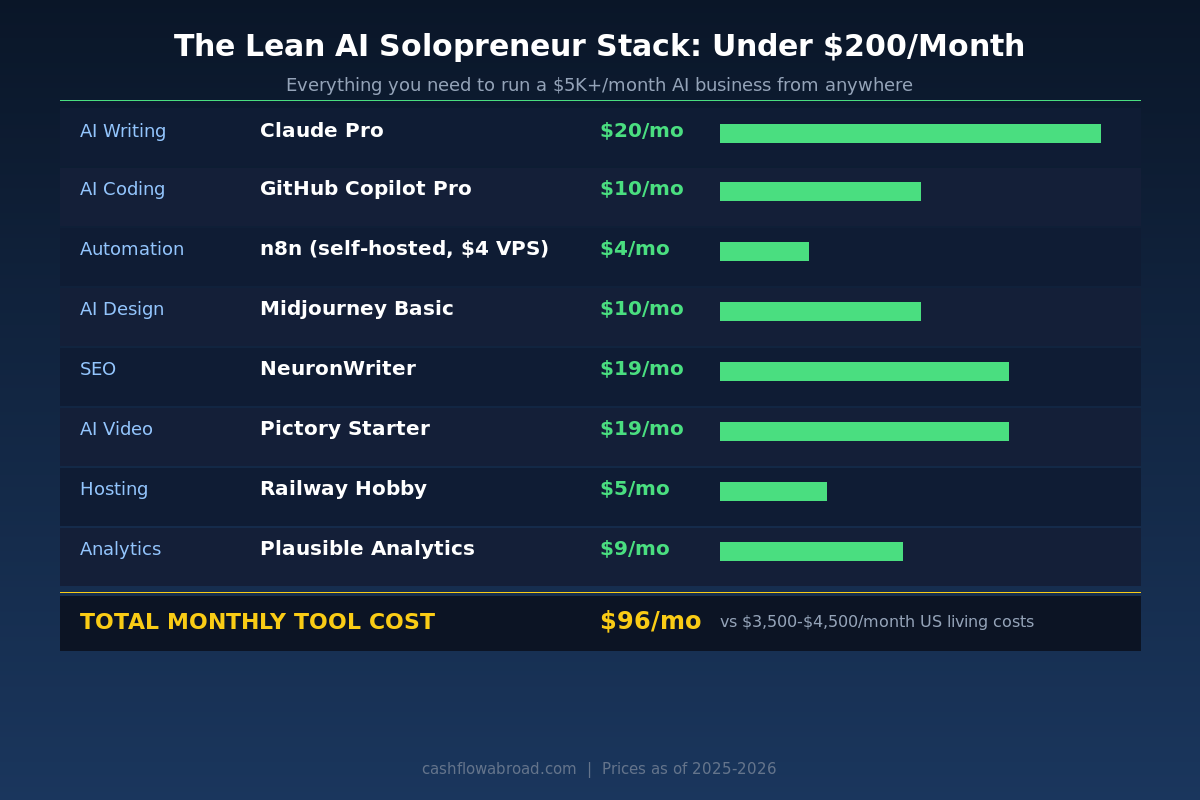
A few notes on key tool choices worth elaborating:
Claude Pro ($20/month): For writing-heavy work, Claude 3.5 Sonnet produces noticeably better long-form content than GPT-4o — fewer hallucinations, better at maintaining a consistent voice, stronger at following complex multi-part instructions. The $20/month plan handles 30–40 client deliverables per month comfortably.
n8n self-hosted on a DigitalOcean Droplet ($4/month combined): n8n is the open-source Make.com alternative. Self-hosted means unlimited workflow executions, no per-operation billing, no usage caps. A $4/month DigitalOcean Droplet (512MB RAM, 10GB SSD) handles most automation workloads. The combination gives you Make.com-level automation capability for $4 instead of $50+/month at scale. Deploy n8n in about 10 minutes:
# Deploy n8n on a $4/month DigitalOcean Droplet (Ubuntu 22.04)

# Install Node.js 20
curl -fsSL https://deb.nodesource.com/setup_20.x | sudo -E bash -
sudo apt-get install -y nodejs

# Install n8n globally
sudo npm install -g n8n

# Start n8n with basic auth protection
N8N_BASIC_AUTH_ACTIVE=true \
N8N_BASIC_AUTH_USER=admin \
N8N_BASIC_AUTH_PASSWORD=yourpassword \
N8N_HOST=0.0.0.0 \
n8n start

# For production: keep it running with PM2
sudo npm install -g pm2
pm2 start "n8n start" --name n8n
pm2 save && pm2 startup
GitHub Copilot Pro ($10/month): The budget AI coding pick. Solid autocomplete, integrates natively into VS Code. Upgrade to Cursor ($20/month) if you're building SaaS products — Cursor's "Composer" agent mode can write and modify entire files from natural language instructions. For consulting and automation work where you're scripting n8n workflows, Copilot is more than enough.
NeuronWriter ($19/month) not Surfer SEO ($99/month): NeuronWriter covers the same core functions — content brief generation, NLP keyword analysis, SERP competitor comparison — at one-fifth the price. The quality difference doesn't justify $80/month extra for a solo content operation. There's also a lifetime deal for ~$89 one-time if you want to eliminate the recurring cost entirely.
NordVPN (~$4/month on annual plan): Working from cafes and co-working spaces across three different countries means public WiFi exposure on client work. NordVPN is worth the $4/month for encrypted connections. Also useful when US-gated tools or APIs restrict access by geography.
Getting Your First Client: The 6-Week Sequence

The most common mistake: spending three weeks on a website and logo before talking to a single prospect. Here's the sequence that works:
Weeks 1–2: Build One Proof Piece
Pick one niche, pick one service, produce one high-quality sample piece for free. Examples:
- A 2,000-word SEO article targeting a specific keyword in your niche (publish on Medium or a free Ghost blog)
- A screen-recorded demo of an automation you built for a fictional company scenario
- A functional AI-powered mini-tool deployed on Vercel's free tier (even if it does one simple thing)
Post it publicly on LinkedIn with a behind-the-scenes breakdown: what tools you used, how long it took, what a client would pay for the equivalent. That post is your proof of work and it's more persuasive than a portfolio page that nobody asked for.
Weeks 2–6: Three Acquisition Channels in Parallel
Channel 1 — Upwork (fastest first dollar):
Create a profile with a laser-specific headline: "AI-Powered SEO Content for SaaS & Tech Companies" not "Content Writer | AI Expert | SEO Specialist." Apply to 5–10 proposals daily with hyper-personalized pitches — reference their specific product, one specific pain point, your one specific offer. Cold response rates on Upwork are 5–10%, so volume is everything in the first 30 days. Starting rate: $300–$500 fixed for a first project to generate a review, then raise rates.
Channel 2 — LinkedIn cold outreach:
Identify 20 ideal prospects per week using LinkedIn's free search filters (job title + company size + industry). Warm them up over 3–5 days: like their posts, leave a substantive comment. Then send a 3-sentence message: one specific observation about their business, one specific offer, one low-friction CTA ("Would a 15-min call be useful?"). Expected response rate: 5–10% cold, 10–15% after warm-up. That's 2–3 booked calls per week from 20 messages.
Channel 3 — Niche community posting (free):
Find 2–3 communities where your target clients hang out. For content services: r/entrepreneur, r/SaaS, founder-focused Slack groups. For automation: r/nocode, n8n community forums, Make.com user communities. Post value-first content — a workflow breakdown, a cost-savings calculation, a tool comparison. Never pitch directly in posts. Add a soft CTA in comments when someone asks a relevant question. One good post in the right community can generate 5–15 inbound leads.
Converting Projects to Retainers
At the 30-day mark after delivering a project: "I can keep your [content calendar / automations / SEO strategy] running and expanding for $X/month — want me to put together a one-page proposal?" Target 60–70% conversion from project to retainer. Three clients at $1,700/month = $5,100 MRR. That's the threshold.
The Delivery Automation That Keeps You at 20 Hours/Week
The difference between a solo operator at $5K/month and one at $20K/month isn't sales skill — it's how much of the delivery side is automated. Here's the system:
| Process | Manual Time | Automated With | Time Saved/Month |
|---|---|---|---|
| Client onboarding | 2 hrs/client | Tally → n8n → Notion + welcome email | ~6 hrs |
| Content production | 6–8 hrs/article | Claude API → Google Docs via n8n | ~40 hrs |
| Monthly reporting | 1.5 hrs/client | Plausible → n8n → PDF → email | ~12 hrs |
| Invoicing & billing | 30 min/client | Stripe recurring + automated receipts | ~4 hrs |
The content production automation is the biggest unlock. Here's the n8n workflow structure for AI-assisted article production via the Claude API:
// n8n workflow: Keyword request → Draft → Google Doc → Client notification

// Node 1: Webhook trigger
// Client submits via Tally form: keyword, article length, tone, target URL

// Node 2: HTTP Request → Anthropic API
POST https://api.anthropic.com/v1/messages
Headers: {
  "x-api-key": "{{ $env.ANTHROPIC_API_KEY }}",
  "anthropic-version": "2023-06-01",
  "content-type": "application/json"
}
Body: {
  "model": "claude-opus-4-6",
  "max_tokens": 4096,
  "messages": [{
    "role": "user",
    "content": "Write a 2,000-word SEO article targeting '{{ $json.keyword }}' for [niche] audience.
    Structure: hook intro (150 words), 4 H2 sections with H3 subpoints, conclusion with CTA.
    Tone: {{ $json.tone }}. Include internal link placeholder: [INTERNAL_LINK_1].
    Output clean HTML only."
  }]
}

// Node 3: Google Docs → Create doc from response
// Node 4: Gmail → "Draft ready for {{ $json.client_name }}: [doc link]"
// Node 5: Slack → #client-deliverables notification
Claude API cost breakdown: approximately $0.003/1K input tokens + $0.015/1K output tokens for Opus. A 2,000-word article generation costs roughly $0.05–$0.12 in API calls. You're billing $1,500/month for 4 articles and spending under $0.50 in Claude API costs to produce them. The margin on AI-assisted content services is absurd.
Banking for AI Solopreneurs Abroad
Two things break AI solopreneurs faster than anything else: getting paid is complicated, and US banking stops working when you leave the country.
For US-based operators or US-LLC structures: Mercury is the cleanest remote-friendly US business bank account. No monthly fees, ACH/wire/international payments, API access for automation, and a debit card that works globally. Stripe connects in minutes. If you're invoicing international clients, Mercury handles USD receipts without the conversion fees that traditional banks impose.
On the tax side: if you qualify for the Foreign Earned Income Exclusion (FEIE), the first $126,500 (2024 limit) of your foreign-earned income may be excluded from US federal income tax. The FEIE guide covers the exact qualification requirements — read it before you set up shop in a new country.
Month-by-Month: What Realistic Progress Looks Like
Here's a realistic progression for the AI content + automation consulting hybrid, starting from zero clients:
- Month 1: Tool stack configured, Upwork profile live, one proof piece published on LinkedIn. First 2–3 Upwork projects at $300–$500 each. ~$800 in project revenue. Living costs in Tbilisi or Chiang Mai: $1,200. Burning through savings, but building proof.
- Month 2: First retainer conversion at $1,200/month. LinkedIn outreach producing 2–3 calls/week. Referral from first client. ~$2,000 MRR. Breaking even in most cheap-country locations.
- Month 3–4: Three retainer clients at $1,200–$1,700/month. n8n automation handling onboarding and reporting. Deliveries taking 12–15 hours/week. ~$4,500–$5,000 MRR. First month of meaningful savings.
- Month 5–6: Four to five clients, referrals filling most new spots. First Gumroad template live (prompt pack or workflow template) adding $200–$500/month passive. ~$6,500–$8,000 MRR.
- Month 7–12: Productize service further, raise rates on new clients, start exploring a SaaS layer. $10K–$15K MRR ceiling for a 20 hr/week solo operation without hiring.
Month 1 requires real outbound hustle and you will get ignored a lot. But the economics favor you: your tool costs are $96/month, your living costs are $1,200–$1,500/month, and your first $1,500 in revenue breaks even. Every dollar above $2,700/month is either savings or reinvestment. That math is almost impossible to replicate working a W-2 job in a high-cost city.
For building the full income architecture — passive streams layered on client work — see the passive income streams guide.
The Point Is to Start
The AI solopreneur playbook isn't about being the smartest operator in the room. It's about using $96/month in tools to deliver $5,000–$20,000/month in value to clients who used to pay agencies 3–5x more for slower output. Add a cheap-country address and that income creates a savings rate that most American salaries can't match.
The first move is the same regardless of which model you pick: choose one niche, build one proof piece, and get it in front of 20 ideal prospects this week. The tools are available, the market is paying, and the barrier to entry has never been lower. The only variable is whether you start.
Financial disclaimer: Income figures cited in this post represent reported results from specific individuals and published surveys; they are not guarantees of what you will earn. AI tool pricing changes frequently — verify current pricing on each tool's official website. This post contains affiliate links; we may earn a commission if you purchase through them, at no additional cost to you. Nothing here constitutes financial, tax, or legal advice. Consult a qualified professional for your specific situation.
This guide is general information, not personalized tax, legal, or investment advice. Rules change; verify current thresholds with official sources or a qualified professional before acting.
Related guides
 AI Income & Cash FlowMay 21, 2026
Sell AI Services on Upwork: $5K/Month From Abroad
Demand for AI skills on Upwork grew 109% in 2026. Use this step-by-step guide to sell AI services and earn $5K–$10K/month while living abroad.
 AI Income & Cash FlowMay 16, 2026
The $200/Month AI Stack That Makes $10K/Month
Exact tools, real prices, 3 business models: how one-person AI businesses generate $10K/month from abroad on under $200/month in software.
 AI Income & Cash FlowMay 14, 2026
AI Affiliate Sites: Earn $5K/Month Living on $1,500 Abroad
Build an AI-powered affiliate site for under $200/month, earn $5K+/month in recurring commissions, and keep 80% by living in a low-cost country.