
A dental office in Atlanta is paying $497 a month for an AI agent that answers every call, books appointments, handles rescheduling, and never calls in sick. The freelancer who built it lives in Medellín on $1,400 a month. Setup took a weekend. His monthly cost to run that client? About $80 in platform fees.
That's an 84% gross margin, from a laptop, in a city where a furnished apartment costs $600.
AI voice agents — software that answers real phone calls, holds natural conversations, and takes action — are quietly becoming the most scalable local business service you can sell remotely. While most people are chasing AI content gigs or fighting for $30/hour on Upwork, a small group of freelancers is building recurring businesses around phone automation. The market is enormous and almost entirely untapped at the local level.
This guide covers exactly how to build, price, and sell AI voice agents to local businesses — from the tech stack to your first sales call.
Why Phone Bots Are the Right AI Business in This Moment
Here's the uncomfortable truth most small businesses deal with daily: they miss calls constantly. A dental office with two staff members fielding phones, managing patients, and handling checkout cannot pick up every call. A restaurant at noon during a lunch rush lets half their calls go to voicemail. A salon owner spending 20 minutes on hold to confirm an appointment is losing that time from somewhere else.
The numbers bear this out. According to Retell AI's 2026 data, businesses that deploy AI voice agents see missed call rates drop by 80% on average. One dental practice reported that an AI receptionist booked over $56,000 in new patient appointments in its first month — simply by answering calls that previously went unanswered. Another practice increased revenue 12%, reduced headcount 17%, and saw profits jump 24%.
Compare the costs: a human receptionist fully loaded (salary, benefits, payroll taxes) runs $2,000–$4,000/month. An AI voice agent handling equivalent inbound call volume costs $20–$150/month in platform fees. That's a 95% reduction in cost for the business owner — and your margin opportunity as the builder and operator.
Demand on the freelance side is exploding too. Upwork reported in February 2026 that demand for AI-related freelance services grew 109% year-over-year, with experienced AI freelancers in niche specializations reaching $5,000–$15,000/month.
Which Businesses Are Buying This
Not every business is a fit. You want businesses that receive high inbound call volume, have appointment-based models, currently pay for a human receptionist or lose revenue to missed calls, and have margins high enough to justify $300–$700/month. The best niches, ranked by ease of sale and willingness to pay:
| Business Type | Avg. Monthly Calls | Revenue Per Missed Call | Willingness to Pay |
|---|---|---|---|
| Dental offices | 200–600/mo | $150–$400 per new patient | Very high |
| Medical/therapy practices | 150–500/mo | $100–$300 per session | Very high |
| HVAC/plumbing/home services | 100–400/mo | $200–$800 per job | High |
| Salons and spas | 100–350/mo | $50–$200 per booking | High |
| Law firms | 50–200/mo | $500–$5,000 per client | Very high |
| Real estate agencies | 100–400/mo | $3,000–$15,000 per deal | High |
| Restaurants | 200–800/mo | $30–$100 per reservation | Medium |
Dental offices and medical practices are your easiest close. The math is obvious to them: one recovered patient call pays for six months of the service. Real estate agencies are highest-ticket — a single qualified lead booked via phone bot can generate $5,000–$15,000 in commission on the other end.
The Tech Stack: What You Actually Need
You don't need to be a software engineer to build this. You need to understand APIs at a basic level, be comfortable in a browser dashboard, and be able to write a clear system prompt. Here's the full stack:
Voice Platform (Pick One)
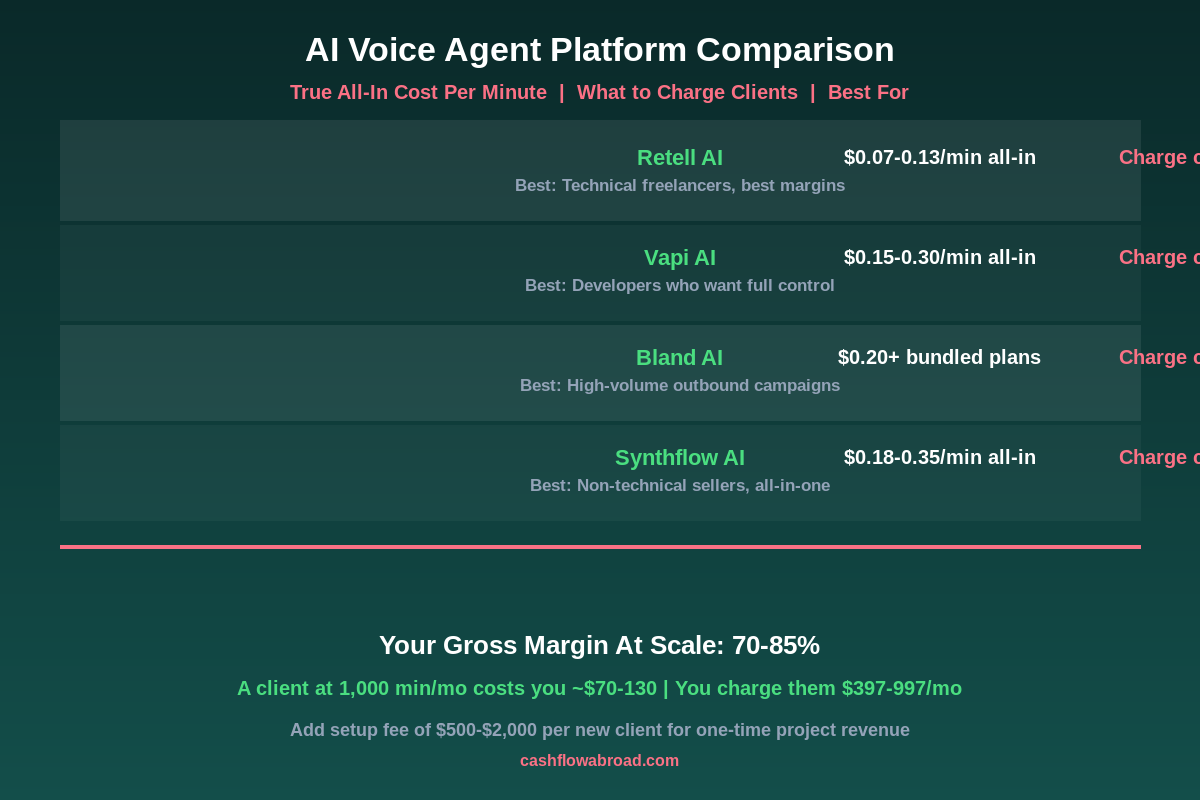
Retell AI is where most independent builders start. It bundles voice infrastructure, STT (speech-to-text), and telephony into one platform. You bring your own LLM — GPT-4o Mini at ~$0.006/min or Claude Haiku. Base rate is $0.07/min; true all-in cost runs $0.07–$0.13/min. Phone numbers are $2/month each through Retell or Twilio. At 1,000 minutes/month per client, your cost is $70–$130 while you charge $397–$697. Margins work.
Vapi AI advertises $0.05/min (platform only) but the real cost reaches $0.15–$0.30/min when you add STT, LLM, TTS, and telephony separately. More configuration flexibility, better for developers who want granular control over every layer. Slightly harder to get running fast.
Bland AI switched to plan-based pricing in December 2025. Their Build plan runs around $359/month for 500 minutes — $0.72/minute effective rate at low volumes, so it only makes sense at 3,000+ minutes/month. Best for high-volume outbound campaigns like appointment reminders and lead follow-up blasts.
Synthflow AI is the no-code option. Higher per-minute cost ($0.18–$0.35) but you can build and deploy through a visual interface without touching an API. Built-in CRM integrations and calendar connections that Retell requires custom webhooks for. Charge a premium to justify the higher platform cost.
LLM + Voice Layer
For the language model, GPT-4o Mini is the workhorse — $0.15/million input tokens, fast latency, handles conversation naturally. Claude Haiku (Anthropic) is a close alternative at similar pricing and handles multi-turn conversations well. Step up to GPT-4o or Claude Sonnet for complex use cases: law firm intake, insurance FAQs, technical service diagnostics.
For voice synthesis, ElevenLabs ($5/month starter, 30,000 characters) produces the most natural output — clients notice the difference versus generic TTS. At the $22/month Creator plan, you can clone custom voices, which some clients pay extra for ("can it sound like our actual receptionist?"). Retell and Vapi both include built-in voices that are passable at the Starter tier.
Phone Numbers and Routing
Most clients want the AI to pick up when their existing line is busy or unanswered — not replace their main number. Configure this using call forwarding rules in their existing phone system. The AI picks up on the second or third ring when no human answers. Most business phone systems (RingCentral, Google Voice, standard carriers) support conditional forwarding out of the box.
Alternatively, provision a dedicated number through Retell's built-in Twilio integration ($2/month) and use it as the business's primary published line. Cleaner setup, more control. Twilio also supports SIP trunking for businesses with existing PBX systems.
Backend (Optional — Unlocks Higher Pricing)
For basic FAQ and appointment capture bots, you need zero backend infrastructure. But calendar integrations (Calendly, Google Calendar, Acuity Scheduling, Jane App) and CRM updates require a small webhook server. A $6/month DigitalOcean droplet running Node.js or Python Flask handles this for 20+ clients. Deploy once, reuse the pattern across clients. This is what separates $297/month builds from $797/month builds — calendar sync and CRM integration commands pricing premiums because it eliminates the business's manual follow-up step entirely.
How to Build Your First Agent (Step by Step)
Using Retell AI and a dental office as the example. Total build time for a complete, production-ready agent: 4–8 hours.
Step 1: Create Your Retell Account and Add a Number
Sign up at retellai.com. Add $50 in credits. Navigate to Phone Numbers → Buy Number. Select a local number in the client's area code ($2/month). This becomes the forwarding destination for the client's existing phone line.
Step 2: Create a New AI Agent
Agents → Create Agent. Choose your LLM (GPT-4o Mini works for most appointment-booking use cases). Select a voice — preview several. "Aria" from ElevenLabs and "Josh" test well for healthcare contexts. Warm but professional. Avoid voices that sound overtly robotic; clients will notice on the first week of calls.
Step 3: Write the System Prompt
This is where the craft is. A strong system prompt gives the agent its identity, its goals, the business facts it needs to know, and explicit handling for edge cases. Here's a condensed working example:
You are Sophie, the virtual receptionist for Bright Smile Dental in Atlanta, GA.
Your job: greet callers warmly, answer common questions, and collect information
to book new appointments or reschedule existing ones.

OFFICE HOURS: Monday–Friday 8am–6pm, Saturday 9am–2pm. Closed Sunday.
SERVICES: General cleanings, fillings, crowns, teeth whitening, Invisalign consults.
BOOKING: Collect caller's full name, best callback number, preferred day/time,
  and reason for visit. Confirm: "We'll call you within 2 hours to finalize."
INSURANCE: "We accept most major plans — our team will verify yours before your visit."
EMERGENCIES: Pain or urgent issue → "Please call our emergency line at [number]
  or visit urgent care. I want to make sure you get seen right away."
DO NOT discuss pricing. Route those questions: "Our team will go over costs with you."
Plan for 2–3 test iterations before the conversation flows naturally. Call the number yourself and role-play as different caller types: the rushed caller, the elderly person unfamiliar with automated systems, the person who changes what they want mid-conversation. Each failure teaches you what to add to the prompt.
Step 4: Configure Call Routing
Work with the client to enable conditional forwarding on their main line: rings twice → forwards to your Retell number if unanswered. The AI picks up on the third ring. From the caller's perspective, it's seamless — they're talking to the dental office, just with a very patient, always-available receptionist.
Step 5: Connect the Calendar (Charges Extra)
Use Make.com (free tier supports 1,000 operations/month) or n8n (self-hosted on your DigitalOcean server, free) to connect appointment intents to the client's booking system. Retell supports webhooks that fire when the agent captures specific variables (caller name, requested time, service type). The webhook triggers a Make.com scenario that creates a draft booking in Acuity or Jane App, which the front desk confirms and sends an SMS reminder. Build this once per booking system type, reuse it across all clients on the same platform. Charge $100–$200/month more for this integration.
How to Price Your Service
Price by value delivered, not by hours spent. The business owner's frame is: "one recovered call covers months of the service." Build your pricing around that math.
| Tier | What's Included | Setup Fee | Monthly Retainer |
|---|---|---|---|
| Starter | AI agent, FAQ + appointment capture, built-in voice | $750 | $297/mo |
| Professional | All Starter + ElevenLabs voice, calendar integration, SMS confirmations | $1,200 | $497/mo |
| Premium | All Professional + CRM integration, email call summaries, monthly prompt optimization | $2,000 | $797/mo |
Never skip the setup fee. It covers your build time and creates a psychological anchor — clients who pay $1,200 upfront take the onboarding seriously, share business info promptly, and stick around. Month-to-month-only clients churn at twice the rate.
When clients push back on price: "If this bot recovers just two missed dental appointments per month, that's $300–$800 in revenue you're currently losing. The bot pays for itself from week one." Most business owners get it immediately. For the ones who don't, offer a 14-day free trial with no setup fee, then full pricing after. Your conversion rate on trials will be above 70% if the bot is working correctly.
Finding Your First 5 Clients
Here's the fastest market research you'll ever do: call 20 dental offices during business hours and count how many don't answer. In most US markets, 30–50% of small business calls go to voicemail. That's your pitch, handed to you.
Cold email with a Loom video: Record a 2-minute demo of a fictional "Sample Dental Practice" agent handling a call. Your email subject: "I built an AI receptionist for dental offices — 2-min demo." Conversion rate to a booked call: 8–15%, which is exceptional for cold outreach. No tech jargon. Lead with: "It answers every missed call and books appointments automatically."
Google Maps prospecting: Search "[city] dental office." Sort by recent reviews. Look for reviews mentioning "hard to reach," "went to voicemail," or "never got a call back." Those businesses have a demonstrated problem and paying customers who've noticed it. These are your warmest leads.
Partner with digital marketing agencies: Agencies serving local businesses already have trust relationships with 10–50 clients each. Offer a 20% referral commission per closed client. One productive agency partner can send you 3–5 clients a month consistently. Pitch it as a new revenue stream they can offer their existing clients without doing any technical work.
Local business Facebook groups: Offer to build a free 7-day trial for one business in the group in exchange for a public testimonial. Do this in two cities and you have social proof that converts paid outreach.

The Geographic Arbitrage Math
Your clients are in Atlanta, Chicago, Austin, Miami. They pay US prices. You live somewhere it costs $1,200–$1,800/month to live extremely well. The work is almost entirely async — client calls happen maybe once a month per account, otherwise you're handling email and making small prompt adjustments.
Here's what 10 clients at the Professional tier looks like:
| Revenue / Cost | Monthly |
|---|---|
| 10 clients × $497/mo | $4,970 |
| Platform costs (Retell, avg 1K min/client): ~$100/mo × 10 | −$1,000 |
| ElevenLabs + Make.com + misc tools | −$80 |
| DigitalOcean webhook server | −$12 |
| Net monthly profit | $3,878 |
Add setup fees: two new clients/month at $1,200 setup = $2,400 extra. By month 6 with 10 retained clients plus new ones rolling in, you're clearing $6K–$8K/month. In Medellín or Chiang Mai, that's a genuinely luxurious life.
For banking, Mercury is the standard US business account for remote operators — no monthly fees, excellent international wire support, and it accepts account applications from business owners living overseas. Pair it with a Traveling Mailbox for a US registered address, which you'll need for LLC formation, business banking, and client invoicing that doesn't raise eyebrows.
If you're considering where to base yourself, Colombia is hard to beat for this business model — strong co-working infrastructure, excellent internet (gigabit fiber is standard in major cities), a large expat tech community in Medellín and Bogotá, and a digital nomad visa that covers stays up to two years. The full guide to Colombia's digital nomad visa covers every step of the application. Use NordVPN when working from cafes or shared spaces — client call data passes through your connection and basic operational security matters, especially for healthcare-adjacent clients.
For the broader strategic framework on building a location-independent business, the geographic arbitrage playbook covers 10 countries where the earning-to-living cost ratio works best.
Scaling Past $10K/Month
At 20+ clients, you have two paths: hire a virtual assistant to handle client onboarding and tier-1 support ($600–$900/month for a skilled VA in Latin America or the Philippines), or productize the whole thing.
The productized path is the bigger play. Build a white-label interface on top of Retell's API where clients log in, see their call logs, update their business hours, and manage their subscription — without calling you. Charge $297–$497/month at essentially zero marginal labor per client. This requires actual development (Python or Node.js backend, basic frontend), but with Cursor or Claude Code as your coding assistant, a non-professional developer can ship a working MVP in 2–4 weeks.
Several solo builders are already doing this at $50K–$100K ARR with 12–18 months of compounding. The ceiling for a solo operator before you need to systematize is somewhere around $20K–$25K/month. The structure of how a solo online business scales past $100K applies directly here.
What to Watch Out For
Healthcare clients and HIPAA: Any system capturing patient information in the US falls under HIPAA. Retell AI and Vapi both offer Business Associate Agreements (BAA). Get it signed before going live with any medical or dental client. This is a real liability, not a technicality.
Churn management: Expect 5–10% monthly churn early on. Common causes: the business owner doesn't feel the ROI, they hired a human receptionist, or the bot had an awkward call that frustrated a patient. Handle this proactively — send monthly call summaries highlighting recovered calls and estimated recovered revenue. Make the value concrete every 30 days.
Platform risk: Your recurring revenue depends on Retell, Vapi, or Bland staying solvent and not repricing. Keep system prompts, client contact lists, and call logs backed up externally. If a platform reprices 3x (it has happened in AI), you need to migrate clients within 30 days.
Difficult callers: AI voice agents struggle with heavy accents, very long rambling calls, and callers who change their request mid-conversation. Build graceful escalation into every prompt: "I want to make sure we handle this correctly — let me have one of our team members call you back within the hour." Train clients upfront to expect 5–10% escalation to humans. That's not a failure; it's the system working.
Getting Started This Week
- Sign up for Retell AI (free; pay only for call minutes used)
- Build a demo agent for a fictional "Sample Dental Office" — make it polished
- Record a 2-minute Loom showing a real call conversation with the demo
- Email 50 dental offices in a high-cost US city (NYC, SF, Boston, Chicago) with your Loom link
- Offer a free 14-day trial with no setup fee to your first two clients
- After the trial, move to $1,200 setup + $497/month for all new clients
The skills that matter here are system prompt writing and sales — not engineering. If you can write a clear instruction set and make a persuasive phone call, you can build this business. The technology is already built. The clients are already losing money to missed calls. The gap between those two facts is your business.
Bottom Line
AI voice agents represent one of the cleaner business opportunities in the current wave: high recurring revenue, sticky clients who see obvious ROI, low overhead, and fully location-independent operations. The technology is mature enough to sell reliably but obscure enough that most local markets have near-zero competition. A dental office in Toledo, Ohio probably has no one pitching them phone bots right now — and won't for another 12–18 months.
That window won't stay open forever. Once the major phone system providers bundle this into their existing services at commodity prices, the margin opportunity compresses. The time to build recurring revenue — and the client relationships that make churning vendors difficult — is before the incumbents arrive.
Build the demo. Send the emails. Get the first client. The business compounds from there.
Disclaimer: Income figures cited represent realistic ranges based on available market data and are not guaranteed. Actual earnings depend on client acquisition effort, market conditions, and execution quality. Platform pricing is subject to change — verify current rates directly with Retell AI, Vapi, Bland AI, and Synthflow before building your pricing model. This post contains affiliate links; we may earn a commission at no extra cost to you.