Build AI Micro-SaaS Abroad: $8K/Month Solo
Build a profitable AI micro-SaaS product from abroad using tools under $200/month. Real stack, real prices, and the geographic arbitrage math that makes it viable.
How to build a profitable AI micro-SaaS from abroad for under $200/month in tools. Real stack, pricing, and income timeline for solo founders.
Disclosure: this article contains affiliate links. If you open an account through one of them, Cashflow Abroad may earn a referral commission at no extra cost to you.
In Q1 2026, 34% of newly launched micro-SaaS products were built by founders with zero prior programming experience. Some of them are generating $5,000 to $50,000 in monthly recurring revenue. The entire tool stack to run one of these businesses costs under $200 a month. And if you're running that business from Medellín or Tbilisi instead of San Francisco, your break-even point drops so low it becomes almost irrelevant.
That's the AI micro-SaaS arbitrage most people are still sleeping on: not just building a software product, but building it at a fraction of the cost — and living at a fraction of the cost — while selling to the same high-income Western markets as every overheated startup in a coworking space in SOMA.
This is not a "think piece" about AI changing the world. It's a practical guide to picking a product, building it with today's AI tools, pricing it correctly, and creating recurring revenue you can run from anywhere with a stable internet connection.
What Is AI Micro-SaaS, Exactly?
Micro-SaaS is a software-as-a-service product built and run by one or two people, targeting a narrow niche with a specific problem, priced at $10 to $200/month per customer. Unlike traditional startups, there's no VC, no 40-person team, no office lease. The goal is $3,000 to $30,000 MRR with 70%+ profit margins — not a $1B exit.
The "AI" part means one of two things: either the product itself uses AI to deliver value (think: an AI tool that rewrites Airbnb listing descriptions, or analyzes customer reviews and surfaces product improvement ideas), or you used AI to build the thing much faster than you could have otherwise.
Both matter. A solo founder in 2026 can now ship a working SaaS product in 2 to 4 weeks that would have taken a 3-person team 6 months in 2021. That compression is the entire opportunity.
Picking a Niche That Actually Sells
The graveyard of failed micro-SaaS is littered with "AI writing tools" and "chatbot builders." The market is saturated at the generic level. You need to go narrow — a specific industry with a specific, painful, recurring problem that people are currently solving manually or with something that barely works.
Niches that are validated and working in 2026:
- Local service businesses — landscapers, HVAC companies, plumbers who need AI-assisted follow-up emails, estimate builders, and review management. One founder hit $6,700 MRR in Q4 2025 selling to kitchen appliance repair shops at $75/month per customer — 89 paying users.
- E-commerce operators — Shopify and WooCommerce sellers who need AI product description generators, automated customer response tools, or inventory alert systems tailored to their platform.
- Real estate agents and property managers — AI listing copy generators, tenant screening email drafts, maintenance request triage tools.
- Podcasters and content creators — show note generators, transcript-to-blog converters, social clip auto-taggers.
- SaaS companies themselves — onboarding email sequence generators, changelog writers, support ticket classifiers that route by urgency and topic.
The pattern: pick a category of business that (a) has recurring cash flow, (b) spends money on software already, and (c) has a pain point that can be solved by automating something they do manually today. You're not selling innovation — you're selling saved time.
The Complete Tool Stack (Real Prices)
This is where the math gets interesting for expats. Your monthly operating costs for a real, customer-facing AI micro-SaaS product are far lower than most people expect.
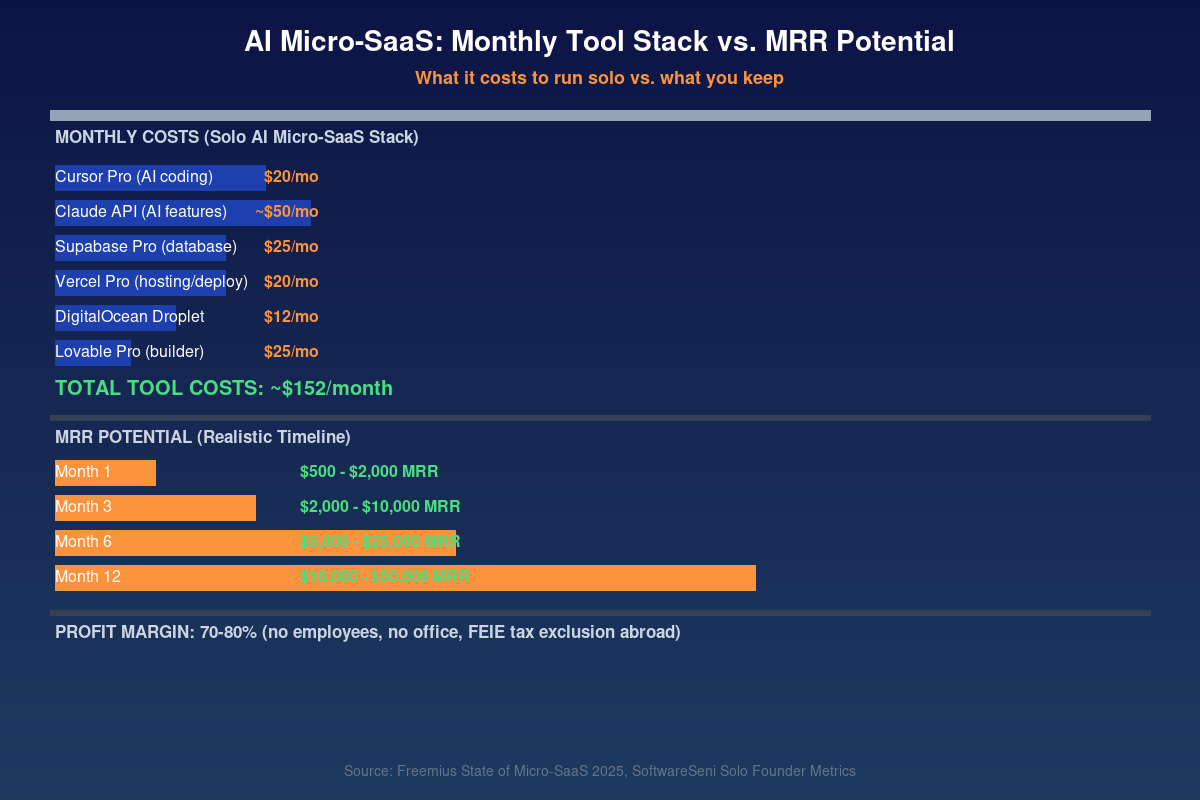
| Tool | Purpose | Monthly Cost | Notes |
|---|---|---|---|
| Cursor Pro | AI-assisted coding (VS Code fork) | $20 | Best for devs; integrates Claude 4.6 and GPT-4o in-editor |
| Lovable Pro | No-code AI app builder | $25 | Best for non-technical founders; ships full-stack apps from prompts |
| Claude API (Haiku model) | AI features inside your product | ~$30–80 | $1/M input tokens, $5/M output — cheapest capable model for production |
| Supabase Pro | Database + auth + file storage | $25 | Postgres under the hood; free tier fine for early testing |
| Vercel Pro | Frontend deployment + serverless | $20 | Zero-config Next.js deploys; free tier works until real traffic |
| DigitalOcean Droplet | VPS for backend/scheduled jobs | $12 | Basic droplet; scales as revenue scales |
| Stripe | Payments + subscriptions | 2.9% + $0.30/tx | No monthly fee; handles recurring billing automatically |
Total fixed monthly cost: ~$152 to $182 depending on whether you use the no-code or code path — plus usage-based API costs that scale with customer activity. At $75/month per customer, you break even at 3 customers. At $50/month, you need 4. Almost every viable niche has at least a handful of people who will pay immediately once the product works.
For the VPS layer, DigitalOcean is the right call once you have any kind of Python backend, cron jobs, or long-running queue workers. A $12/month Basic Droplet handles these cleanly without the cold-start latency issues of serverless functions — and it won't surprise you with a $400 bill if something loops unexpectedly.
Build Path 1: No Code (Lovable + Bolt)
Lovable (lovable.dev) and Bolt (bolt.new) are the two best no-code AI app builders as of mid-2026. Both generate full-stack applications — frontend, backend, database schema, auth flows — from natural language prompts. Both connect to Supabase natively for data persistence and user management.
The difference: Lovable has better UX polish, GitHub sync for full code ownership, and cleaner Stripe integration. Bolt is faster for initial prototyping and handles edge cases better in complex UI logic. Both are $25/month at the Pro tier.
The step-by-step workflow for a non-technical founder:
- Write a detailed product spec in plain English. Example: "Build a web app where real estate agents paste in a property description and get 5 AI-generated MLS listing variations, with a history of past generations, a copy button, and a download-as-PDF option."
- Paste this into Lovable. It generates a working app in 3 to 8 minutes.
- Connect Supabase in two clicks for user authentication and data storage.
- Connect your Anthropic API key — use Claude Haiku for cost efficiency, Claude Sonnet 4.6 for higher-quality outputs when the price difference matters.
- Test with 10 to 20 real users before touching payment integration. Validate that people actually use it.
- Add Stripe via Lovable's built-in payment module. Set a monthly subscription price.
The full build for a focused MVP takes 2 to 5 days for a first-time founder. No code written manually. The result is a real, deployed web application with user accounts, persistent data, and a working payment flow.
Build Path 2: With Code (Cursor + Next.js)
Cursor Pro at $20/month has the best ROI in software development right now. It's a VS Code fork that uses Claude 4.6 and GPT-4o as pair programmers in context of your entire codebase — not just autocomplete, but full "write this entire feature" reasoning conversations.
The stack that solo founders are shipping on:
# Bootstrap the project
npx create-next-app@latest my-saas --typescript --tailwind --app
cd my-saas

# Core dependencies
npm install @supabase/supabase-js @supabase/ssr
npm install stripe @stripe/stripe-js
npm install @anthropic-ai/sdk
From there, you describe what you need in Cursor's AI chat — "add a route that accepts a property description, calls Claude Haiku with this system prompt, and returns 5 listing variations" — and it writes the component, API route, and error handling. A developer with intermediate JavaScript skills can ship a working SaaS MVP in 7 to 14 days this way, compared to 6 to 12 weeks without AI assistance.
For the AI feature layer, Claude API pricing for production use: Haiku is $1.00 per million input tokens and $5.00 per million output tokens. For most micro-SaaS workloads — summarization, content generation, classification — a customer using your tool 20 times a day costs you under $0.10 in API fees. At $49/month subscription, your gross margin stays above 85% even at scale.
Pricing, Launch, and First Customers
Most first-time micro-SaaS founders underprice by 3x. If your tool saves a real estate agent 45 minutes per listing and they write 8 listings a month, you're saving them 6 hours. At their billing equivalent of $100/hour, that's $600 in value created monthly. Charging $49/month is almost insulting. Price at $79 to $149 — B2B buyers interpret price as a signal of quality, not a barrier.
| Payment Processor | Fee per Transaction | VAT Handling | Best For |
|---|---|---|---|
| Stripe | 2.9% + $0.30 | Manual (you handle) | US-only customer base; technical founders |
| Lemon Squeezy | 5% + $0.50 | Automatic (MoR) | EU/global customers; non-technical founders |
| Gumroad | 10% flat | Automatic (MoR) | Simple products; built-in discovery audience |
| Paddle | 5% + $0.50 | Automatic (MoR) | Scale-stage SaaS with complex billing needs |
For most early-stage AI micro-SaaS products targeting US customers, Stripe is cleanest. If you're selling internationally with European customers, Lemon Squeezy acting as Merchant of Record handles VAT across 40+ countries automatically — one less compliance headache when you're already managing an international lifestyle.
Launch channels that actually convert in 2026:
- Reddit — Find the subreddit for your target customer (r/realestate, r/ecommerce, r/airbnb, r/freelance). Post a genuine "I built this — roasting welcome" thread with a free trial offer. Authenticity works; promotional tone gets downvoted into oblivion.
- Product Hunt — Still drives real signups if you crack the top 5 for the day. Line up 50 engaged supporters before launch day; the algorithm compounds from there.
- Cold email — Find 200 businesses in your niche via LinkedIn or Apollo. Three-sentence pitch with a free trial. A 2% conversion rate at $75/month is $300 MRR from one morning's work.
- Industry Facebook groups and Slack communities — Be genuinely helpful for 2 weeks before mentioning your product. Pattern-match to what's already discussed; frame your product as a solution to specific complaints you've seen raised.
Why Building Abroad Changes the Math Entirely

A micro-SaaS founder in Austin, Texas with $5,000 MRR and $182/month in tool costs nets roughly $3,500 after self-employment taxes and a basic cost of living. Comfortable. But a single bad month, a customer churn spike, or an unexpected expense creates real stress.
The same founder living in Medellín, Colombia has $1,200 to $1,800/month in total living expenses — a good apartment, food, coworking space, and occasional travel included. After tools and taxes, they're clearing $2,800 to $3,500 per month with zero financial pressure, and they could sustain a 40% revenue drop for 6 months without depleting savings.
| Location | Monthly Living Cost | At $3K MRR | At $5K MRR | At $10K MRR |
|---|---|---|---|---|
| Austin, TX (US) | $3,500–4,500 | Tight | Comfortable | Good |
| Medellín, Colombia | $1,200–1,800 | Comfortable | Very comfortable | Exceptional |
| Chiang Mai, Thailand | $1,000–1,500 | Comfortable | Wealthy | Exceptional |
| Tbilisi, Georgia | $800–1,200 | Very comfortable | Wealthy | Exceptional |
| Lisbon, Portugal | $1,800–2,500 | Tight | Comfortable | Very comfortable |
The geographic arbitrage model converts a $5K/month micro-SaaS from "decent side income" into financial independence. The product, the customers, and the revenue don't change. The purchasing power of that revenue changes by 2x to 4x depending on where you live. That difference in purchasing power translates directly into extended runway, lower stress, and the patience to iterate on a product until it actually works — which is the actual secret to surviving the first year of micro-SaaS.
Setting Up the US Business Infrastructure From Abroad
Most internationally mobile micro-SaaS founders keep a US LLC for customer confidence, clean Stripe access, and straightforward US banking. You can form a Wyoming or Delaware LLC remotely for $50 to $150 through Stripe Atlas, Northwest Registered Agent, or similar services.
For banking, Mercury is the standard choice for expat founders — it's a US-based business checking account you can open 100% remotely, no branch visit required. Connects directly to Stripe for payouts and handles ACH and wire transfers to international accounts cleanly.
You'll need a US mailing address for LLC registration, IRS correspondence, and many banking requirements. Traveling Mailbox gives you a real US street address, scans incoming mail, and forwards anything important — IRS notices, state filings, bank statements — digitally wherever you are. Starting at $15/month, it's one of the most useful expat infrastructure tools available. More on this in the full expat virtual mailbox guide.
One practical note on connectivity: when operating internationally, a reliable VPN matters for accessing US banking portals consistently, testing geo-specific product behavior, and reaching certain US-gated SaaS platforms. NordVPN at ~$4 to $5/month (annual plan, 10 simultaneous devices) handles this without the unreliability issues common to cheaper alternatives.
For a deeper look at operating a US entity while abroad, the guide to running a US business from Colombia covers the same mechanics that apply to most expat locations.
Realistic Income Timeline
Based on Freemius 2025 data and SoftwareSeni's solo founder metrics analysis, here's the median progression for a micro-SaaS that has genuine product-market fit — not the Twitter highlight reel:
- Month 1: $500 to $2,000 MRR — first 5 to 20 paying customers from personal network, Reddit launch, or Product Hunt
- Month 3: $2,000 to $10,000 MRR — word of mouth activates, cold outreach at scale, first affiliate or integration partnerships
- Month 6: $5,000 to $25,000 MRR — SEO begins contributing, customer referrals compound, potential AppSumo or marketplace placement
- Month 12: $10,000 to $50,000 MRR — established product with strong retention, possible adjacent niche expansion
The real failure rate in this space is significant — around 70% of micro-SaaS never reach $1,000 MRR. But the failure mode is concentrated in specific patterns: wrong niche (no real pain), wrong pricing (too cheap to be taken seriously), or giving up before month 3 (before any SEO or word-of-mouth compounds). The structural advantage of operating from a low-cost country is extended runway. You can outlast competitors who are burning savings faster than they're building traction. Staying alive until the product clicks is the actual competitive strategy.
Profit margins for micro-SaaS done right hit 70% to 80% — no employees, no office, no inventory. At $10,000 MRR with a 75% margin, you're netting $7,500 a month from a laptop. Living in Tbilisi or Chiang Mai, that's genuine financial independence by almost any definition.
Where to Start This Week
The single most useful thing you can do in the next 48 hours: identify one industry you understand or have contacts in, write down the three most painful recurring tasks people in that industry do manually, and ask which one could be solved by a well-prompted LLM with a clean UI. That's your product idea.
Then spend $25 on Lovable Pro and build a prototype. Not a pitch deck — a working thing. Show it to 10 people in the target industry before spending another dollar. If three of them ask how to pay for it, you have a product. If none of them get excited, pick a different problem.
The AI tools exist. The infrastructure is affordable. The customers exist and are spending money on worse solutions. The geographic arbitrage advantage is real and accessible. The only remaining variable is execution: picking a real, specific problem and shipping something that reliably solves it.
Conclusion
AI micro-SaaS is one of the few income models where the inputs — a laptop, internet, and $150 to $200/month in tools — are genuinely accessible from anywhere, and the outputs — recurring software revenue — scale in ways that hourly freelance work cannot. Combined with the cost-of-living advantages of building from Southeast Asia, Eastern Europe, or Latin America, it's a model that creates financial independence at revenue levels that would barely cover rent in a US city.
The window won't stay this wide indefinitely. AI coding tools will commoditize further, which means more competition at the niche level. Founders who build now, while barriers are real enough to discourage casual entrants, accumulate the brand equity, customer base, and distribution advantages that late movers will spend years trying to replicate.
Financial disclaimer: This article is for informational purposes only and does not constitute financial, legal, or tax advice. Revenue figures cited reflect reported data from third-party sources and individual results vary significantly based on product, market, execution, and effort. Consult a qualified professional regarding your business structure, tax obligations, and international compliance requirements.
This guide is general information, not personalized tax, legal, or investment advice. Rules change; verify current thresholds with official sources or a qualified professional before acting.
Related guides
 AI Income & Cash FlowMay 21, 2026
Sell AI Services on Upwork: $5K/Month From Abroad
Demand for AI skills on Upwork grew 109% in 2026. Use this step-by-step guide to sell AI services and earn $5K–$10K/month while living abroad.
 AI Income & Cash FlowMay 16, 2026
The $200/Month AI Stack That Makes $10K/Month
Exact tools, real prices, 3 business models: how one-person AI businesses generate $10K/month from abroad on under $200/month in software.
 AI Income & Cash FlowMay 14, 2026
AI Affiliate Sites: Earn $5K/Month Living on $1,500 Abroad
Build an AI-powered affiliate site for under $200/month, earn $5K+/month in recurring commissions, and keep 80% by living in a low-cost country.