AI Digital Products: The $5K/Month Passive Income Blueprint
Easlo — a solo creator with no team, no venture funding, no massive Twitter following — made over $300,000 selling Notion templates in a single year.
Easlo — a solo creator with no team, no venture funding, no massive Twitter following — made over $300,000 selling Notion templates in a single year.
Easlo — a solo creator with no team, no venture funding, no massive Twitter following — made over $300,000 selling Notion templates in a single year. His entire product catalog was a collection of database pages that took maybe 15 hours to build total. He didn't manufacture anything, hire anyone, or ship a single box. He did most of this work while living cheaply in Southeast Asia, where $300K USD buys a lifestyle most Silicon Valley employees can't afford.
That's the core thesis of AI-powered digital products as an expat income stream: zero marginal cost, immediate delivery, global market, no physical presence required. AI tools now cut product creation time by 70–80%, so the barrier to entry has essentially collapsed. You don't need to be a developer or a designer. You need to understand what problems people will pay $19–$49 to solve, then create the solution once and sell it indefinitely.
This guide breaks down exactly which product types work, where to sell them, how much you'll actually make, and the minimal tool stack that gets you live within a weekend.
Why Digital Products Work Especially Well for Expats
Most remote income strategies still require active hours — you consult, you deliver, you invoice. Digital products break that link entirely. One Gumroad listing you build on a Tuesday afternoon in Medellín or Chiang Mai can generate sales at 3 AM while you're asleep, in USD, paid instantly.
The geographic arbitrage math here is brutal in your favor. A product priced at $29 sells to customers in the US, UK, and Canada who barely blink at that price. You spend $1,200–$1,800/month on rent, food, and a coworking space in a low-cost city. Sell 170 copies of a $29 template per month — doable after month 6 with proper distribution — and you're clearing $5,000/month. That's $60,000/year, working a handful of hours weekly.
For US expats specifically, combine this with the Foreign Earned Income Exclusion and you may owe zero federal tax on the first $126,500 (2024 limit). Digital product income qualifies as earned income when you're actively creating and managing the business. And unlike consulting income, your earning doesn't stop when you stop working.
The Three Product Categories Worth Your Time
1. Notion Templates: The Beginner's On-Ramp
The Notion template market now exceeds $50 million annually across Gumroad, Etsy, and direct sales. Buyers are freelancers, small business owners, and startup teams who want to skip the setup work and just use a polished system. They'll pay $15–$49 for a CRM template, a project tracker, a client onboarding hub, or an editorial calendar — things a competent person can build in Notion in 2–4 hours, especially with Claude helping structure the databases and write the documentation.
Realistic earnings trajectory based on actual creator data:
- Month 1–2: $50–$400 (1–2 templates, limited traffic)
- Month 3–6: $600–$2,000 (3–6 templates, ranking on Etsy/Gumroad search)
- Month 6–12: $2,000–$5,000+ (10+ templates, bundles, email list)
Nick Lafferty made $80,000 in 12 months. One creator reported $847 in their first 30 days from just three templates. The ceiling is real: Easlo's $300K/year is not a one-in-a-million outcome — it's what happens when you pick high-demand niches, build a catalog, and let marketplace algorithms compound.
What sells best right now: freelancer CRM templates ($25–$49), content planning dashboards ($19–$35), business finance trackers ($29–$49), and client portal templates ($39–$59). Avoid generic "life dashboard" templates — they're saturated. Go niche: a Notion template specifically for wedding photographers, or a project tracker built for web development agencies, will convert 3–4x better than a generic productivity template.
2. AI Prompt Packs: Lowest Effort, Highest Volume
PromptBase hosts over 260,000 prompts and still moves serious volume. The platform takes 20% commission, individual prompt prices run $1.99–$9.99, and — critically — you can sell via referral link at 0% fees once you've completed 5 sales. Their Creator ($19/mo) and Pro ($39/mo) plans unlock even lower marketplace fees for high-volume sellers.
But the real money isn't individual listings — it's prompt packs and libraries bundled on Gumroad or Etsy. A 50-prompt pack for real estate marketing professionals at $29. A 100-prompt library for e-commerce product descriptions at $39. A ChatGPT system prompt bundle for consultants at $49. These sell on search traffic alone, with no audience required.
The key insight most sellers miss: prompts that solve a specific professional workflow dramatically outperform generic "productivity" packs. A "LinkedIn content calendar prompt bundle for B2B SaaS founders" outsells "100 ChatGPT prompts for business" at the same price, because it answers a specific search query from someone with a specific problem and a credit card.
3. n8n and Make Workflow Templates: Premium Price Points
This is the highest-paying category and the most underexploited. Pre-built automation workflows for n8n or Make that solve specific business problems sell for $47–$197, sometimes more. A workflow that automatically scores inbound leads from a CRM, summarizes them with AI, and routes them to the right salesperson is worth $97 to a startup — that's a trivial price versus the outcome it delivers.
n8n is particularly powerful here because it's open-source and self-hostable. You can host your own n8n instance on DigitalOcean for $6/month on a basic droplet, which doubles as your testing environment for workflows you sell. The cloud version starts at $20/month if you prefer managed infrastructure.
Real income: creators building and selling n8n workflows report $3,000–$8,000/month at the higher end, with individual workflows at $47–$197. One creator documented $4,200 total in their first four months — not explosive, but that's the ramp-up phase before the catalog compounds. The workflows that sell consistently are ones that connect AI tools to business outcomes: lead qualification, content publishing pipelines, customer support triage, invoice processing.
Platform Breakdown: Where to Sell and What It Costs You
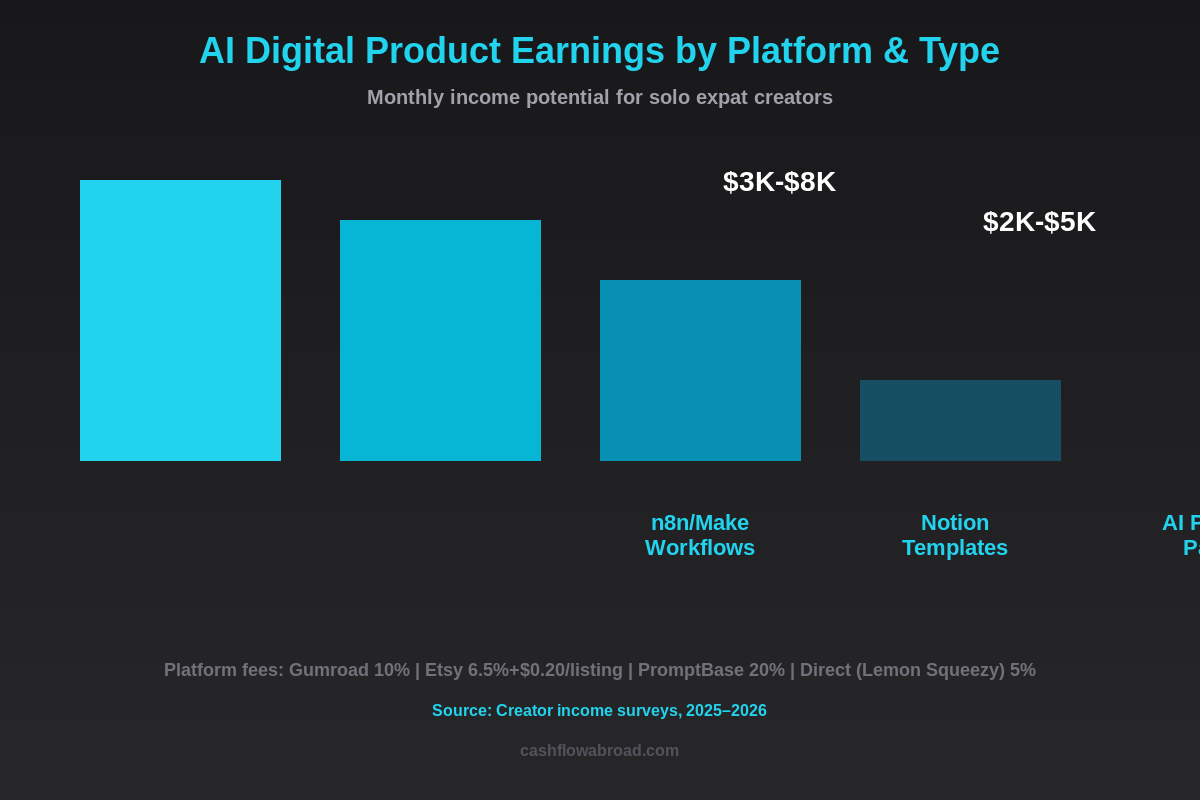
| Platform | Fee Structure | Best For | Built-In Discovery |
|---|---|---|---|
| Gumroad | 10% + 2.9%+$0.30 | Notion templates, prompt packs, courses | Limited |
| Etsy | 6.5% + $0.20/listing | Notion templates, Canva templates, printables | Strong SEO traffic |
| PromptBase | 20% (0% via referral after 5 sales) | Individual prompts, prompt collections | Strong marketplace |
| Notion Marketplace | 0% | Notion templates (links to your Gumroad) | Yes — free listing |
| Lemon Squeezy | 5% + $0.50 | Higher-priced workflow templates, SaaS add-ons | None (bring traffic) |
The distribution strategy that maximizes revenue: list on Etsy for organic search traffic and Gumroad for the storefront/brand. Mirror PromptBase listings as bundles on Gumroad at 3–5x the per-prompt price. For workflow templates priced $47+, use Lemon Squeezy to cut fees by roughly half versus Gumroad.
A genuine benefit for expats: Gumroad became a Merchant of Record on January 1, 2025, meaning they now handle all sales tax collection and remittance worldwide. That's a material compliance relief when you're selling to EU customers with their complex VAT requirements — one less thing you need to manage from a hammock in Bali.
Build Your First Product in 4 Hours: The Exact Workflow
This is the step-by-step workflow for a Notion template — the fastest path from zero to first sale.
Hour 1: Research the niche
Open Etsy and search "Notion template [profession]." Sort by Best Sellers. Find products with 200+ sales. Read the reviews obsessively — what do buyers love, and what do they wish was included? That gap is your product. Don't reinvent what's selling; improve on it with what buyers are explicitly asking for in the reviews.
Hour 2: Build with Claude
Give Claude Pro your research findings and prompt it to design the full Notion database structure. Here's a prompt that works:
I'm building a Notion CRM template for freelance copywriters. It needs to track clients,
projects, deadlines, invoice status, and monthly revenue. Design the full database
structure with all properties, views, and formulas. Then write a 500-word Quick Start
guide that I'll embed in the template itself as the first page.
Claude outputs a complete blueprint in seconds. Build it in Notion following the spec. With AI handling the architectural thinking, this takes 60–90 minutes instead of 4+ hours. Claude Pro ($20/mo) is the right tool here — it handles long, complex document generation better than free tiers and doesn't cut off mid-output.
Hour 3: Polish and document
Duplicate your template as a clean "demo" version without any sample data. Add an instructions page. Prompt Claude to write a product description optimized for Etsy search — put your target keyword in the first 40 characters. Create 5–7 listing images in Canva using screenshots with clean backgrounds showing the template in use.
Hour 4: Publish and distribute
Create your Gumroad listing (fastest setup — takes 10 minutes). Then create your Etsy listing with the same copy. Submit to Notion's official template gallery for free discovery traffic. Post a genuine, non-spammy share in r/Notion and r/freelance when you go live.
That's your first product live. Ship imperfect. Let buyer feedback guide iteration. The single biggest mistake new sellers make is spending three weeks perfecting a template that has no customers yet.
The Complete Tool Stack: Under $55/Month

| Tool | Monthly Cost | What It Does |
|---|---|---|
| Claude Pro | $20 | Product design, content generation, copywriting |
| Notion | Free (personal) | Build and host templates |
| Canva Free | $0 | Listing images, mockups, product previews |
| Gumroad | Free + 10% per sale | Product storefront and delivery |
| DigitalOcean Droplet | $6 | Self-host n8n for workflow template testing |
| MailerLite | Free (under 1,000 subs) | Email list for repeat buyer campaigns |
Hard cost to start: $26/month (Claude Pro + one droplet). Everything else runs on free tiers until you're generating revenue, at which point platform fees run 10–15% of gross — far below the margin structure of any physical product business.
For US expats, two pieces of infrastructure matter before you collect your first dollar:
- US banking: Gumroad, Etsy, and Lemon Squeezy all pay out in USD via ACH. Mercury is the standard for expat founders — free business checking, no monthly fees, receives ACH payouts instantly, opens fully remotely.
- US address: Most payment processors and banking platforms require a US address for verification. A Traveling Mailbox virtual address ($15/month) gives you a real street address in 50+ US cities, with mail scanning you access digitally from anywhere. The full breakdown is in the virtual mailbox guide.
The Realistic Income Timeline
Here's the honest version based on aggregated creator data — not the "$50K in month one" influencer pitch:
| Timeline | Products Live | Expected Monthly Revenue | What's Happening |
|---|---|---|---|
| Month 1–2 | 1–3 | $50–$400 | Learning the platforms, first reviews, algorithm trust-building |
| Month 3–4 | 4–8 | $400–$1,200 | Search traffic kicks in, first repeat buyers, bundle opportunity |
| Month 5–6 | 8–15 | $1,200–$2,500 | Email list starts contributing, seasonal search spikes |
| Month 7–9 | 15–25 | $2,500–$4,500 | Bundling products, raising prices, cross-platform distribution |
| Month 10–12 | 25+ | $4,000–$8,000+ | Compound effect: reviews + backlinks + email list + word of mouth |
The creators who hit $5K/month fastest share one habit: they ship 2–3 new products per week in the early months, accept imperfect products, and let buyer feedback drive their roadmap. The creators who stall ship one template, spend a month tweaking it, and wonder why nothing is selling.
The math for expats living in affordable cities: $2,000/month in digital product revenue already covers most of your cost of living in Southeast Asia, Eastern Europe, or Latin America. You're building the income while the geographic arbitrage already makes you financially comfortable. That changes your risk tolerance significantly.
The Tax Picture for Expat Digital Product Sellers
Digital product income is self-employment income when you're operating as a solo creator. For US expats, the FEIE can exclude up to $126,500 (2024 limit) of that income from US federal tax if you pass the physical presence or bona fide residence test. A $60,000/year digital product business could generate zero US federal income tax liability — something no domestic creator can replicate.
The self-employment tax (15.3%) applies to net self-employment income regardless of FEIE status, though it's often reduced by foreign tax credits in countries where you pay equivalent local taxes. Check whether the US has a totalization agreement with your country of residence — those agreements can eliminate double SE tax entirely.
If your business grows to $100K+, it's worth exploring whether incorporating in a territorial tax country like Georgia or Paraguay makes sense. Both have near-zero foreign-source income tax. You'd want proper expat tax counsel at that point — the savings are real but so are the compliance requirements.
Scaling from $5K to $10K/Month
Once you're generating $2,000–$3,000/month from standalone products, the scaling levers become clear:
Bundle aggressively. A buyer who paid $29 for a freelancer CRM template is a prime target for a $79 "Complete Freelancer Business Bundle" packaging five of your templates. Bundles consistently convert at 40–60% higher rates than individual products at the same per-component price, because the value math is obvious.
Build an email list from day one. Add a free lead magnet to your Gumroad storefront — a 10-template starter pack, a free prompt collection, a mini-guide. Capture emails. Every new product launch you send to that list converts at 3–8%, which is 3–8x higher than cold organic traffic. This is how $29 products eventually generate $2,000+ per launch day.
Add a course tier. After a template concept has proven it sells, create a $97–$197 course teaching buyers to build that template type from scratch. The apparent paradox — why teach people to build what they could buy? — resolves when you realize buyers bifurcate: some want done-for-you, others want to learn the skill. Both are valuable customers who don't compete with each other.
Systematize creation with AI workflows. At scale, you're not building templates manually — you're prompting Claude to draft the database structure, reviewing it in 30 minutes, and shipping. For prompt packs, an entire collection of 50 prompts can be drafted in under an hour with a well-crafted system prompt and editorial judgment about what makes a prompt actually useful versus generic. The passive income streams guide covers additional compounding strategies worth layering in.
The Bottom Line
AI digital products represent one of the cleanest expat income models available: no inventory, no employees, no client management, no invoicing disputes. You build it once, sell it globally, and the margin structure is absurd — 85–94% of every sale goes to you after platform fees. Living in a city where $1,500/month covers everything comfortably, $5K/month in digital product revenue isn't just financial independence. It's complete overkill in the best possible way.
The tools are cheap, the market is large, and the barrier to entry has never been lower. Start with one Notion template this weekend. The catalog compounds from there.
Disclosure: This post contains affiliate links. If you click and purchase, we may earn a commission at no extra cost to you. Digital product income projections cited in this post are based on aggregated public creator data and individual results will vary significantly based on niche selection, product quality, marketing effort, platform algorithm changes, and competition. This is not financial, legal, or tax advice. Consult a qualified expat tax professional regarding your specific situation before making business or tax decisions.
This guide is general information, not personalized tax, legal, or investment advice. Rules change; verify current thresholds with official sources or a qualified professional before acting.
Related guides
 AI Income & Cash FlowOctober 23, 2026
Dental Insurance Verification Services Cost
See what dental offices pay for a benefits check, from $2.50 eligibility to an $8 full breakdown, and what a $0.30 clearinghouse pull leaves you.
 AI Income & Cash FlowOctober 18, 2026
AI Receptionist for Restaurants: What to Charge
Price a restaurant AI receptionist at $299 a month, $100 under Slang's $399 Core plan, and check the Retell minute math before you sell it.
 AI Income & Cash FlowOctober 13, 2026
AI Receptionist for Med Spas at $453.48
See the $453.48 month for a med spa AI receptionist, with the $297 HIPAA add-on that stays on and a $50 plan for the first 100 minutes.