
A mid-level AI consultant billing 12 hours a week charges $150–$250/hr. Do the math: that's $7,200–$12,000 a month working part-time. Now subtract your living costs in Medellín, Tbilisi, or Chiang Mai — roughly $1,400–$1,800/month. The delta is quietly one of the best geographic arbitrage plays available right now, and almost nobody is talking about it.
AI consulting is not a job for ex-Google researchers. It's a service business built on a specific, learnable stack — Python, LLM APIs, a few orchestration libraries — combined with the ability to speak business outcomes to non-technical stakeholders. You don't need a PhD. You need to understand what companies actually want, which is automation that saves them 40 hours a month or a chatbot that handles 60% of tier-1 support tickets. This post breaks down exactly how to build that skillset, what to charge, where to find clients, and how the math works when you're living in a country where $2,000/month buys a genuinely good life.
What Companies Are Actually Buying
Enterprise demand for AI implementation has outstripped supply since late 2023, and the gap is widening. Most companies don't need a full-time machine learning engineer — they need someone to connect the OpenAI API to their existing CRM, build a document Q&A system using their internal knowledge base, or set up a pipeline that summarizes incoming support emails and routes them by urgency.
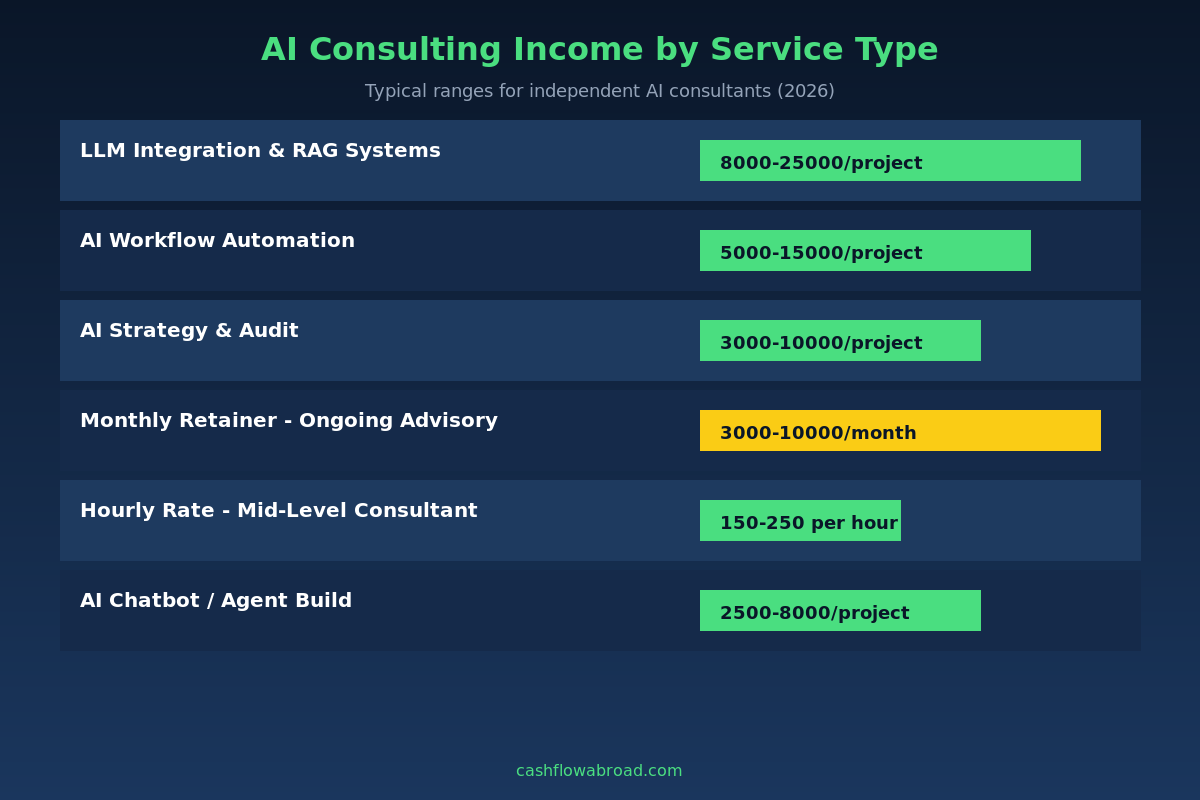
The six service categories getting the most traction right now:
| Service Type | Typical Project Fee | Monthly Retainer |
|---|---|---|
| LLM Integration & RAG Systems | $8,000–$25,000 | $3,000–$8,000 |
| AI Workflow Automation | $5,000–$15,000 | $2,500–$6,000 |
| AI Strategy & Audit | $3,000–$10,000 | $2,000–$5,000 |
| AI Chatbot / Agent Build | $2,500–$8,000 | $1,500–$4,000 |
| Prompt Engineering Optimization | $1,500–$5,000 | $1,000–$3,000 |
| Training Data & Fine-Tuning | $5,000–$20,000 | $2,000–$6,000 |
The sweet spot for a solo consultant is a combination of one project fee per month ($5K–$10K) plus one or two retainers ($2K–$4K each) for ongoing advisory and maintenance. That's $9K–$18K/month without needing to land a whale.
The Technical Stack You Actually Need
The barrier to entry is Python fluency plus familiarity with a handful of libraries. You don't need to train models from scratch. Your job is integration, orchestration, and delivery. Here's the minimum viable stack:
Core Languages and APIs
- Python 3.10+ — everything runs on Python in this space. Focus on
fastapi,asyncio, and basic data wrangling before pitching clients. - OpenAI API ($5–$100/month based on usage) — GPT-4o is the default workhorse. Know how to use the Chat Completions endpoint, function calling, and the Assistants API for persistent threads.
- Anthropic API ($5–$80/month based on usage) — Claude excels at long-context tasks and instruction-following. Many clients prefer it for document processing. Install in seconds:
pip install anthropic.
import anthropic

client = anthropic.Anthropic(api_key="your-key")

message = client.messages.create(
    model="claude-sonnet-4-6",
    max_tokens=1024,
    messages=[
        {"role": "user", "content": "Summarize this contract in 3 bullet points: [contract text]"}
    ]
)
print(message.content[0].text)
RAG and Vector Search
Retrieval-Augmented Generation is the most common deliverable in enterprise AI consulting right now. The pattern: chunk a company's documents, embed them using OpenAI's text-embedding-3-small model (about $0.02 per million tokens), store vectors in a database, and retrieve relevant chunks at query time. This lets you build a system where a lawyer can ask "what are the indemnification clauses in the contracts we signed last quarter?" and get accurate answers from their own documents.
- LlamaIndex — free, open-source. Best for quick RAG pipelines.
pip install llama-index. - LangChain — free, mature ecosystem. Better for complex multi-step agent workflows.
- Pinecone — free tier (up to 2GB), $70/month for starter. The go-to production vector store.
- ChromaDB — free, open-source, runs locally. Perfect for client demos and smaller deployments.
Deployment and Infrastructure
Most clients want a REST API they can call from their existing systems. Deploy a FastAPI endpoint to DigitalOcean's App Platform (starts at $12/month for a basic droplet) or use a serverless function. For client demos, a public HTTPS endpoint on DigitalOcean is enough — and you can provision a new server in 60 seconds from anywhere in the world with a decent internet connection.
Dev Environment
- Cursor IDE — $20/month. The AI code completion accelerates development speed by 40–60%, which directly translates to higher profit margins per project.
- GitHub Copilot — $10/month. Secondary option or complement to Cursor.
- Postman — free. For testing APIs and demonstrating endpoints to clients.
Total Monthly Tool Cost: $76–$284
| Tool | Monthly Cost | Notes |
|---|---|---|
| OpenAI API | $20–$80 | Scale with usage; pass to client for large projects |
| Anthropic API | $10–$50 | Claude for long-doc and multi-turn tasks |
| Cursor IDE | $20 | Essential for developer speed |
| GitHub Copilot | $10 | Optional if using Cursor |
| DigitalOcean | $12–$48 | Demo servers and client deployments |
| Pinecone Starter | $0–$70 | Free tier covers most small projects |
| NordVPN | $4–$6 | Access US platforms reliably while abroad |
| Total | $76–$284 | Pass API costs to client on larger engagements |
Compare this to a physical consulting firm with office overhead. A $10,000 revenue month costs you under $300 in software. The margins at scale are absurd.
Where to Find Clients
Most new AI consultants post a profile on Upwork and wait. The faster path combines platform presence with direct outreach in parallel.
Upwork
Upwork currently lists thousands of open AI implementation contracts. The key to standing out: don't sell "AI consulting." Sell the specific outcome — "I build RAG systems that let your team ask questions about your internal docs" or "I connect your CRM to GPT-4 so your sales reps get AI-drafted follow-ups automatically." Outcome-specific job titles convert at 3–5× the rate of generic profiles. Upwork's fee is 20% on the first $500 per client, dropping to 10% up to $10,000, and 5% above that — so the economics improve significantly with long-term clients.
Toptal
Toptal screens the top 3% of applicants through a technical interview and test project. Acceptance is hard, but the payoff is direct access to clients at $150–$300/hr without competing on price. If you have 2+ years of Python and can show a working RAG project during their screening, your odds are reasonable. A single Toptal client at $200/hr for 15 hours/week is $12,000/month gross before fees.
LinkedIn Cold Outreach
Target heads of operations, CTOs, and VPs of engineering at companies with 50–500 employees — large enough to have AI budget, small enough not to have in-house AI teams yet. Message structure: connection request with a personalized note → 3 days later, a 2-sentence value message referencing a specific automation relevant to their industry → follow-up with a brief case study. Target 20 personalized outreaches per week. A 5–10% positive response rate yields 1–2 conversations weekly. One closed project per month from LinkedIn at $6K is $6,000 in incremental revenue.
Build in Public
Post projects on X/Twitter and LinkedIn as you build them. "I just built a RAG system for a law firm that reduced contract review time by 70%" with a 30-second Loom demo will generate inbound inquiries from operators who have the exact same problem. This takes 60–90 days to gain traction but produces warm leads with zero pitch fatigue. Founders follow builders.
Realistic Income Timeline
Here's what a typical progression looks like for someone starting with Python basics and learning the AI stack in their spare time:
| Month | Focus | Revenue Target |
|---|---|---|
| 1–2 | Build skills: RAG project, LangChain agent, FastAPI deployment | $0 (learning investment) |
| 3 | First 2–3 paid projects: small automations at $1K–$2K each | $1,500–$3,000 |
| 4–5 | First retainer client, grow hourly rate to $100–$150 | $3,000–$5,000 |
| 6–8 | Two retainers + project work, specialize in one vertical | $5,000–$8,000 |
| 9–12 | Rate increase to $150–$250/hr, referrals compound | $8,000–$15,000 |
Month 3 example: $2,500 earned minus $1,500 living costs abroad = $1,000 positive cash flow. That's break-even at worst while building a business with near-infinite upside. By month six, consultants who execute this consistently are clearing $4,000–$6,000/month after all expenses.

The Geographic Arbitrage Math
A US-based AI consultant billing $200/hr still needs to cover Manhattan rent ($3,500+), health insurance ($500+), and a ~35% effective tax rate. Those costs alone erase $5,000–$6,000/month before any lifestyle spending. Living abroad rewrites the entire equation.
Sample monthly budget in Medellín, Colombia (one of the best cities for this model):
- 1-bedroom apartment in El Poblado or Laureles: $550–$850
- Food (restaurants 3–4x/week + groceries): $300–$500
- Co-working space with gigabit fiber: $100–$200
- Transport (Uber + metro): $50–$80
- Health insurance via SafetyWing: $56–$90/month
- Total: $1,056–$1,720/month
Billing just 12 hours per week at $175/hr: $175 × 12 × 4.3 weeks = $9,030 gross. After $200 in tools and $1,500 in living costs, you're banking approximately $7,330/month. That's $87,960/year — and you're working a 3-day week. The same billing rate in San Francisco nets you maybe $4,000–$5,000/month after taxes and cost of living.
The financial infrastructure that makes this work: a Mercury US business checking account for receiving USD wire payments (no incoming wire fees), a Charles Schwab International account for ATM withdrawals worldwide with zero foreign transaction fees, and a Traveling Mailbox virtual US address for contracts, business registration, and mail forwarding. A NordVPN subscription (~$4/month on a multi-year plan) covers platforms that geo-restrict US accounts.
For the full breakdown on setting up a US business entity while living in Latin America, see: how to run a US LLC from Colombia.
Pick a Vertical and Own It
Generalist AI consultants compete on price. Vertical specialists command a 30–50% rate premium because the client doesn't have to explain their industry — you already speak their language. The fastest path to $150+/hr is deep domain knowledge + AI implementation skills, not AI skills alone.
High-value verticals for solo consultants right now:
- Legal: Contract review, due diligence automation, regulatory compliance Q&A. Law firms pay well and have a crystal-clear ROI story ($400/hr attorney time vs. $200/hr AI automation).
- Healthcare/MedTech: Clinical documentation automation, EHR data extraction, patient communication workflows. Requires HIPAA awareness but carries premium rates.
- SaaS/Product Companies: Adding AI features — smart search, auto-summarization, intelligent email drafts — into existing products. Fast-moving clients with engineering budgets who don't want to hire full-time.
- E-commerce/Retail: AI product descriptions at scale, customer service automation, personalization engines. High volume, naturally recurring work.
- Financial Services: Internal knowledge bases, regulatory document Q&A, risk analysis augmentation. High rates, longer sales cycles, but stickier retainers.
Building a Portfolio Before You Have Clients
The classic chicken-and-egg problem: clients want portfolio work, but you need clients to build portfolio work. The solution is building real systems for hypothetical use cases and publishing them.
- Rebuild a well-known AI feature from scratch — clone Notion's AI summarizer or GitHub Copilot's explain-this-code feature using the Claude or OpenAI API, deploy it on DigitalOcean, document the architecture in a GitHub README.
- Free work for a local business — one free implementation in exchange for a written testimonial and case study rights. A restaurant with a menu Q&A chatbot, a real estate agent with a property search tool, a local accountant with a document Q&A system — all of these are genuinely useful and take 20–30 hours to build.
- Open-source one tool per month — GitHub projects signal technical credibility and get discovered by potential clients searching for solutions to the exact problem your tool solves.
- Micro-gigs on Upwork — take three $500–$1,000 projects at below-market rates explicitly for portfolio-building. Treat them as paid case studies, not income generation.
After 60 focused days, you should have three to five projects: one RAG document Q&A system, one workflow automation, one client-facing chatbot. That's enough to command $100–$150/hr on your first real engagement and justify the next rate increase 90 days later.
Scaling Past $10K/Month
There are two levers: raise rates or add capacity. For solopreneurs, rate increases come first — they require no operational complexity. The trigger: when you're turning down work or booked 6+ weeks out. If you have a waitlist, you're underpriced. Raise by $25–$50/hr with each new client engagement. Existing clients stay at their contracted rates until natural renewal points, when you renegotiate.
Beyond $10K/month, three paths: subcontract to a trusted junior developer (you own strategy and client relationships, they handle implementation grunt work), develop productized service packages with a fixed scope and fixed price that you can deliver in a predictable 40-hour workflow, or build a SaaS micro-product alongside consulting that generates passive subscription revenue. For a full breakdown of the passive income angle from digital products, see passive income streams for expats.
The One Thing Most Consultants Get Wrong
New AI consultants over-index on technical depth and under-index on scope management. A $15,000 project that creeps to 200 hours is a $75/hr job. Every engagement needs a written scope of work, a definition of "done," and a change request process for anything outside the original spec. If a client asks for a "small tweak" that requires 4 hours of rearchitecting, that's a billable change request, not a favor.
Write scope before writing code. Document all decisions in Notion. Charge a change request fee equal to your hourly rate. This single discipline separates consultants hitting $10K+/month from those stuck at $4K while working the same hours.
Conclusion
AI consulting from a low-cost country is one of the cleanest arbitrage trades in the current market: US enterprise billing rates ($150–$300/hr), sub-$2,000/month living costs, under $300/month in tools, and a skills gap in enterprise demand that won't close for several years. The barrier to entry is real — it takes 60–90 days of focused learning and portfolio-building — but the asymmetry between input effort and output income is hard to find elsewhere. If you want a broader look at which countries offer the best cost-of-living math for this model, the geographic arbitrage playbook lays out 10 specific destinations with real cost breakdowns.
Financial disclaimer: Income figures cited in this post reflect published industry rate benchmarks and are not guarantees of individual earnings. AI consulting income varies significantly based on experience, specialization, client base, and hours worked. Before structuring your business and tax obligations abroad, consult a licensed CPA or international tax attorney familiar with US expat tax law. Nothing in this post constitutes legal or financial advice.