
A restaurant owner in Phoenix is leaving $4,200 a month on the table — in missed reservations, unanswered after-hours questions, and leads that called the next place on Google Maps. He knows it's a problem. He doesn't know a $497/month AI chatbot would solve it. You do. And you can build it, deploy it, and collect a recurring payment from your laptop in Medellín while spending about two hours a month maintaining it.
That's the core business model: most local businesses desperately need automated customer communication, have the budget for it, and have zero idea where to start. The technical barrier has collapsed. A non-developer with two weekends of learning can now deploy production-grade AI chatbots that would have cost $40,000 to build custom just three years ago. Add geographic arbitrage — running the same business from a country where $1,400/month covers a comfortable life — and the numbers become extraordinary.
Here's exactly how to build it.
Why Local Businesses Are the Right Target
Enterprise companies have IT departments. SaaS startups build in-house. But the 33 million small businesses in the US — dental clinics, restaurants, real estate agents, med spas, law offices, HVAC companies — are running customer communication on a part-time receptionist and a contact form from 2019.
The gaps that create your business:
- A dental clinic misses 40% of after-hours calls. Each missed call = one lost new patient = ~$1,200 lifetime value.
- A restaurant's website gets 600 visitors/day with zero chat. If even 5% of those visitors have a question before booking, that's 30 conversations per day getting no response.
- A real estate agent manually replies to property inquiries 10-12 hours after they arrive. The lead has already called someone else.
A well-configured AI chatbot solves all three for under $600/month. The business owner doesn't care about "AI" or "large language models." They care that their phone stops ringing at 11pm and website visitors stop bouncing without booking. Sell the outcome, not the technology.
The Tech Stack: What to Actually Use
You don't need to code anything from scratch. The no-code chatbot platforms have matured to the point where a full-featured, AI-powered bot can be configured and deployed in 4-6 hours on first build, and in under 2 hours once you've done it a few times. Here's the current landscape with honest pricing:
Chatbase — Best Starting Point
Your cost: $99/month (Standard plan). Chatbase lets you train a GPT-4-powered bot on any website URL, PDF, document, or pasted text — in under 10 minutes. You get a JavaScript embed snippet that drops onto any site. No webhooks required for basic deployments.
White-label removal (removing "Powered by Chatbase" branding) costs an extra $199/month. For your first few clients you can avoid this by embedding under your own branded domain name. By client 5-6, white-label becomes worth the cost for professional positioning.
Ideal for: FAQ bots, lead capture forms, after-hours coverage, service business Q&A. Restaurants, salons, gyms, law firms with predictable question patterns.
Limitation: Weak on multi-step workflows. If a client wants CRM sync or live appointment booking, chain it with a Zapier automation ($20/month). That still keeps your all-in tool cost well under $150/month.
Voiceflow — Best for Complex Flows
Your cost: $60/editor/month (Pro). Voiceflow is where you go when the client wants a bot that doesn't just answer questions — it qualifies a lead with 5 questions, checks real-time availability via API, and books the appointment into Calendly or Acuity automatically.
Voiceflow's drag-and-drop canvas makes branching conversation logic visual and fast to build. It supports Claude API, GPT-4, and custom HTTP calls natively. On the Pro plan, one $60/month seat covers unlimited published bots, so the unit economics hold as you add clients.
Ideal for: Real estate lead qualification (collects budget, timeline, property type), med spa pre-consultation screening, insurance quote flows, e-commerce product recommendation.
ManyChat — The Instagram/Social Play
Your cost: $15/month (Pro, up to 1,000 contacts). ManyChat runs on Meta's platforms — Instagram DMs, Facebook Messenger, WhatsApp. If your client generates leads through social media, this is the tool.
A typical fitness studio setup: Instagram post says "Comment PRICING" → ManyChat bot sends an automated DM with a pricing PDF → follows up 24 hours later → books a consultation call → adds the lead to an email list. All fully automated. The client pays you $250/month; your tool cost is $15. That's a 94% gross margin.
Botpress — Enterprise Tier
Your cost: $495/month (Team plan: 50,000 messages, 3 bots, live agent handoff). This is overkill for most SMB clients, but when you land a mid-market company (50-500 employees) that needs CRM integration, SSO, and a human escalation path, Botpress handles it. Charge $1,000-$1,500/month at this tier and the margin is still solid.
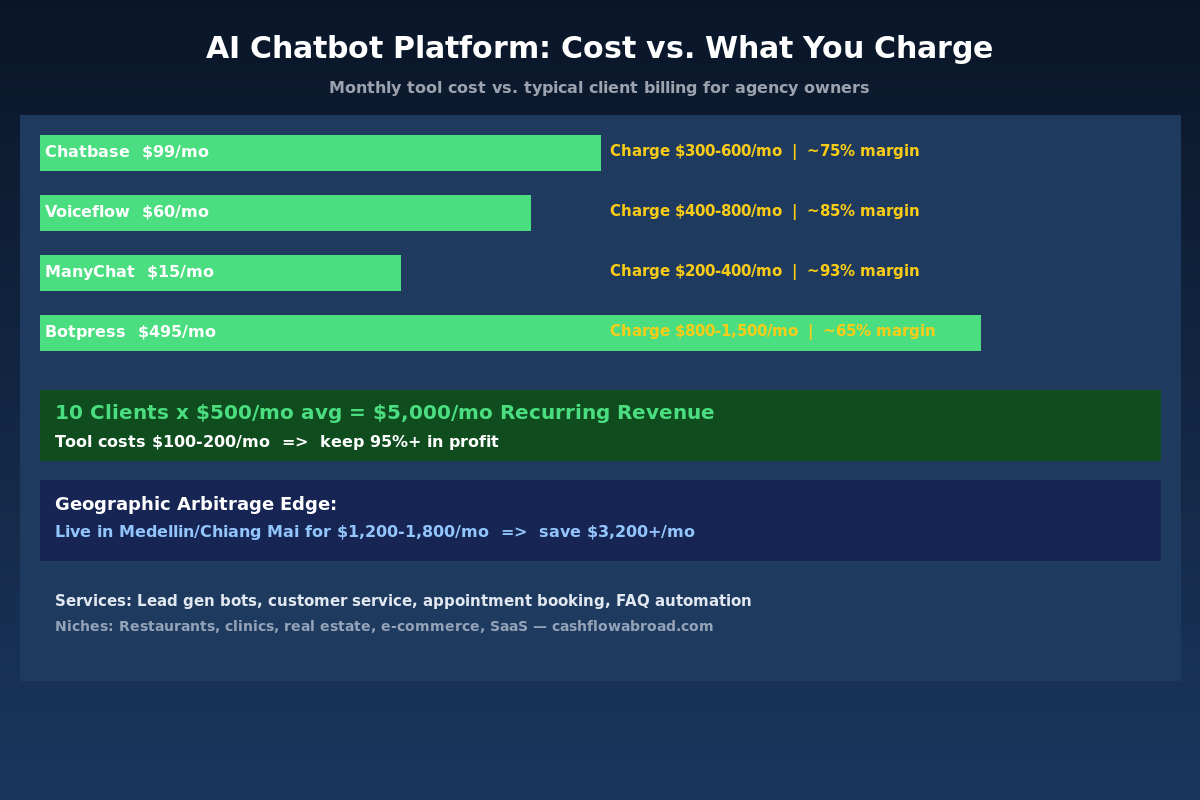
| Platform | Your Monthly Cost | Charge Client | Gross Margin | Best Use Case |
|---|---|---|---|---|
| Chatbase | $99/mo | $300–$600/mo | ~75% | FAQ, lead capture, service businesses |
| Voiceflow | $60/mo | $400–$800/mo | ~85% | Complex flows, real estate, booking |
| ManyChat | $15/mo | $200–$400/mo | ~93% | Instagram/Facebook DM automation |
| Botpress (Team) | $495/mo | $800–$1,500/mo | ~65% | Mid-market, enterprise handoff |
Recommendation: Start with Chatbase. Learn one tool well before touching the others. Build your first 5 clients on it, then add Voiceflow when you land a client with complex needs.
The Packages You Sell
Never sell a "chatbot." Sell a specific business outcome with a clear deliverable and an ongoing maintenance commitment. Here's a three-tier structure that converts well against a local business audience:
| Package | Setup Fee (one-time) | Monthly Retainer | What's Included |
|---|---|---|---|
| Starter | $497 | $297/mo | 1 bot, FAQ training on existing content, website embed, monthly performance report |
| Growth | $997 | $497/mo | 2 bots, lead capture with CRM sync, appointment booking integration, weekly analytics |
| Scale | $1,997 | $997/mo | Unlimited bots, multi-channel (website + SMS + WhatsApp), custom AI training, priority support |
Your target client is in the Growth tier: a business doing $500K-$5M/year in revenue that's actively spending on marketing and can immediately point to recovered leads to justify $500/month. At 10 Growth clients, you're at exactly $5,000/month in recurring revenue — before accounting for setup fees, which add another $500-$1,500/month from new client onboarding.
Finding Your First 10 Clients
The fastest path to clients is outbound targeting of a single niche. "Local businesses" is too vague — pick dental clinics, or med spas, or real estate agents, and go deep on one vertical. One niche means you can build a demo bot for that industry, name competitors who've done it, and write outreach that speaks directly to their exact pain points.
The Outreach Script That Converts
Avoid: "Hi, I build AI chatbots and would love to discuss..."
Use this instead:
"Hi [Name], I was on your website last night looking up your hours and ended up having to call — noticed you don't have a chat option. I build after-hours lead recovery systems for dental clinics. I built one for [Competitor Clinic Name in a different city] and they recovered $3,200 in new patient appointments in the first 60 days. Would a 15-minute screen share be worth your time this week?"
What makes this work: a specific dollar amount, a named reference, a clear problem they recognize, and an easy low-commitment ask. You're not pitching a product — you're demonstrating you understand their world.
Where to find prospects:
- Google Maps: Search "[niche] [city]" → check the first 3 pages of results → cross-reference against businesses with no chat widget on their website. Most won't have one.
- LinkedIn Sales Navigator ($99/month): Filter by industry, 5-50 employees, specific metro area. Message the owner directly, not the front desk or office manager.
- Local Facebook Groups: Join "[City] business owners" groups. Post a genuine question ("Has anyone experimented with AI chat for after-hours leads? Curious what's working") — you'll get warm inbound from owners who want the answer.
Target 20 outreach contacts per day, 5 days per week. At a 10% response rate and 30% close rate on demos, that's ~3 new clients per month. The math compounds: by month 3, you have 9 clients and referrals starting to come in passively.
The Geographic Arbitrage Advantage

Here's where this business model becomes genuinely exceptional. You're charging US market rates — $297 to $997/month per client — while living in a country where those rates translate to a completely different quality of life.
| City | Monthly Living Costs | Internet Quality | Overlap with US Clients |
|---|---|---|---|
| Medellín, Colombia | $1,200–$1,600 | Excellent (100-300 Mbps fiber) | EST-1 — ideal for US calls |
| Chiang Mai, Thailand | $900–$1,400 | Good (50-150 Mbps) | EST+11 — async-friendly |
| Tbilisi, Georgia | $1,000–$1,500 | Excellent (100+ Mbps fiber) | EST+8 — early morning calls |
| Mexico City, Mexico | $1,400–$1,900 | Very good (100-200 Mbps) | CST — synced with US |
At 10 clients averaging $500/month, you're grossing $5,000/month. Tool costs: ~$150/month (Chatbase + Zapier). Living costs in El Poblado, Medellín: $1,400/month including a bright apartment, coworking membership, and eating out most nights. Net monthly surplus: $3,450.
That's $41,400/year in savings while working 3-5 hours per day on client maintenance and outreach. Running the same business from Austin: rent alone eats $1,800/month, plus $200 in utilities, $600 in food, and you need 18+ clients to hit the same net savings. Geographic arbitrage is worth 8 extra clients per month in effective earnings.
Medellín is particularly compelling for this business model — excellent fiber internet, a thriving expat and nomad community, and a 1-hour time difference from EST that makes US business calls effortless. Colombia's digital nomad visa is one of the most accessible in Latin America and converts to a longer-term residency path. For the full calculation on running a US business from Colombia, the numbers consistently point to it as one of the best setups for US-facing online businesses.
This is the core thesis behind the geographic arbitrage playbook: earn in a high-cost market, spend in a low-cost one, and keep the difference.
Setting Up the Business Correctly
You need four things to run this cleanly as a US-facing business from abroad:
1. A US LLC
Form a single-member LLC in Wyoming ($100/year in filing fees, no state income tax) or Delaware. This gives you a US business entity that clients can pay via ACH or wire, sign contracts with, and trust implicitly. Without a US entity, most clients will pause before sending money to a foreign account.
2. US Business Banking
Mercury is the de facto standard for remote founders: free, no monthly fees, full domestic and international wire support, solid API for accounting integrations. Mercury connects cleanly to Stripe for client billing and sends international wires without friction once you're ready to move revenue abroad.
3. A Permanent US Mailing Address
Your LLC, IRS correspondence, and US business accounts all need a real US address. A Traveling Mailbox subscription ($15-$25/month) gives you a permanent US street address (not a PO Box) that scans and forwards mail digitally. Essential for maintaining US banking and receiving legal documents while living abroad. Full details in the virtual mailbox guide for expats.
4. VPN + Basic Hosting
When accessing client CRM integrations and sensitive business data from café WiFi in Chiang Mai or a coworking space in Tbilisi, run a VPN. NordVPN runs $4-5/month on an annual plan — the standard tool for remote founders who work across multiple countries. Once you build any custom integrations (webhook receivers, lead-routing scripts, client dashboards), a $6/month DigitalOcean droplet handles everything a 10-client agency needs.
The 90-Day Roadmap to $5K MRR
Here's a concrete timeline based on realistic conversion numbers:
Days 1–14: Build the Foundation
- Pick Chatbase or Voiceflow. Complete all onboarding tutorials (both platforms have free tiers for learning)
- Build a demo bot for one specific niche (example: "dental clinic FAQ + after-hours lead capture")
- Register Wyoming LLC, open Mercury account, get Traveling Mailbox address
- Write your outreach sequence (initial message → follow-up → demo ask → close)
Days 15–45: Consistent Prospecting
- Send 20 outreach contacts per day via Google Maps + LinkedIn
- Target 3 booked demos per week minimum
- Close first paid client — even at $297/month. Document every step of the setup process
- Create a case study from client 1 before actively closing client 2
Days 46–90: Scale and Optimize
- Clients 2-6 through referrals and continued outreach
- Raise minimum retainer to $397/month for all new clients after month 2
- Hire a VA ($5-8/hour) for prospecting research and outreach at client 5
- By day 90: 8-12 clients, $3,500-$6,000 MRR
The math compounds faster than it looks on paper. At 10 clients you have enough case studies to raise rates on new clients. At 15 clients you're generating $6,000-$8,000/month and spending roughly 10-15 hours/week on the whole business — maintenance, outreach, onboarding.
What 6 Months Actually Looks Like
Stress-testing a realistic scenario (with 15% monthly churn and 4 new clients per month after ramp-up):
- Month 1: 2 clients × $297 avg = $594 MRR + $994 in setup fees
- Month 2: 5 clients × $380 avg = $1,900 MRR
- Month 3: 8 clients × $430 avg = $3,440 MRR
- Month 4: 11 clients × $470 avg = $5,170 MRR
- Month 5: 13 clients × $490 avg = $6,370 MRR
- Month 6: 15 clients × $510 avg = $7,650 MRR
By month 6: $7,650 MRR. Tool costs: ~$300/month. Part-time VA at $600/month. Net: $6,750/month. In Medellín, that's $5,350/month in savings. In Chiang Mai, closer to $5,850/month.
That's not a lifestyle business — that's a real business generating real wealth from a laptop in a $650/month apartment with a mountain view.
For broader context on building online businesses that scale, see the guide to building a $100K online business from anywhere and the overview of passive income streams that work across countries.
Conclusion
The AI chatbot business targeting local SMBs is one of the cleanest cash-flow opportunities for expats and digital nomads right now. The technical barrier is low (no-code platforms, $60-$99/month tool cost), the market is vast (33 million US small businesses, most with zero chat automation), the price point is defensible ($300-$997/month for outcomes clients can directly measure), and the overhead is minimal.
The real investment is time: 4-6 weeks of consistent outreach before the first dollar comes in, and 2-3 months to build reliable MRR. After that, each new client adds $400-$600/month in recurring income requiring 2-3 hours of maintenance per month. Add geographic arbitrage and you're earning at a rate that would be impressive anywhere — while spending at a rate that makes it extraordinary.
Financial disclaimer: Income figures referenced in this post are based on publicly available platform data, agency pricing guides, and reported freelancer earnings. Individual results vary significantly based on sales skill, niche selection, client churn, and time invested. This post is for informational purposes only and does not constitute financial, tax, or legal advice. Consult qualified professionals before making decisions about business structure, foreign residency, or investment strategy. The author may receive compensation from affiliated partners linked in this article.