
A dental office in Phoenix loses roughly $150 every time a patient no-shows. A chatbot that texts appointment reminders, handles rescheduling, and answers FAQ at 2am pays for itself with a single prevented no-show per month — and the dentist is still paying you $1,500/month a year later because they'd never think to cancel it. That's the chatbot agency model in one sentence: solve a bleeding-money problem, install a bot that runs forever, collect a retainer.
This isn't a "passive income" fantasy. It's a real service business — except you can run it from a $600/month apartment in Medellín, charge US market rates, and keep 70–80% of every dollar because your overhead is just a few SaaS subscriptions. The geographic arbitrage math is brutal in your favor.
Here's what a solo operator running a chatbot agency from abroad actually looks like financially: 8–12 local business clients at $500–$2,000/month each, $6,000–$24,000/month in recurring revenue, and tool costs of $400–$700/month total. This guide walks you through the exact stack, the niches that pay the most, and the workflow from cold outreach to monthly retainer.
Why Local Businesses — Not Big Brands — Are the Real Opportunity
Enterprise companies already have AI vendors and procurement processes. Local businesses — the dentist with three chairs, the med spa, the real estate broker doing $8M in deals annually — have no IT department, no vendor relationships, and a very specific pain: they're hemorrhaging money through unanswered calls, missed appointments, and staff time spent repeating the same information 30 times a day.
That gap is your market. A restaurant owner whose staff wastes 2 hours/day answering "do you have gluten-free options?" and "can I book a table for Saturday?" will pay $400/month for a chatbot that handles it all — that's less than one part-time employee's weekly cost. The ROI conversation writes itself.
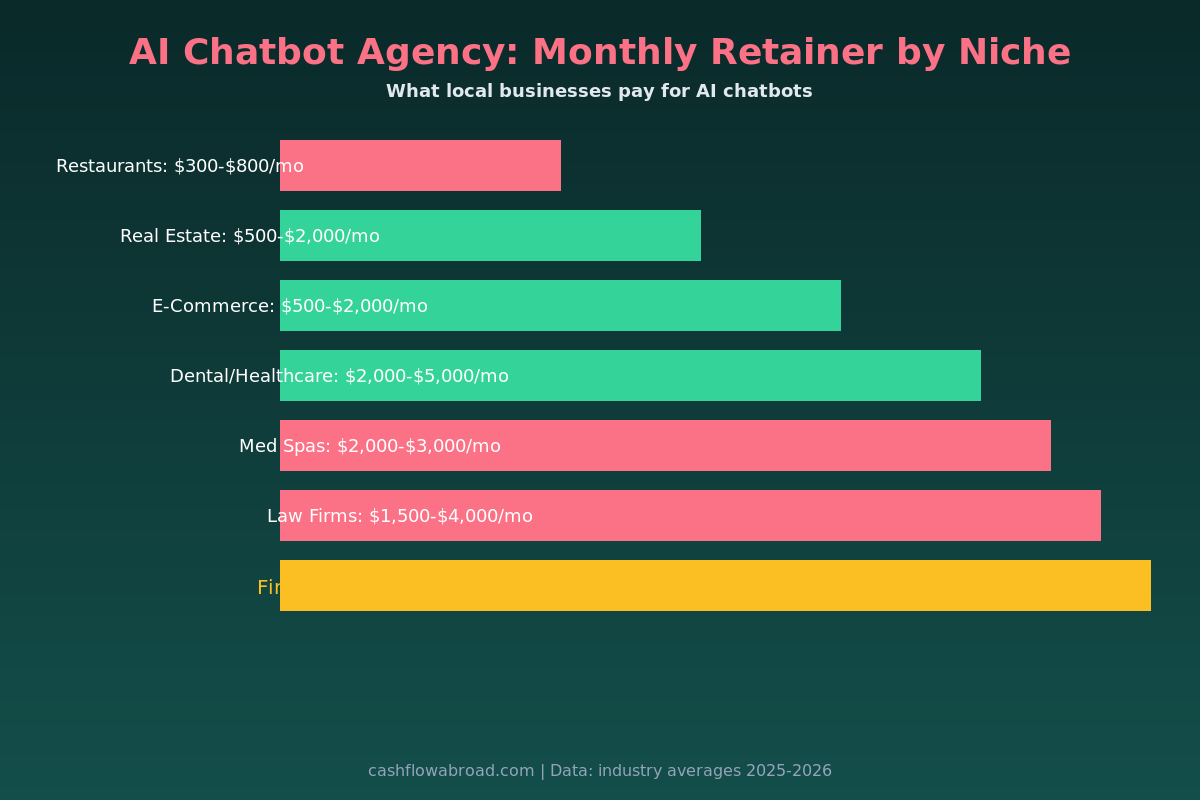
The niches with the highest willingness to pay are those where the math is undeniable:
- Dental offices: One prevented no-show ($50–$200 lost revenue) = chatbot ROI. Dentists with 3+ chairs are the sweet spot.
- Real estate brokers: Speed-to-lead is everything. A bot that responds instantly at 11pm when a buyer fills out a Zillow form can be the difference between a $12,000 commission and losing the lead. They know this.
- Med spas and aesthetics clinics: Average revenue $1.4–$2M/year, services priced $500–$3,000 per visit, chronic problem with no-shows and inquiries. High ticket means high willingness to pay.
- Law firm intake: A personal injury firm that signs 2 extra clients per month because their intake bot is running 24/7 is looking at $20,000+ in additional revenue for a $2,000/month retainer. These numbers convert fast.
- Mortgage brokers and insurance agents: Commission-based businesses with high lead acquisition costs. A bot that pre-qualifies leads before a human ever touches them is a no-brainer pitch.
The Tool Stack: What You Actually Need (And What It Costs)
The barrier to entry is low. You can have a functional chatbot agency running on under $400/month in tools before you land your first client. Here's what the stack looks like:
| Tool | Purpose | Cost | Best For |
|---|---|---|---|
| GoHighLevel Unlimited | All-in-one CRM + chatbot + SMS + calendar | $297/month | Main client delivery platform |
| Chatbase Pro | Website chatbot trained on client docs | $99/month | Quick website FAQ/lead bots |
| Botpress Community | Complex multi-step flows, API integrations | $0 (self-hosted) or $89/month | Custom logic-heavy bots |
| ManyChat Pro | Instagram DM, Facebook Messenger automation | $15–$65/month | Social media-heavy clients |
| OpenAI API | GPT-4o backbone for custom bots | $20–$80/month (per client) | Custom GPT wrapper builds |
| DigitalOcean Droplet | Hosting Botpress or custom deployments | $12–$24/month | Self-hosted infrastructure |
The most efficient starting stack: GoHighLevel Unlimited ($297/month) plus Chatbase Professional ($99/month). Total: $396/month. Land one client at $500/month and you're cash-flow positive before you've done anything else. GoHighLevel's white-label capability means you can brand everything as your own platform — clients never see the GHL interface.
For hosting any custom infrastructure, DigitalOcean is the clean choice for self-hosting Botpress or running Node.js chatbot APIs — predictable pricing, no surprise bills, and droplets from $12/month get you a long way. Pair it with a NordVPN connection when managing client accounts from abroad to avoid any geo-flagging issues with US-based platforms.
Building the Bot: A Step-by-Step Workflow
Most first-time chatbot builders overthink this. A basic bot for a dental practice doesn't need machine learning pipelines or a team of engineers. Here's the actual workflow:
Step 1: Intake and Training Data
Your first call with the client should extract: their 20 most frequently asked questions, their services menu and pricing (if public), booking process, hours, location, payment methods, and cancellation policy. Turn this into a Google Doc. That doc becomes your bot's training data.
In Chatbase: create a new chatbot, paste the URL of their website plus upload your FAQ doc, and the bot trains in under 5 minutes. In GoHighLevel: use the "Conversation AI" module, paste in the knowledge base, set the bot's objective (appointment booking, FAQ, lead capture), and configure the fallback to a human agent after 2 failed attempts to answer.
Step 2: Platform Configuration
For a dental office, you want the bot handling:
- New patient FAQ ("Do you accept Delta Dental?", "What's the process for a first appointment?")
- Appointment booking — integrate with their existing system (Dentrix, Eaglesoft, or Calendly as a bridge)
- Appointment reminders — GHL sends automated SMS 48 hours and 2 hours before the appointment
- Missed call text-back — when someone calls and no one answers, GHL fires an immediate SMS within 30 seconds
Here's what a basic GHL "Missed Call Text-Back" workflow looks like:
Trigger: Missed Call
  ↓
Action: Wait 30 seconds
  ↓
Action: Send SMS
  Message: "Hi! Sorry we missed your call.
  This is [Business Name] — how can I help?
  Reply here or book online: [calendar link]"
  ↓
Action: Start Conversation AI (if reply received)
This alone — the missed call text-back — closes deals. Show a dentist the 23 missed calls they got last month and ask how many converted. The answer is usually close to zero. Show them this workflow and watch their face change.
Step 3: Custom GPT Wrapper for Higher-Margin Projects
For clients who need something more sophisticated — a real estate chatbot that can discuss specific listings, or a law firm intake bot that pre-qualifies by practice area — build a custom GPT-powered wrapper. The economics are very favorable:
- OpenAI GPT-4o API cost for a small business bot with moderate traffic: $5–$30/month
- What you charge the client: $500–$1,500/month
- Your gross margin: 85–95%
Basic Python structure for a document-aware chatbot using OpenAI's Assistants API:
from openai import OpenAI

client = OpenAI(api_key="your-key")

# Create assistant with client's knowledge base
assistant = client.beta.assistants.create(
    name="Dental Office Assistant",
    instructions="""You are a helpful assistant for [Dental Practice].
    Always be warm and professional. For appointments, collect name,
    phone, and preferred time, then confirm you'll call to finalize.""",
    model="gpt-4o",
    tools=[{"type": "file_search"}]
)

# Upload client's FAQ document
with open("dental_faq.pdf", "rb") as f:
    file = client.files.create(file=f, purpose="assistants")

# Create thread per user session
thread = client.beta.threads.create()

def chat(user_message, thread_id):
    client.beta.threads.messages.create(
        thread_id=thread_id,
        role="user",
        content=user_message
    )
    run = client.beta.threads.runs.create_and_poll(
        thread_id=thread_id,
        assistant_id=assistant.id
    )
    messages = client.beta.threads.messages.list(thread_id=thread_id)
    return messages.data[0].content[0].text.value
Deploy this on a $12/month DigitalOcean droplet with a FastAPI endpoint, embed it in the client's website with a simple JavaScript widget, and you have a production chatbot running for under $50/month total cost. That's 90%+ gross margin at any price point above $300/month.
Pricing Your Services: The Retainer Architecture
The biggest mistake new chatbot agency owners make is underpricing. You are not selling a chatbot — you are selling the outcome: appointments booked at 2am, no-shows reduced, leads captured that would have otherwise bounced. Price the outcome, not the tool.
| Tier | Monthly Price | What's Included | Best Niche |
|---|---|---|---|
| Starter | $299–$499/mo | Website chatbot, FAQ training, monthly report | Restaurants, local shops |
| Growth | $500–$1,200/mo | Multi-channel (web + SMS + Instagram), CRM integration, missed-call text-back | Real estate, e-commerce |
| Pro | $1,500–$3,000/mo | Full AI pipeline: lead qualification, appointment booking, follow-up sequences, custom GPT | Dental, med spas, law firms |
| Enterprise | $3,000–$7,000/mo | Custom AI voice + chat stack, CRM syncs, dedicated build, priority support | Mortgage, insurance, multi-location |
Add a one-time setup fee of $1,000–$3,000 on top of the retainer. This covers your time to build, train, integrate, and deliver. After that, the monthly fee is for hosting, maintenance, and optimization. A well-configured bot needs 2–4 hours of attention per month. At $800/month, that's $200/hour effective rate — while you're working from a co-working space in Lisbon or a cafe in Chiang Mai.
Finding Clients: The 3 Channels That Actually Work

Channel 1: The Demo Bot Cold Email
Build a demo chatbot for a specific business before you ever contact them. Go to their website, create a Chatbase bot trained on their content in 10 minutes, record a 90-second Loom video showing it answering real questions from their FAQ. Send this email:
"Hi [Name], I built an AI chatbot for [Business Name] in 10 minutes — it answers your 15 most common customer questions and can book appointments 24/7. Watch the demo: [Loom link]. Would you want something like this running on your site? Happy to set it up free for 30 days."
Generic cold email gets 2–3% reply rates. A personalized demo bot email routinely hits 10–20% because you've already solved their problem — they're just deciding whether to pay you for it.
Channel 2: Google Maps Scraping + Direct Outreach
Use Outscraper or Apollo to pull dentists, med spas, and real estate offices in a specific US city. Filter for 3.5–4.5 star ratings (real customers, real problems). Check their websites — no chatbot, no automated Google Business responses? That's your prospect. Send the demo bot email and follow up twice over 10 days.
Best target cities: Phoenix, Austin, Tampa, Denver, Raleigh — high real estate activity and healthcare density, strong willingness to pay for tech that works. You don't need to be local. Your clients just need their calls answered.
Channel 3: Local Business Facebook Groups
Every mid-size US city has a "Small Business Owners [City]" Facebook group with 2,000–15,000 members. Join several, comment helpfully for a week, then post a genuine case study: "I helped a dental office in Scottsdale reduce no-shows by 31% with an AI chatbot — happy to share what worked." The DMs will come to you.
The Geographic Arbitrage Math
Running this business from abroad is a structural financial advantage, not just a lifestyle choice. Two scenarios with the same income goal:
Austin, TX: $3,500 rent + $800 food + $500 transport + $400 tools = $5,200/month expenses. To net $8,000/month, you need $13,200/month revenue — roughly 8 clients at $1,650/month average.
Medellín, Colombia: $700 rent + $300 food + $100 transport + $400 tools = $1,500/month expenses. To net $8,000/month, you need $9,500/month revenue — 6 clients at $1,580/month average. Same income, 25% fewer clients needed, 75% lower financial pressure.
The geographic arbitrage edge means you can be more selective about clients, invest in better systems, and learn new AI tools without the survival pressure that forces bad decisions. Colombia's Digital Nomad Visa is legitimate and straightforward for US citizens — legal remote work for foreign clients, at a fraction of US living costs. See the complete guide here if you're considering it.
For maintaining US business presence from abroad: a Traveling Mailbox gives you a real US address plus mail scanning for ~$15/month. Pair with a Mercury business checking account — no fees, built for remote founders, ACH and wire transfers work cleanly. That's your entire US business infrastructure for under $20/month.
On the tax side: if you spend 330+ days abroad and qualify for the Foreign Earned Income Exclusion, your first ~$126,500 in earned income may be excluded from US federal income tax. Consult an expat CPA to confirm your situation — but this is a real, meaningful advantage that amplifies every dollar your chatbot agency generates.
Scaling From First Client to $10K/Month
Most people stall at 2–3 clients because delivery becomes the bottleneck. The fix is systematization — building processes that don't require your full attention for every client.
Month 1–2: Land your first 2–3 clients at $500–$800/month. Do everything manually to understand what works. Document every step in Notion.
Month 2–4: Build SOPs for the 5–7 deliverables that happen with every client. Every step should have a checklist a VA could follow.
Month 4–6: Hire a part-time VA at $8–$12/hour for 20 hours/week — plenty of talent available through Trabajo Colombia or OnlineJobs.ph if you're working from LATAM or Southeast Asia. Delegate monthly reports, FAQ updates, and routine integration checks.
Month 6–12: You handle discovery calls, complex integrations, and VA management. 8–15 clients, $8K–$15K/month, under 30 hours of your personal time per week.
The path to $10K/month isn't 10 clients at $1,000 — it's 6 clients at $1,200 plus 2 at $2,500. Every Starter client is a candidate for an upgrade once you show them month-three results. "Your bot handled 340 conversations and booked 28 appointments last month" is a strong argument for moving to a Pro retainer.
What to Avoid: Mistakes That Kill Agencies Early
Building before selling. Don't spend 3 months perfecting a bot for a niche nobody's paid you to serve. Do a demo, get a verbal yes, then build. Sell first, always.
Underpricing out of imposter syndrome. $200/month for a chatbot signals low value. Prospects assume it doesn't work well. Start at $399/month minimum. The ROI math at $500/month is still a no-brainer for any business losing money to unanswered calls.
Ignoring churn prevention. Month 3 is when clients cancel if they don't see clear value. Send a monthly results email: conversations handled, appointments booked, leads captured, staff hours saved. Make the ROI undeniable before the invoice arrives.
Wrong niche for your first client. Don't start with restaurants — low ticket, price-sensitive, high churn. Start with dental, real estate, or med spas: higher ticket, quantifiable ROI, low price sensitivity once they see the numbers.
The Business That Actually Runs at 2am
The chatbot agency model works from abroad because the product is genuinely autonomous. You build it, train it, deploy it — and then it handles 200 customer conversations overnight while you're asleep. The clients wake up to appointment confirmations and answered leads. You wake up to a recurring invoice that paid itself.
The broader context here matters: this is one of a small number of service businesses where geographic location genuinely doesn't matter to clients, the work is mostly setup-heavy front-load with light ongoing maintenance, and the margins get better as you scale because you're not selling time linearly. A chatbot retaining 10 clients isn't 10x the work of 1 client — it's maybe 3x, because the SOPs, tools, and templates all compound.
Start with one niche. Build one great demo bot. Send 50 cold emails this week. The first $500/month client is always the hardest. After that, you have a portfolio, a process, and proof.
Financial Disclaimer: Income figures cited in this article represent ranges reported by chatbot agency operators and platform providers, and are not guarantees of individual results. Earnings depend on client acquisition, pricing strategy, niche selection, and execution. AI tool pricing is subject to change — verify current rates directly with each platform. This post contains affiliate links; we may earn a commission if you purchase through them at no extra cost to you. This is not financial, legal, or tax advice — consult qualified professionals for guidance specific to your situation.