
The US State Department charges $2,350 to renounce your citizenship. Paraguay charges $357 to grant you permanent residency. That gap tells you everything about who is serious about attracting capital.
Paraguay has quietly become one of the most accessible permanent residency programs in the Western Hemisphere — with zero income requirement, no minimum stay after approval, and a territorial tax system that charges nothing on foreign-sourced income. While expats debate Portugal's collapsing NHR program and Thailand's $500,000 wealth threshold, Paraguay has been handing out permanent residency for the cost of a decent laptop.
This is not a flag-theory fantasy. It's a legal, well-documented program that thousands of Americans have used. Here's how the numbers actually work.
Why Paraguay Is Different
Most countries that offer low-tax residency require you to prove income, park money in local real estate, or survive a bureaucratic marathon. Paraguay's standard permanent residency requires exactly one thing: a bank deposit of approximately $5,000 in a local account — which remains your money, in your account. There is no minimum income proof, no property purchase, and no mandatory annual stays after you're approved.
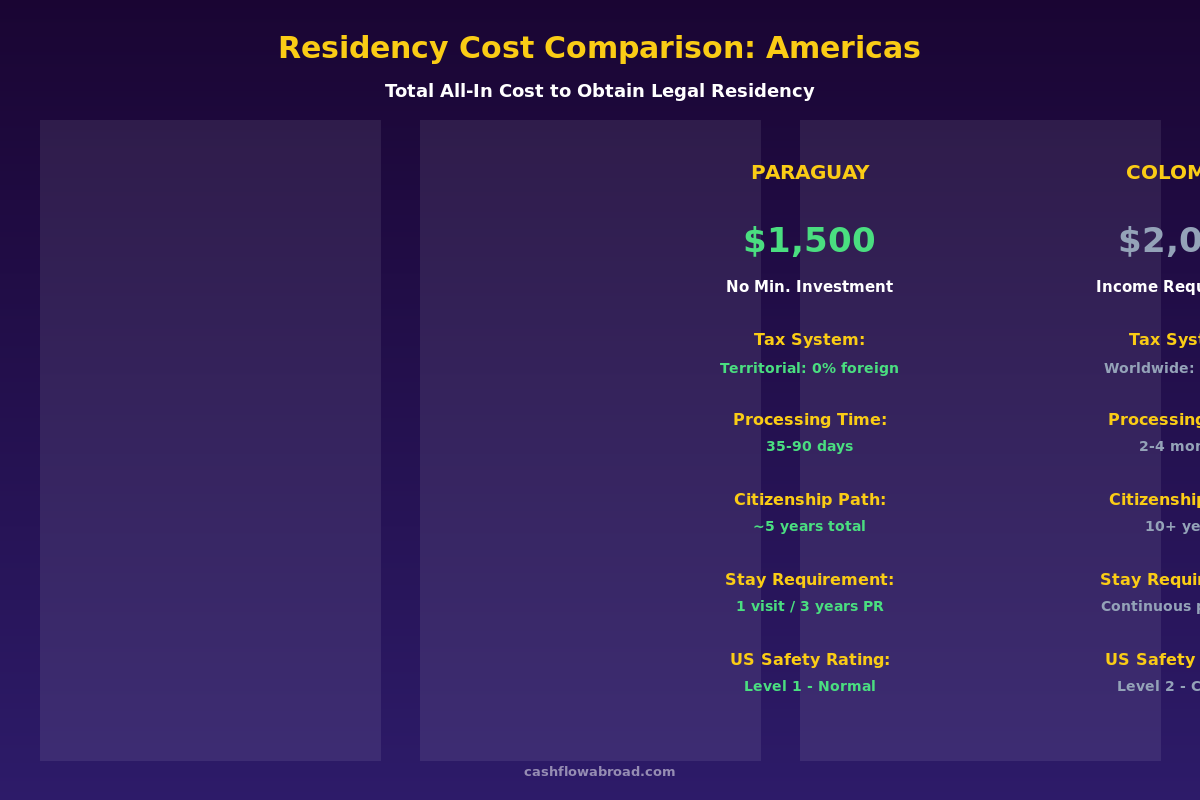
The tax regime runs on pure territorial principles. Paraguay taxes income earned inside its borders at a flat 10%. Everything earned outside — dividends from a US brokerage, rental income from a property in Texas, consulting fees from a European client — is taxed at 0%. No wealth tax. No inheritance tax. No gift tax. No exit tax.
For a digital nomad, a retired investor, or anyone with a US-based income stream, Paraguay's tax system is structurally irrelevant to their daily finances. You live cheaply, pay nothing on your foreign income, and keep the option of citizenship after three years of permanent residency.
The Two Paths to Residency
Paraguay offers two realistic routes for most Americans.
Standard Permanent Residency
This is the most common route. Required documents include an apostilled birth certificate, a clean police background check from your home country, and a deposit of approximately $5,000 (35 minimum monthly wages) into a Paraguayan bank account. Government fees run $357. A local immigration attorney typically charges $1,400 to $1,800. Total all-in: $7,000 to $8,500, with $5,000 of that sitting in your own account.
Processing takes three to six months. Once granted, your residency is permanent. The only hard requirement to maintain it is visiting Paraguay once every 36 months — a long weekend every three years.
SUACE Investor Route (Immediate Permanent Residency)
SUACE is Paraguay's investor program, and its defining feature is speed. Instead of the standard application, you submit a business plan committing to invest $70,000 in a Paraguayan business or enterprise over 10 years — roughly $7,000 per year. There's no requirement to front the full amount upfront. In exchange, you receive permanent residency in 45 days to six months. The catch: you need five registered employees and a credible business plan. Attorney fees for SUACE typically run $3,000 to $5,000. For most passive investors, the standard route is simpler and cheaper.
| Requirement | Standard Permanent | SUACE Investor |
|---|---|---|
| Minimum Total Cost | ~$7,000–$8,500 (incl. $5K deposit you keep) | ~$3,000–$5,000 in fees + $70K over 10 yrs |
| Processing Time | 3–6 months | 45 days–6 months |
| Business Plan Required | No | Yes (with 5 employees) |
| Min. Stay After Approval | 1 visit per 36 months | Minimal |
| Residency Status Granted | Permanent | Permanent (immediate) |
| Income Proof Required | No | No |
The $5,000 Deposit: What It Actually Is
The bank deposit requirement trips up first-time researchers. It sounds like a fee you burn — it isn't. You deposit $5,000 into a Paraguayan bank account that you own. The money stays in your account. Paraguay's banking system is largely dollarized in practice, with many accounts denominated in USD alongside the local Guaraní.
Opening a bank account in Paraguay requires your Cédula de Identidad — the local ID card you receive once residency is approved. Some banks will accept passport documentation while the Cédula is being processed. For your main banking infrastructure, Charles Schwab International remains the gold standard for expats — no foreign transaction fees, free ATM withdrawals worldwide, and a US address you can use for brokerage and banking even while living in Asunción.
For your ongoing US address — critical for maintaining IRS correspondence, state domicile, and US banking relationships — a virtual mailbox is essential. Traveling Mailbox gives you a real US street address in 50+ cities, scans incoming mail, and handles check deposits for $15/month. If you're managing banking from Asunción, that single address keeps your entire US financial infrastructure intact.
Paraguay's Territorial Tax in Practice
Under Paraguay's Impuesto a la Renta Personal (IRP), individuals pay 10% on income from Paraguayan sources. Passive income from abroad — dividends, capital gains, pension distributions, foreign rental income, consulting from foreign clients — is exempt from Paraguayan income tax entirely.
This matters most for three groups:
- Remote workers with foreign clients: If your clients are all outside Paraguay, you owe Paraguay nothing on that income. You still owe the IRS as a US citizen — the Foreign Earned Income Exclusion lets you exclude up to $132,900 (indexed annually) from US federal tax if you pass the bona fide residency or physical presence test.
- Retirees with US investment income: Dividends, Social Security, IRA distributions, and brokerage gains are all foreign-sourced relative to Paraguay. Paraguay sees zero of it. Your US tax picture depends on your treaty position and applicable credits.
- Business owners with international structures: If you operate through a US LLC or foreign entity with no Paraguayan nexus, Paraguay's local tax doesn't apply. Pair this with the FEIE for earned income and you can dramatically reduce your effective global tax rate — legally.
One thing Paraguay does not offer: exemption from US worldwide taxation. Americans pay tax on global income regardless of where they live. Paraguay's territorial system means you won't also pay Paraguayan tax on top of US tax — elimination of double taxation on the same income stream. For a deeper look at how the US expat tax and banking system actually works, review that before booking a flight to Asunción.
For moving money between your US and Paraguayan accounts, Remitly is the most straightforward option for US-to-Paraguay transfers — transparent fees and fast delivery to local bank accounts. For full context on what international transfers actually cost, see the expat money transfer guide. If you hold dollar balances within Latin America and want the flexibility of stablecoins alongside traditional transfers, ARQ Finance lets you hold USDC/USDT, swap to local currencies like PYG or ARS, and earn up to 4% on dollar balances.

Cost of Living in Asunción
Paraguay is not the cheapest country in Latin America — Colombia and Bolivia undercut it on several metrics — but Asunción's lifestyle index is high relative to cost. Most expats settle here for infrastructure, banking access, and the international community that's grown steadily over the past decade.
| Expense | Monthly Cost (USD) | Notes |
|---|---|---|
| 1-BR apartment (central Asunción) | $350–$500 | Many leases denominated in USD |
| 1-BR apartment (outer neighborhoods) | $200–$350 | Lower density; car is helpful |
| Groceries (1 person) | $150–$250 | Local markets far cheaper than imports |
| Utilities (electric, water, internet) | $80–$150 | Electricity can spike in summer heat |
| Neighborhood restaurant meals | $3–$8 per meal | Asado, sopa paraguaya, empanadas |
| Dinner for two (mid-range) | $25–$40 | Wine and tip included |
| Basic private health insurance | $50–$120 | Local plan; basic coverage only |
| Total (comfortable, one person) | $1,200–$1,800 | Higher if importing a Western lifestyle |
A couple can live well — central apartment, eating out regularly, gym, occasional regional travel — for $2,500 to $3,000 per month. Compare that to Lisbon at $4,500+ or Chiang Mai with its hidden costs once you factor in visa runs, accommodation markups in high season, and the new foreign income remittance rules that Thai authorities are tightening.
For health coverage, SafetyWing is the most flexible international option — starting at $56.28/month for nomads under 39 and covering you across countries, which matters if you're not spending all 12 months in Asunción. For a full breakdown of your options, see our expat health insurance guide.
The Path to a Paraguayan Passport
Paraguayan citizenship by naturalization requires three years of permanent residency with a minimum of 183 days per year in-country. That transforms Paraguay from a low-maintenance flag into a genuine physical-presence commitment. The judicial approval process can add another one to two years after you apply. Realistically, budget five to six years total from initial residency application to passport in hand — assuming you actually live there for the required period.
For most people, citizenship is a long-term optionality play. The passport exists, the path is accessible, and you don't need to commit on day one. Many expats get residency for the tax and banking benefits, live there intermittently, and revisit the citizenship question in year three.
What Paraguay Is Not For
Paraguay rewards patience and self-sufficiency. There is no expat infrastructure comparable to Mexico City, Medellín, or Lisbon. The English-speaking community is thin outside specific Asunción neighborhoods. Healthcare quality lags behind regional options in Argentina and Brazil — if you have chronic conditions or expect complex medical care, budget accordingly and maintain robust international coverage.
The bureaucracy operates mostly in Spanish and Guaraní at a pace that frustrates Americans conditioned to digital government services. Your immigration attorney is not optional — budget $1,500 to $2,000 for a reliable one, vet them carefully, and don't attempt the process solo unless you're already fluent.
Paraguay also has no treaty-level solution to US FBAR and FATCA obligations. Your Paraguayan bank accounts must be reported if their aggregate balance exceeds $10,000 at any point during the year. Straightforward compliance, but not something to overlook.
Action Checklist
If Paraguay fits your situation, here's the realistic sequence:
- Get your US documents apostilled: Birth certificate plus criminal background check (federal fingerprint-based + any states where you've lived 3+ years). Allow four to eight weeks.
- Hire a Paraguay-based immigration attorney: Budget $1,400 to $1,800. Get references. Verify they have experience with American clients specifically — FATCA and FBAR awareness matters.
- Open a US account that works globally: Charles Schwab International checking gives you fee-free ATM withdrawals anywhere — essential in a cash-based economy.
- Set up a US virtual mailbox: Traveling Mailbox keeps your IRS address, state domicile, and banking correspondence functional while you're abroad.
- Make your initial trip to Paraguay: Most attorneys require at least one in-person visit during the application process. Plan for five to seven days minimum.
- Open a Paraguayan bank account after Cédula approval: Fund the $5,000 deposit requirement; keep it as your local operating account.
- File US taxes correctly as a resident abroad: Report all foreign financial accounts (FBAR/FinCEN 114), use the FEIE if applicable, and work with an expat CPA for your first return from Paraguay.
For a full relocation framework — documents, banking setup, state domicile, and international move checklist — the Expat Relocation Kit covers the full process. For a broader comparison of countries offering similar tax efficiency, the geographic arbitrage playbook ranks 10 destinations across tax, cost, lifestyle, and residency access.
The Bottom Line
Paraguay will not win a lifestyle competition with Spain or Thailand. What it offers instead is legal simplicity: a permanent residency you can maintain with one visit every three years, a tax system that ignores all foreign income, and a cost of living that makes $2,000 a month feel like abundance. The barrier to entry is a $357 government fee, a $5,000 bank deposit you keep, and a competent immigration attorney.
Most expats dismiss Paraguay before they do the math. The ones who do the math tend to book a flight.
This post is for informational purposes only and does not constitute tax, legal, or immigration advice. Tax laws and residency requirements change — consult a licensed attorney and CPA familiar with US expat tax law and Paraguayan immigration before making any decisions. All cost estimates are approximations as of the publication date and may vary based on individual circumstances.