How I Run a US Business While Living in Colombia (And Keep an Extra $50K/Year)
Two years ago I was paying $2,400/month for a one-bedroom in Austin, sitting in traffic, and watching half my freelance income disappear into taxes, health insurance, and overpriced burritos. Today I run the exact same US-based business from a modern apartment in Medellín, Colombia — where my total cost of living is less than what I used to pay in rent alone.
I’m not retired. I’m not “traveling.” I’m running a real business with US clients, a US LLC, and US bank accounts — just from a country where the math actually makes sense. My quality of life went up dramatically, my expenses dropped by over 60%, and I’m in the same time zone as my clients in New York.
This is the complete, no-BS breakdown of how I set it all up — and how you can too.
Table of Contents
- Why Colombia? The Geographic Arbitrage Case
- Getting Legal: The Digital Nomad Visa
- The US LLC Structure: Why Wyoming Wins
- Banking Setup: The Three-Account Stack
- Taxes: The Part Everyone Gets Wrong
- Cost of Living: The Real Numbers
- Workspace and Internet: Better Than You’d Think
- Healthcare: Better Care, 80% Less
- Legal Considerations: Do You Need a Colombian Entity?
- The Time Zone Cheat Code
- Community and Networking
- The Complete Playbook
Why Colombia? The Geographic Arbitrage Case
Geographic arbitrage is simple: earn in a strong currency, spend in a weaker one. And Colombia is one of the best places in the world to do it.
Here’s what makes Colombia uniquely suited for US business owners:
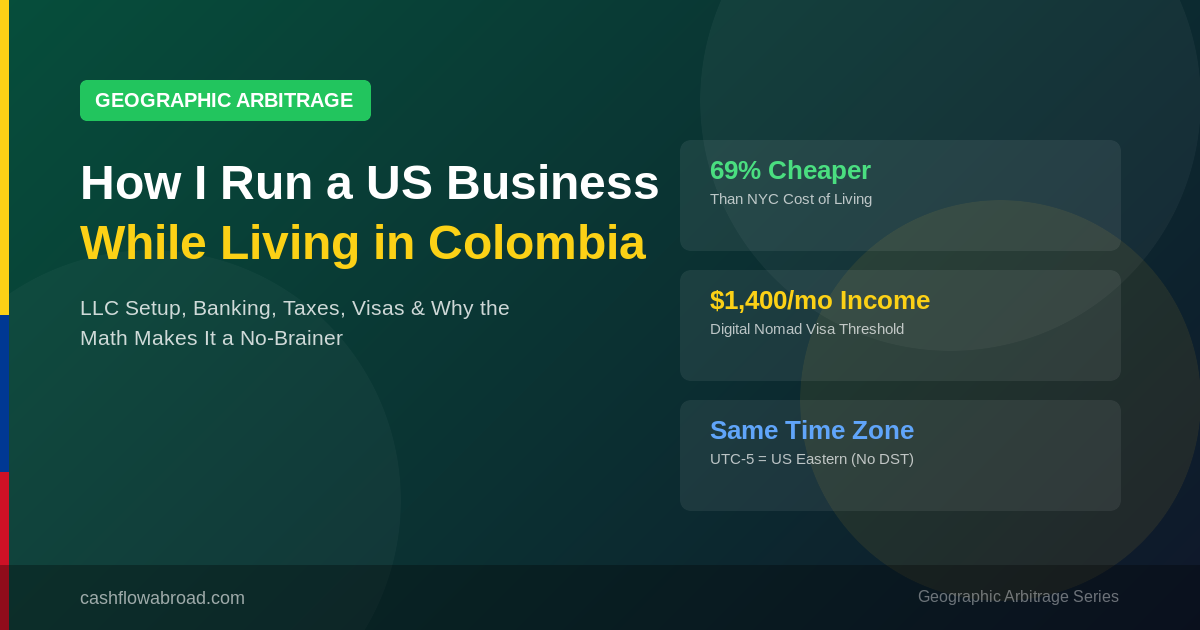
- 69% cheaper than NYC — Colombia’s cost of living index is 30.6 vs. New York’s 100 (Numbeo, 2026)
- Same time zone as the US East Coast — UTC-5, no daylight saving time confusion
- Fiber internet up to 1 Gbps in major cities — faster than the US average
- Digital nomad visa with a low income threshold (~$1,400/month)
- World-class healthcare at 70-80% less than US prices
- Thriving expat communities in Medellín, Bogotá, and Cartagena
If you want to understand what it’s actually like to make the move, ColombiaMove’s guide to moving to Colombia as an American covers everything from the emotional prep to the practical logistics. It’s the single best starting-point resource I’ve found.
The bottom line: if you’re earning $60K-$200K from a US-based business and currently living in any major American city, you are leaving $30,000-$80,000 per year on the table by not doing this.
Getting Legal: The Digital Nomad Visa
Colombia launched its Visa V – Nómadas Digitales (Digital Nomad Visa) and it’s one of the easiest in the world to qualify for.
Requirements
- Income: At least 3x Colombia’s minimum wage — approximately $1,400/month (2026). If you’re running a US business, you almost certainly exceed this.
- Proof: 3 months of bank statements showing regular foreign-sourced deposits
- Health insurance: Private coverage valid in Colombia for the full visa duration
- Passport: Valid for at least 6 months
- Application: Fully online through the Cancillería portal
Cost and Duration
- Application fee: ~$50-55 USD
- Issuance fee: ~$170-230 USD
- Duration: Up to 2 years
- Processing time: 2-4 weeks
The key detail: you do NOT need to be an employee. Freelancers, self-employed, and business owners all qualify. You just need to prove foreign-sourced income. For the full step-by-step walkthrough, ColombiaMove’s Digital Nomad Visa guide breaks down every document and step.
Once you have the visa, you’ll need a Cédula de Extranjería (foreign ID card) — this unlocks everything from banking to signing leases. Here’s how to get your cédula. Apply within 15 days of arrival; it costs about $60 and takes 5-15 business days.
For a broader view of all visa options (investor visa, pensionado visa, etc.), ColombiaMove’s master visa guide covers every type.
The US LLC Structure: Why Wyoming Wins
The backbone of this setup is a US-based LLC. This is not optional — it’s what keeps your banking, client relationships, and tax structure clean.
Why Wyoming?
- $100 formation fee (Articles of Organization)
- $60/year annual report fee
- Zero state income tax on LLC profits
- Strongest asset protection in the US — charging order is the exclusive remedy, even for single-member LLCs
- Maximum privacy — no requirement to disclose members publicly
- Registered agent: $50-200/year (required since you won’t have a Wyoming address)
Total annual cost to maintain: $160-260/year. That’s less than a single month of a WeWork hot desk in Manhattan.
As a single-member LLC, your business income passes through to your personal tax return — no corporate-level tax. You’re taxed as a sole proprietor, which keeps things simple and lets you take full advantage of the Foreign Earned Income Exclusion (more on this in the tax section).
Delaware vs. Wyoming?
Delaware is popular for VC-backed startups, but for a bootstrapped business run from abroad, Wyoming wins on every metric: lower fees ($60 vs. $300 annual), better privacy, better asset protection, and zero state tax.
Banking Setup: The Three-Account Stack
Banking is where most expat business owners screw up. The goal is a clean separation: US business operations → international transfers → local spending.
Layer 1: US Business Banking — Mercury
Mercury is the default choice for non-resident LLC banking:
- Explicitly serves founders living outside the US
- Fully managed from anywhere — mobile app and web dashboard
- No monthly fees
- Integrates with QuickBooks, Xero, Stripe
- US routing and account numbers for ACH, wire transfers, and client payments
This is where your US clients pay you. Invoices go out from your Wyoming LLC, payments land in Mercury.
Layer 2: International Transfers — Wise Business
Your bridge between US dollars and Colombian pesos:
- Multi-currency account holding 40+ currencies
- Mid-market exchange rate — no bank markup
- Fees starting at 0.41%
- Local bank details in 8+ currencies
When you need pesos, you transfer from Mercury to Wise, convert at the real exchange rate, and send to your Colombian bank. The savings vs. traditional wire transfers ($25-50 per transaction plus 2-4% FX markup) are massive over a year.
Layer 3: Local Spending — Nequi + Colombian Bank
For daily life in Colombia, you need local accounts. ColombiaMove’s banking guide for foreigners covers this thoroughly, but the short version:
- Nequi — Open in 10 minutes with just your cédula. Mobile-only, widely accepted, perfect for daily transactions
- Bancolombia — Colombia’s largest bank, for larger transactions, rent payments, and building credit history
Recommended sequence: Nequi first (instant), then Bancolombia (requires appointment and more paperwork).
As I covered in my complete guide to banking and taxes as a US expat, keeping a US bank account is critical — the IRS is phasing out paper refund checks, and you need a US account for direct deposit of tax refunds.
Taxes: The Part Everyone Gets Wrong
This is the section that will save you — or cost you — the most money. Pay attention.
Your US Tax Obligations (These Never Go Away)
As a US citizen running a US LLC, you owe:
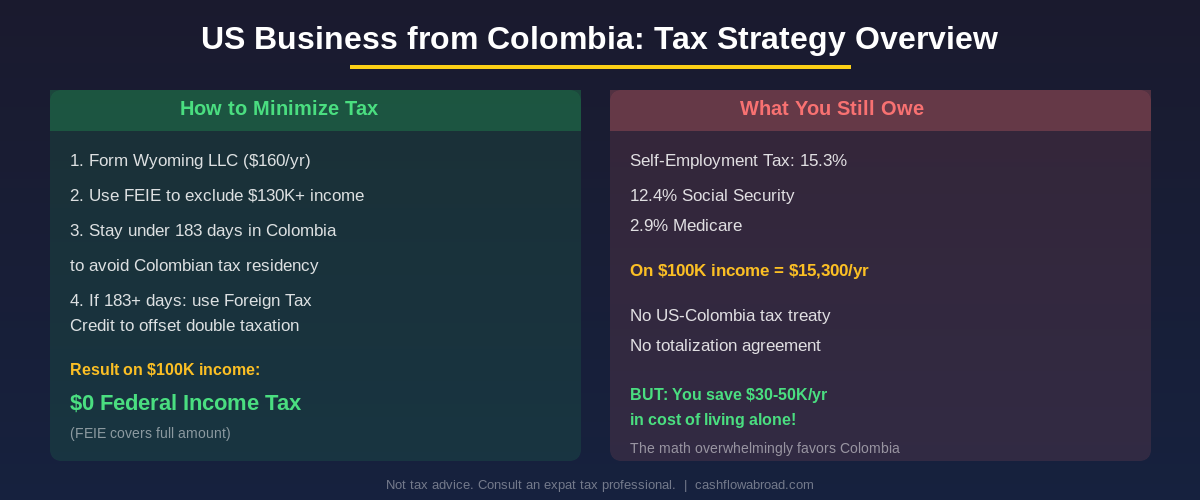
1. Federal Income Tax — BUT you can likely eliminate it using the Foreign Earned Income Exclusion (FEIE):
- Exclude up to $130,000 (2025) / $132,900 (2026) of foreign earned income
- Must pass the Physical Presence Test (330 days abroad in 12 months) or Bona Fide Residence Test
- Filed on Form 2555
- Result on $100K income: $0 federal income tax
I break this down in detail — including the FEIE vs. Foreign Tax Credit decision — in my US Expat Banking and Taxes guide.
2. Self-Employment Tax — 15.3% (The One You Can’t Escape)
- 12.4% Social Security (on earnings up to $176,100)
- 2.9% Medicare (no cap)
- The FEIE does NOT reduce this. Period.
- On $100K of self-employment income: $15,300
3. FBAR and FATCA reporting — if your foreign accounts exceed $10,000 aggregate (FBAR) or $200,000/$400,000 (FATCA Form 8938). Non-compliance penalties start at $10,000+. I detail both in the FBAR vs FATCA section of my expat tax guide.
Colombian Tax: The 183-Day Rule
This is where strategy matters:
- Under 183 days in Colombia (in any 365-day rolling period): You are NOT a Colombian tax resident. Your US-sourced remote income is generally not taxable in Colombia.
- Over 183 days: You become a Colombian tax resident and are taxed on worldwide income at progressive rates from 0% to 39%.
Critical fact: There is no US-Colombia tax treaty and no totalization agreement. This means there’s no bilateral agreement to prevent double taxation on social security contributions. If you become a Colombian tax resident, you’ll want to use the Foreign Tax Credit (Form 1116) to offset US taxes with Colombian taxes paid.
For context on Colombia’s wealth tax and property considerations, ColombiaMove covers the wealth tax for foreign property owners.
The Math That Makes It Work
Let’s run the numbers on $100,000 of self-employment income:
| Expense | Living in Austin | Living in Medellín |
|---|---|---|
| Federal Income Tax | ~$14,000 | $0 (FEIE) |
| Self-Employment Tax | $15,300 | $15,300 |
| State Income Tax | $0 (TX) | $0 |
| Health Insurance | $6,000-8,400/yr | $960-2,160/yr |
| Cost of Living | $42,000-64,000/yr | $14,400-24,700/yr |
| Total Outflow | $77,300-101,700 | $30,660-42,160 |
| Money Kept | $0-22,700 | $57,840-69,340 |
You keep an extra $35,000-69,000 per year. That’s not a rounding error — it’s life-changing money that can go toward investments, savings, or simply living better.
Cost of Living: The Real Numbers
I’m not talking about backpacker budgets. I’m talking about a comfortable, professional lifestyle — a nice apartment, good food, coworking membership, social life, and health insurance.
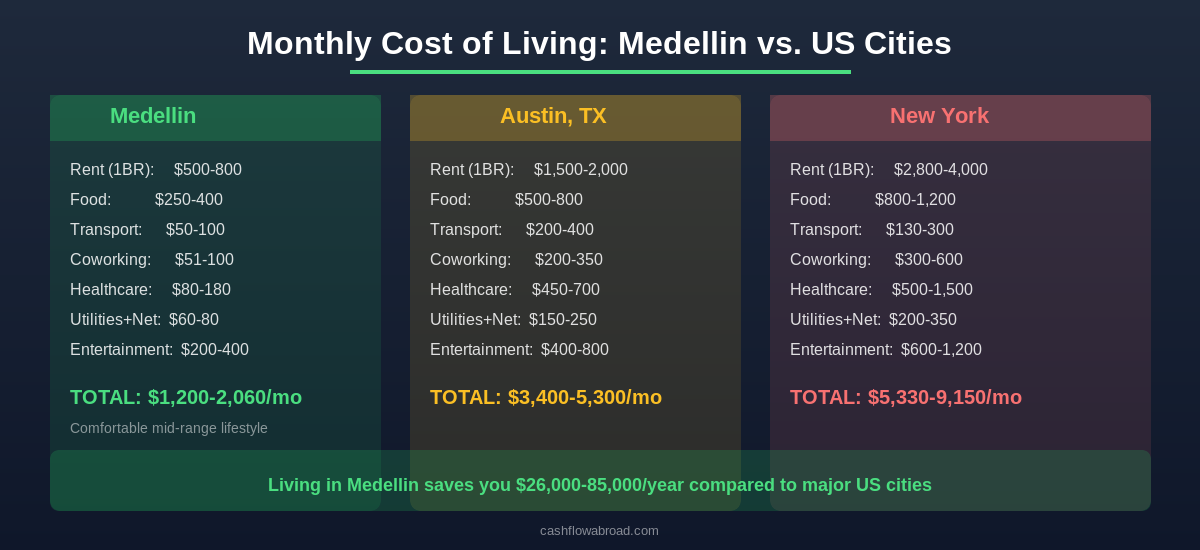
My Actual Monthly Budget in Medellín
| Category | Monthly Cost |
|---|---|
| Rent (modern 1BR, Laureles) | $650 |
| Groceries + dining out | $350 |
| Coworking membership | $90 |
| Utilities + 300Mbps fiber internet | $65 |
| Transportation (Metro + Uber) | $45 |
| Health insurance (prepagada) | $120 |
| Entertainment + social | $250 |
| Phone plan (Claro) | $15 |
| Total | $1,585 |
This buys a lifestyle that would cost $4,500-6,000+ in Austin and $7,000-10,000+ in New York.
The lunch situation alone tells the story: a comida corriente (set lunch with soup, main course, rice, drink, and dessert) costs $3-6. The equivalent in a US city is $15-20 minimum. A sit-down dinner for two with drinks: $20-40 vs. $80-150 in the US.
For a full breakdown including neighborhood-by-neighborhood pricing, ColombiaMove’s Medellín cost of living guide is the most detailed I’ve seen.
If you’re still in the planning phase and wondering about startup costs, their guide on how much money you need to move recommends $5,000-10,000 for the first three months, covering flights, visa fees, deposit, and getting settled.
Workspace and Internet: Better Than You’d Think
This was my biggest concern before moving. Could I actually run a US business from here without connectivity issues?
Short answer: yes, easily.
Internet
- Home fiber: 300 Mbps-1 Gbps available in modern buildings in Medellín and Bogotá
- Cost: $20-40/month (vs. $60-100+ in the US for comparable speeds)
- ISPs: Claro, Movistar, Tigo, ETB
- Average speeds: Medellín median fixed broadband is 130 Mbps down / 33 Mbps up
- Reliability: Occasional brief interruptions during heavy rainstorms, but nothing that impacts a workday
Medellín’s fiber internet now rivals or exceeds many US cities at a fraction of the cost.
Coworking Spaces
Medellín has a mature coworking ecosystem. ColombiaMove ranks the best coworking spaces in Medellín, but here are the highlights:
- Day passes: $8-30
- Monthly memberships: $90-350
- WiFi speeds: 100-500+ Mbps (most combine fiber and business-grade hardware)
- Private call booths: Available at most spaces (critical for client calls)
- Popular areas: El Poblado (highest concentration, premium pricing), Laureles (better value, growing scene)
I work from a coworking space 3 days a week and from home the other 2. The $90/month membership pays for itself in productivity, networking, and having a dedicated space for video calls with US clients.
Healthcare: Better Care, 80% Less
Colombia’s healthcare system is ranked 22nd globally by the WHO — the US is 37th. And it costs a fraction of what you’re used to paying.
The Two Options for Expats
EPS (Public System):
- ~$36-85/month depending on income
- Comprehensive coverage including hospitalization
- Longer wait times for specialists
- Requires cédula
Medicina Prepagada (Private System):
- $80-325/month for premium plans
- Short wait times, choice of doctors, private rooms
- English-speaking staff available at major hospitals
- Quality comparable to top US hospitals
Price Comparisons
| Service | Colombia | United States |
|---|---|---|
| GP visit | $20-50 | $150-300 |
| Dental cleaning | $15-30 | $100-300 |
| Root canal | $100-200 | $700-1,500 |
| LASIK (both eyes) | $800-1,200 | $4,000-6,000 |
| Monthly insurance | $80-325 | $450-1,500 |
Medellín in particular is a medical tourism destination — people fly from the US specifically for dental work, cosmetic surgery, and specialized procedures. And you get to live there.
For the complete guide to navigating the system as a foreigner, ColombiaMove’s healthcare guide covers EPS enrollment, prepagada recommendations, and emergency protocols. You’ll also want travel/health insurance for the visa — SafetyWing is what most digital nomads use and it satisfies the visa requirement.
Legal Considerations: Do You Need a Colombian Entity?
For most remote US business owners: no.
If you’re working remotely for US/international clients through your US LLC, and you have no Colombian customers, employees, or local operations, you do not need a Colombian business entity. The digital nomad visa explicitly permits this.
When You WOULD Need a Colombian Entity
- Hiring Colombian employees (labor law compliance requires local payroll)
- Selling directly to Colombian customers
- Registering foreign investment with the Banco de la República
Hiring Colombians: The Contractor Trap
If you hire Colombian workers as contractors through your US LLC, be extremely careful about misclassification. Colombian labor law is protective — if someone works set hours, uses your tools, and reports to you, they may be classified as an employee regardless of what the contract says.
Solutions:
- Use an Employer of Record (EOR) like Deel, Remote, or Oyster
- If you must hire locally, form a Colombian SAS (Sociedad por Acciones Simplificada)
For more on Colombian business structures and making a living in Colombia, ColombiaMove’s income guide for expats covers the local options.
The Time Zone Cheat Code
This is the underrated advantage that makes Colombia uniquely superior to most digital nomad destinations.
Colombia = UTC-5, permanently. No daylight saving time.
| Your Colombia Time | US Eastern | US Pacific |
|---|---|---|
| 9:00 AM | 9:00 AM (EST) / 10:00 AM (EDT) | 6:00 AM / 7:00 AM |
| 5:00 PM | 5:00 PM (EST) / 6:00 PM (EDT) | 2:00 PM / 3:00 PM |
Compare that to other popular nomad destinations:
- Bali (UTC+8): 13 hours ahead — zero overlap with US business hours
- Lisbon (UTC+0/+1): 5-6 hours ahead — limited afternoon overlap
- Bangkok (UTC+7): 12 hours ahead — you’re working midnight to morning
- Colombia (UTC-5): 0-1 hour difference — full overlap
If your clients are in the US, there is no better time zone match in the developing world. You can take 9 AM calls, attend lunch meetings over Zoom, and be done by 5 PM — all without touching a graveyard shift.
Community and Networking
You’re not going to be alone. Medellín has one of the largest digital nomad communities in Latin America.
Medellín
- El Poblado: Highest concentration of coworking spaces, international restaurants, and expat-friendly services. More expensive but very walkable.
- Laureles: Growing alternative with more local character, lower prices, and a strong nomad presence. My personal pick.
- Regular meetups: Startup pitch nights, networking events, language exchanges
- Coliving spaces: Co.404, Balu Coliving, Nomadico — designed for entrepreneur community building
Bogotá
- More professional/corporate expat scene
- Larger startup ecosystem with access to Colombian business networks
- Usaquén and Chicó neighborhoods popular with foreign entrepreneurs
Not sure which city is right for you? ColombiaMove has a quiz that helps you narrow it down, and their ranked list of best cities for expats gives a data-driven comparison.
If you’re leaning toward Medellín (most people are), read 10 things nobody tells you before moving to Medellín — it’s the honest reality check that most blogs skip.
The Complete Playbook
Here’s the exact sequence to follow:
Phase 1: Before You Leave (2-3 Months Out)
- Form your Wyoming LLC — $100 + registered agent ($50-200/yr)
- Get an EIN from the IRS (free, instant online)
- Open Mercury or Relay for US business banking
- Open a Wise Business account for international transfers
- Open a SoFi personal account as a US banking backup (expat-friendly)
- Get SafetyWing health insurance (satisfies visa requirement)
- If in a “sticky” state (CA, VA, NM, NY): establish domicile in a no-tax state first
- Apply for the Digital Nomad Visa — follow this guide
- Get a VPN — essential for accessing US-only services from abroad
Phase 2: First Two Weeks in Colombia
- Get your Cédula de Extranjería — within 15 days of arrival
- Open Nequi — takes 10 minutes with your cédula
- Open Bancolombia — schedule an appointment, bring passport + cédula
- Get a local SIM/eSIM — ColombiaMove’s internet and SIM guide
- Sign up for a coworking space
- Set up your money flow: US clients → Mercury → Wise → Nequi/Bancolombia
Phase 3: Ongoing
- Track your days — keep a log for the Physical Presence Test (330 days needed for FEIE)
- File your US taxes annually with Form 2555 (FEIE) — consider an expat tax specialist
- File FBAR by April 15 (auto-extension to October 15) if foreign accounts exceed $10K
- Monitor the 183-day rule if you want to avoid Colombian tax residency
- Join the community — coworking events, expat meetups, online groups
If you want the ultimate preparation checklist, ColombiaMove’s 47-item moving checklist covers everything across a 6-month timeline. And if you want it all in one package, their Colombia Relocation Kit bundles the guides, checklists, and resources into a single download.
The bottom line: Running a US business from Colombia isn’t a hack or a loophole — it’s a legitimate, legal optimization of where you choose to live. The US tax system follows you regardless, but the cost-of-living savings, the time zone alignment, and the quality of life make the math overwhelmingly clear.
I went from keeping $0-22K/year in Austin to keeping $57K-69K/year in Medellín — on the same income. That delta is building wealth at an extraordinary rate.
The question isn’t whether you can do this. It’s why you haven’t done it yet.
Planning your move? Start with ColombiaMove.com for the most comprehensive Colombia relocation guides online, and check out our complete guide to US expat banking and taxes to get your financial house in order before you go.
Disclaimer: This article is for informational purposes only and does not constitute tax, legal, or financial advice. Tax laws change frequently. Consult a qualified tax professional for advice specific to your situation. Some links in this post are affiliate links — we may earn a commission at no extra cost to you.